You cannot go inside Thevally Palace. It is a working National Cadet Corps establishment on Kerala PWD land, and the gravel in front of it is a parade ground. What you can do is stand on the drive and read a wall.
What is on it
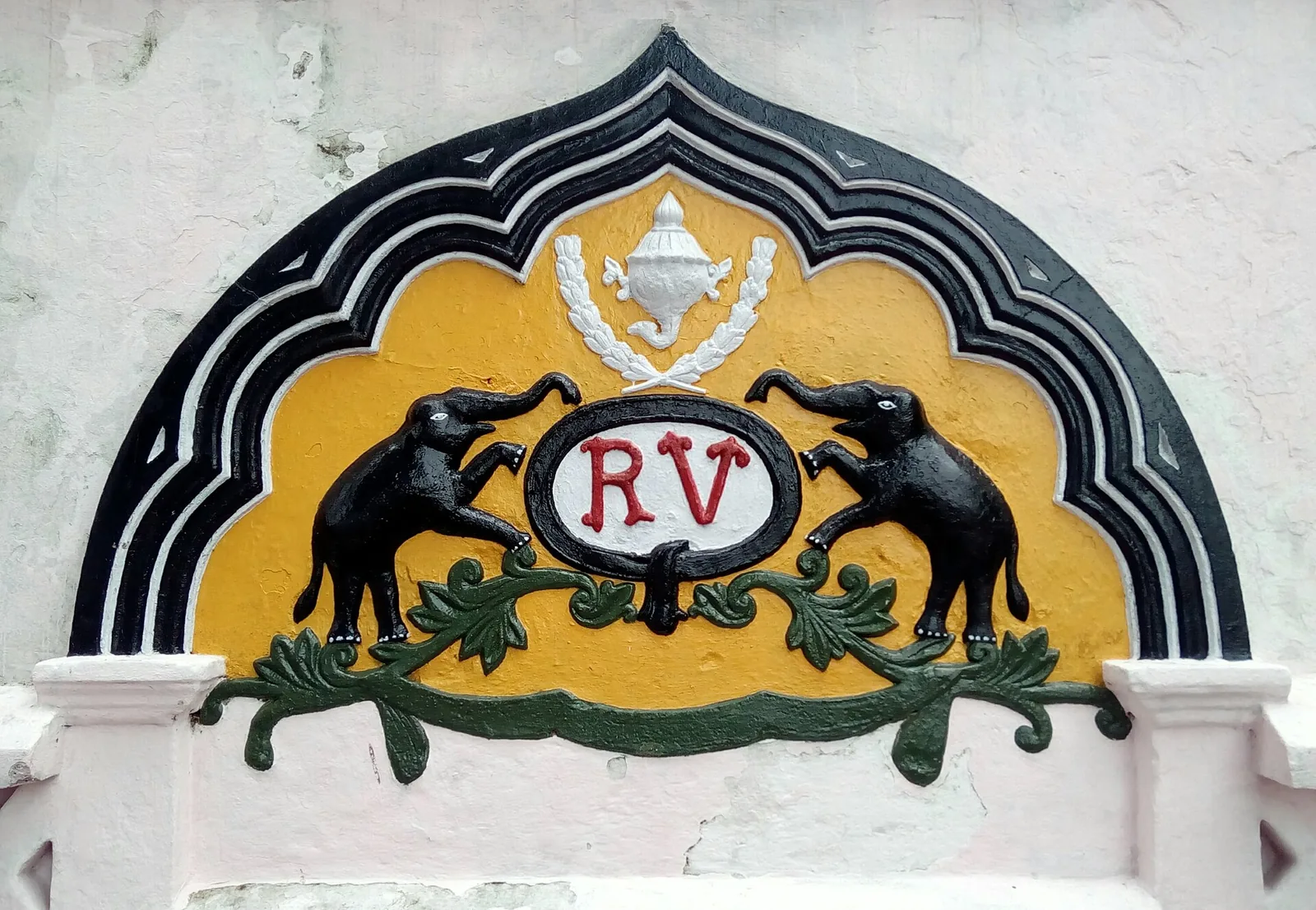
Set into the masonry is an arched, moulded plaque, and it is painted with some care. A black many-lobed arch with white fillets frames a yellow field. At the centre sits a white oval bearing, in red, the monogram RV. Two black elephants rear on either side of it with trunks raised. Above the oval is a white vessel-like device flanked by a wreath — the form reads as a conch, which was Travancore’s state emblem, though the plaque itself does not label it. Below, a green foliate scroll runs across the base.
The detail that gives it away is the paint. In the 2016 photograph the crest is freshly painted and the plaster around it is not. Somebody has been maintaining this specific object, and it is not a conservation department, because no conservation department has any responsibility here.
What RV does not tell you
RV is Rama Varma. That is the easy part, and it is where the certainty ends.
Rama Varma is the name borne by Travancore’s rulers through the nineteenth century and into the twentieth — among them Swathi Thirunal Rama Varma, who reigned from 1829 to 1846, and Moolam Thirunal Rama Varma, who reigned from 1885 to 1924. A bare RV on a wall does not distinguish between them, and there is no inscription, no date and no accompanying text on the plaque to help.
It would be easy to pick one. Travel writing does this constantly: the crest gets assigned to whichever ruler the page has already named, and the assignment then propagates. We are not going to do it, because the honest position is more interesting than the guess.
Consider what you are actually looking at. This is a building whose construction date does not exist in any primary source — the universally printed 1811 to 1819 under Gowri Parvati Bayi is chronologically impossible, and matches the British Residency a kilometre away and Colonel Munro’s tenure instead. It has no heritage protection, so no monument dossier was ever compiled. And the one royal object still fixed to it carries two initials and no date.
A crest with no date, on a building with no date. That is not a gap in the research. That is the building.
Twenty metres away
The counterpoint stands close enough to appear in the same photographs. A red-painted plinth on the lawn carries the badge of the National Cadet Corps, lettered in Malayalam and English for NCC Group Headquarters, Kollam.
It is worth being precise about what the NCC is, because the internet is not. It is not the Indian Army. It is a tri-service youth organisation under the Ministry of Defence, organised into Directorates; the Directorate for Kerala and Lakshadweep runs five Group Headquarters, at Thiruvananthapuram, Kollam, Kottayam, Ernakulam and Kozhikode. Kollam’s is here. The site also hosts 3 (Kerala) Naval Unit NCC, whose board is down at the palace’s old lake landing. Almost every page that says the Indian Army occupies Thevally Palace has got the wrong organisation.
No transfer date is published anywhere. The NCC was certainly in occupation by 2007. Before that, the same Malayalam account records that the palace had been used for some time as a guest house for British officials — which is a better and more plausible story than the usual one about the property passing into government hands after independence, since it was Travancore state property all along.
The cost of being useful
Occupation has not been free of consequence. The 2007 account records that fitting the building out for its new use involved additions with concrete roofing, which it says has damaged the overall composition, and that a tin sheet was laid over the music pavilion, which it calls an eyesore.
Its author closed by saying the building deserved more protection than it was getting. Nineteen years on, it has none: not a State Protected Monument, not an ASI monument, not on any list.
And yet the crest is freshly painted, and the boat landing is still swept, and there are chairs set out facing the water. There is a version of this story in which the cadets are the villains of a heritage tragedy. Standing in front of the wall, that is not the version the evidence supports.
What to look for
From the drive off the highway you can see the pink front elevation, the curved bay, the arcaded verandah, the white flagstaff, the NCC plinth and the crest. Look at the elephants — they are rearing, trunks up, not couchant, which is not the commonest treatment. Look at the paint. Then look at the gravel and remember that in the photograph taken here around 1900 it was a lawn set with potted plants.
Frequently asked questions
What does the RV on the crest stand for?
Rama Varma, the name borne by Travancore’s rulers through the nineteenth century. Which Rama Varma is not recorded — the plaque carries no date and no inscription, and candidates include Swathi Thirunal Rama Varma (r. 1829–1846) and Moolam Thirunal Rama Varma (r. 1885–1924). Any page that names one is guessing.
Is Thevally Palace occupied by the Indian Army?
No. It is occupied by the National Cadet Corps, a tri-service youth organisation under the Ministry of Defence. Kollam is one of five NCC Group Headquarters under the Directorate for Kerala and Lakshadweep, and 3 (Kerala) Naval Unit NCC shares the site. The property itself is held by the Kerala PWD.
Can I see the crest without going inside?
Yes. It is set into the wall on the approach side, and is visible from the drive along with the front elevation, the curved bay, the arcaded verandah and the NCC plinth on the lawn. There is no entry to the building itself.
Has the occupation damaged the building?
A 2007 local account says additions with concrete roofing were made for the new use and damaged the overall composition, and that a tin sheet was laid over the music pavilion. The same account argued the palace deserved more protection. It still has none of any kind.