Drive to Thevally Palace and you will arrive at the back of it. The Kollam–Theni highway runs past the compound, the gate opens onto gravel, and the pink two-storey front with its arcaded verandah sits there looking like a house that has been slightly wrong-footed. It has. The road is not the approach the building was designed for. The lake is.
What the Malayalam account says, and what nobody translates
The most detailed description of this palace that exists in any language is not in a guidebook. It is a Kollam local-history post from January 2007, in Malayalam, and it states the design logic outright: because the main entrance was from the lake face, the main building was designed to stand facing Ashtamudi.
That single sentence explains the whole elevation. It explains why the lake side carries the carving and the road side does not. It explains the long unbroken row of windows and the ranked verandahs, which are there to be read from a distance across water rather than from a few metres away on a drive. And it explains the thing visitors find strangest — that a building this size has no impressive front gate, because its front gate was a flight of steps at the waterline.
The same account describes a complex of roughly 63,800 square metres: the palace proper, the antappuram or inner apartments, the ootupura or dining hall, and a lake landing rich with carving. From that landing the steps rise and then fork. Left goes to the palace. Right goes to a pavilion, described as showing Chinese architectural influence, used by the Maharaja’s instrumental troupe.
So the sequence was: barge, landing, carved steps, and then a choice between the house and the music.
The postcard that proves it
Around 1910 someone photographed this shoreline from midwater for a picture-postcard series, and the print survives in Leiden University Library as KITLV 1402360, captioned simply “The Lake, Quilon.” It is in the public domain and it is, as far as we can establish, used by nobody.
Read it left to right. There is a retaining wall along the water with an ornate arched gateway set into it. At the left, standing out over the water at the end of a short jetty, is a small gabled pavilion. Behind and above, on the rise among the trees, a columned pavilion with a flagstaff. Higher again, the gabled roofs of the palace and, unmistakably, a square tower with arched openings. And out on the water, being punted in from the right, a long covered barge with a curved prow and two men standing.
It is not a view of a building. It is a photograph of an arrival sequence, working.
The tower nobody mentions
That tower deserves a paragraph of its own, because it is the clearest example of what has gone missing from the record. The 2007 Malayalam account describes it in the present tense: about twenty-two metres high, enclosing a circular wooden staircase whose handrails are sheathed in copper plate — a kind, it says, not found in ordinary Kerala building practice.
It is corroborated. The British Library’s caption on a c.1900 photograph of this palace, taken by the government photographer of Travancore, reads: the palace shown here was built in the European style with a square tower. The tower is plainly in the print, two arcaded stages with pinnacles at the right-hand end of the roof. It is in the 1910 postcard. It is in a 1906 printed plate captioned “Thavally Palace, Quilon.”
Three period images, one library caption, one detailed local survey — and not one English-language travel page about Thevally Palace mentions a tower at all. They mention, instead, a blend of Dutch, Portuguese and British styles, for which no source exists.
We are not going to tell you the tower is still there, because we cannot see it in the modern front-elevation photograph — but in that photograph the building runs out of frame on the right, exactly where the tower stands in the historic ones. That is absence of evidence and nothing more.
What happened to the landing
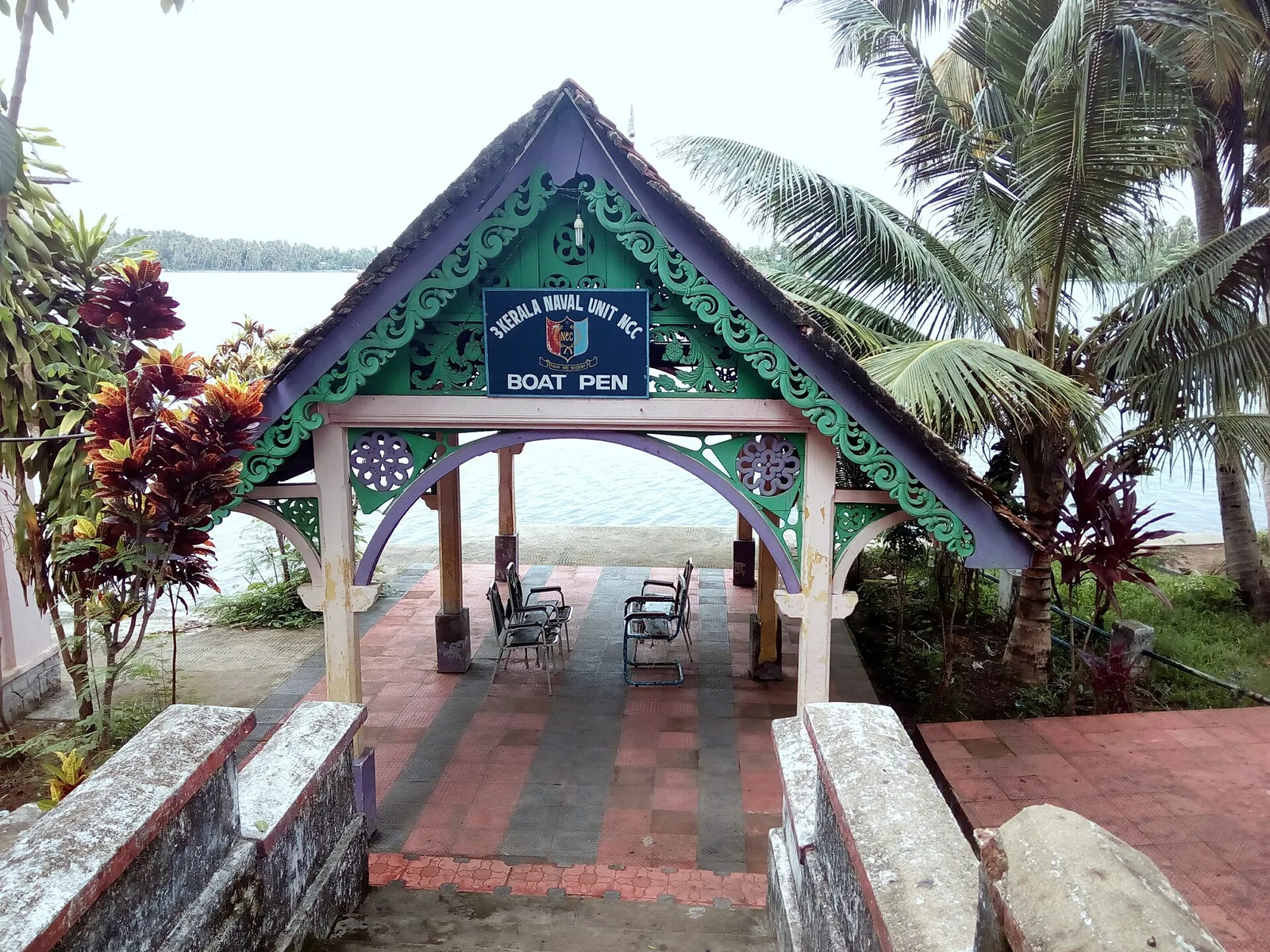
The landing is still in use, and the continuity is almost too neat. Photographs taken on 27 May 2016 show the steps down to Ashtamudi with a small carved gabled pavilion at their head: fretwork bargeboards, pierced rosettes, painted green and purple and cream, a lamp hanging from the apex, a few steel chairs set out facing the water.
Fixed to it is a blue-and-white board reading “3 KERALA NAVAL UNIT NCC — BOAT PEN.”
The National Cadet Corps occupies the palace, and its Kerala naval unit shares the site. So the landing built so that a Maharaja could step off a barge is now where cadets keep boats. We cannot establish whether the present pavilion is the 1910 structure repaired or a later replacement on the same spot, and we are not going to guess. What is certain is the function: this is still the place where people arrive by water.
How to use any of this
You cannot go in. The palace is Kerala PWD property occupied by a working NCC Group Headquarters, with a cadet parade ground on the gravel in front, and there is no ticket and no timing whatever a few travel listings claim.
But you can see the building the way it was meant to be seen, and it costs you nothing extra, because every Ashtamudi cruise and houseboat run out of Kollam passes this promontory. Get on the water, look for the compound wall, the landing and the small red-and-white gabled Sastha shrine standing at the shoreline inside the wall, and then look up through the trees.
From the road you are looking at the back of a house. From the lake you are standing where the guests stood.
Frequently asked questions
Why does Thevally Palace face the lake rather than the road?
Because the main entrance was from the lake. A Kollam local-history account of 2007 states it explicitly: since the principal approach was from the lake face, the main building was designed to stand facing Ashtamudi. The lake-side elevations carry the carving and the long window run for that reason.
Is there really a tower?
A 2007 Malayalam survey describes a twenty-two-metre tower with a circular wooden stair and copper-sheathed handrails, while a square tower appears in photographs and prints from around 1900–1910. Current photographs do not establish whether the tower still survives, so ask locally before expecting to see it.
Can I get down to the old boat landing?
No. The landing is inside the compound and is in use by 3 (Kerala) Naval Unit NCC as a boat pen. You can see it from the water on any Ashtamudi cruise.
What was the pavilion beside the palace for?
The 2007 account describes a pavilion reached by taking the right-hand fork of the steps up from the landing, showing Chinese architectural influence, used by the Maharaja’s instrumental troupe. It appears in the 1910 postcard as a columned structure among the trees with a flagstaff.