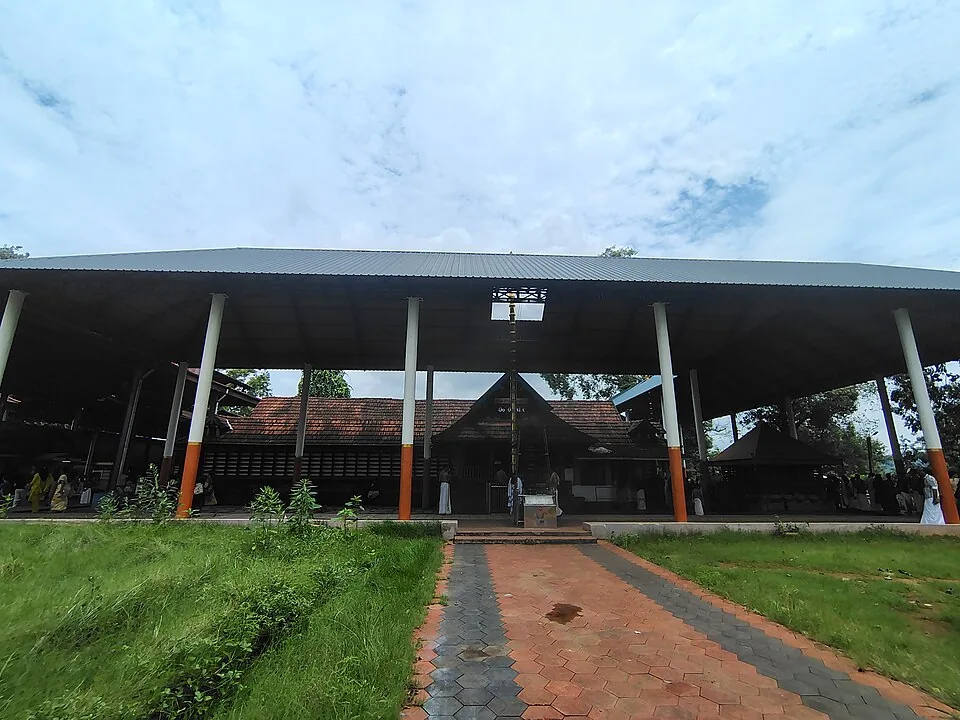
In front of Thirumandhamkunnu Temple, at Angadipuram in Malappuram, there is a plain, low stone platform that most visitors walk straight past. It is called the chaver thara — the platform of the martyrs. And to understand why it stands there, in front of the goddess, you have to know two stories that meet at this hill: how the shrine came to be, and how, for centuries, young men left it to go and die.
The linga that would not be moved
The older legend is a gentle one. King Mandhata, it is told, won from Shiva a Shivalinga and carried it down from Mount Kailasa on his own head. When he reached this green hill in Kerala, the idol grew suddenly, unbearably heavy; he set it on the ground to rest — and the linga sank into the earth and would not be lifted again. Reading the god’s will, Mandhata handed the local people a grantha, a book of instructions for its worship, entrusted the shrine to them, and withdrew into the neighbouring forest of Kukshipparakkad, where by his yogic power he left the world of mortals. From him the hill takes its name: Thiru-Mandham-kunnu, the sacred hill of Mandhata.
The goddess of a lost kingdom
Though Shiva is the principal deity, the presence everyone comes for is the goddess — Bhadrakali, Thirumandhamkunnilamma, “the mother of Thirumandhamkunnu,” worshipped here alongside Ganesha. She was the paradevata, the guardian deity, of the kings of Valluvanad, the medieval chieftains whose capital was Angadipuram. To pray to her was to pray to the very heart of the kingdom. And that is where the second, darker story begins.
The warriors who walked out to die
Long before, the Valluvanad kings had held the supreme honour of presiding over the Mamankam, the vast twelve-yearly festival at Thirunavaya on the Bharathapuzha. Then the Zamorin of Calicut seized that right by force. The Valluvanad rulers never accepted it — and so, at each Mamankam, they sent their chavers: warriors sworn to death, who would try to cut their way through the Zamorin’s army to kill him, knowing they had no hope of survival. Before they set out, these martyrs came to Thirumandhamkunnu, touched the feet of the goddess, and made their farewells at the platform still called the chaver thara. From here they walked to Thirunavaya, and from Thirunavaya almost none of them walked back.
The Pooram
Today the hill is alive not with grief but with celebration. The Thirumandhamkunnu Pooram, an eleven-day festival, is one of the great events of Malappuram, its climax the Aarattu when the goddess is carried on the tallest of a line of caparisoned elephants down to the temple lake to be bathed. The Mangalya Puja here — an offering for marriage and family — draws devotees from far away. Standing in that happy crowd, it is worth remembering the quiet stone platform at the gate, and the boys who once said goodbye there.
Visiting Thirumandhamkunnu
Angadipuram lies near Perinthalmanna in Malappuram district, an easy stop inland. Come for the eleven-day Pooram, or on an ordinary day to climb the hill, sit with the goddess, and find the chaver thara for yourself. Details are on the Thirumandhamkunnu place page; more of the district is on the Malappuram hub.
Frequently asked questions
What is the chaver thara at Thirumandhamkunnu?
It is a stone platform in front of the temple from which the “chavers” — suicide warriors of the Valluvanad kings — set out for the Mamankam festival at Thirunavaya. They came to touch the feet of the goddess and make their farewells before marching to almost certain death in the attempt to reach the Zamorin of Calicut.
What is the legend of Thirumandhamkunnu temple?
Legend holds that King Mandhata carried a Shivalinga from Mount Kailasa on his head; when he set it down on this hill to rest, it sank into the earth and could not be moved. He entrusted its worship to the local people and withdrew from the world, giving the hill its name — the sacred hill of Mandhata.
Who is the goddess of Thirumandhamkunnu?
Although Shiva is the principal deity, the temple is famous for the goddess Bhadrakali, known as Thirumandhamkunnilamma, the paradevata (guardian deity) of the medieval kings of Valluvanad. The Mangalya Puja performed here is a noted offering for marriage.
When is the Thirumandhamkunnu Pooram?
The Pooram is an eleven-day annual festival, a major event in Malappuram district, culminating in the Aarattu when the goddess is carried on the tallest elephant to the temple lake for a ceremonial bath.