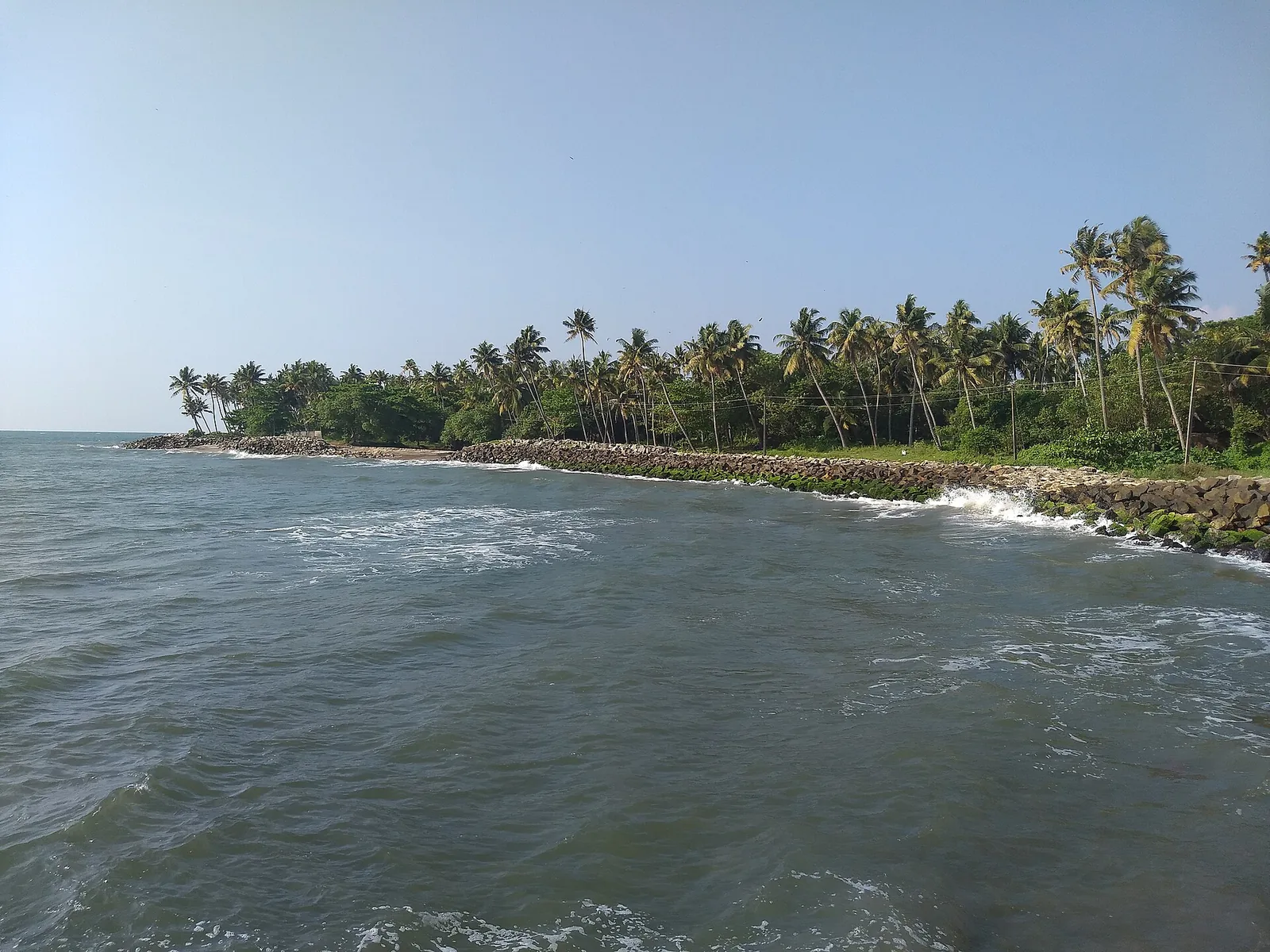
On most days, Thirumullavaram Beach is the gentlest stretch of coast in Kollam — calm, shallow water and a hush broken only by the surf. (The calm may well be built: most of this frontage is a granite revetment with a groyne running seaward, and the sand is a pocket rather than a sweep.) But on one new-moon morning each Malayalam summer, the shoreline fills before dawn with tens of thousands of people, many of them waist-deep in the sea, murmuring the names of the dead. To understand why a quiet swimming beach becomes one of Kerala’s great gathering places, you have to start with the old temple that stands just behind the sand.
The temple that legend gave to the coast
The landmark of Thirumullavaram is the Sree Maha Vishnu Swamy temple, an ancient shrine set close to the sea about six kilometres north of Kollam town. According to folklore, it was one of seven temples founded by the warrior-sage Parashuram, the mythic figure who — tradition holds — flung his axe into the ocean and raised the whole Kerala coast from the waves. Whether or not any of that happened, the story matters: it is why generations have treated this particular curve of sand as sacred ground rather than just a place to swim, and why the temple and the beach are spoken of in the same breath.
Two gods, back to back
The temple has an unusual arrangement that visitors often miss. It houses two principal deities — Maha Vishnu, whose sanctum faces west toward the sea, and Siva, whose shrine faces east toward the land. Worshippers can turn from one to the other within the same complex, an old south-Indian idea of the divine holding both directions of the compass. The westward gaze of Vishnu, out over the water, is not incidental: it points to the ritual that ties the shrine to the shore below it.
When the deity walks down to the water
The temple’s annual festival falls in the Malayalam month of Meenam, roughly March to April, running for ten days and culminating on the Atham asterism. Its sequence follows the classic Kerala template — Thrikkodiyettu, the ceremonial hoisting of the temple flag, then the processions of the deity’s ornaments, a symbolic royal hunt, and finally the Arattu. In the Arattu the presiding deity is carried in procession out of the sanctum and down to the sea itself, where the image is ritually bathed. It is the one day the temple and the beach become a single stage, the god brought to the same water the pilgrims will later stand in.
The new moon of the ancestors
Thirumullavaram’s largest crowds, though, come not for the festival but for a single day of remembrance. On Karkidaka Vavu — the new-moon day of Karkidakam, the last Malayalam month, falling between mid-July and mid-August — Hindus across Kerala perform bali tharpanam, offerings for the souls of departed family. Thirumullavaram is one of the most important places in the state to do it, drawing enormous crowds; local accounts hold that after Varkala it attracts the biggest gathering on this coast, with lakhs of people arriving in a single morning. Men in dhotis stand in the shallows, place rice, sesame, herbs and water on banana leaves, and release the offerings to the sea for the dead they name aloud.
Why the sea here forgives beginners
That so many people, including the elderly, can safely stand in the surf is no accident of mood — it is the water itself. Thirumullavaram is repeatedly described as one of the safest swimming beaches in the region, with calm, clear, shallow water and gentle tides where even children can wade without much danger. Kerala Tourism promotes it precisely for this rare calm; on a coast better known for strong Arabian Sea currents, a beach where the water stays low and mild is unusual enough to have built its whole reputation on it.
The rock that surfaces at low tide
The beach has one quiet geological curiosity. Reaching out into the sea is a low rocky spur locally called Nyarazhcha Para, or Sunday Rock — a hillock said to run about a kilometre and a half into the water, which surfaces and becomes walkable from the shore only when the tide drops low. It gives the beach a changing shape through the day and a natural vantage point that appears and vanishes with the sea, the kind of small wonder regulars time their visits around.
A shoulder of the Ashtamudi coast
Thirumullavaram does not stand alone. It is one of the three beaches of Kollam, the old port city that sits on the banks of Ashtamudi Lake, the sprawling palm-shaped backwater that feeds Kerala’s southern lagoon system. That geography is why a short trip out of Kollam can put lake, town and open sea within a single afternoon — the temple beach on the ocean side, the vast still water of Ashtamudi just inland, and the working harbour of a town that has traded across the Arabian Sea for more than a thousand years.
Visiting Thirumullavaram Beach
Thirumullavaram Beach lies about six kilometres north of Kollam town and is easily reached by autorickshaw or bus; the railway station is roughly the same distance away. Come early for calm water and thin crowds, and combine it with the Sree Maha Vishnu temple beside the sand — but expect huge, reverent crowds if you arrive on Karkidaka Vavu in July or August, when the beach turns into a ritual ground rather than a swimming spot. For where it sits among the district’s coast, backwaters and other sights, see the Kollam hub.
Frequently asked questions
Is Thirumullavaram Beach safe for swimming?
It is widely regarded as one of the calmest and safest swimming beaches in the Kollam area, with shallow, gentle water and mild tides — though, as anywhere in the open sea, conditions vary and children should be watched closely.
What is the Karkidaka Vavu ritual held here?
On the new-moon day of Karkidakam (mid-July to mid-August), huge numbers of people gather on the beach to perform bali tharpanam, offerings made in the sea for the souls of departed ancestors. It is Thirumullavaram’s busiest day of the year.
How far is the beach from Kollam town?
About six kilometres north of Kollam town, a short autorickshaw or bus ride, with the railway station a similar distance away.