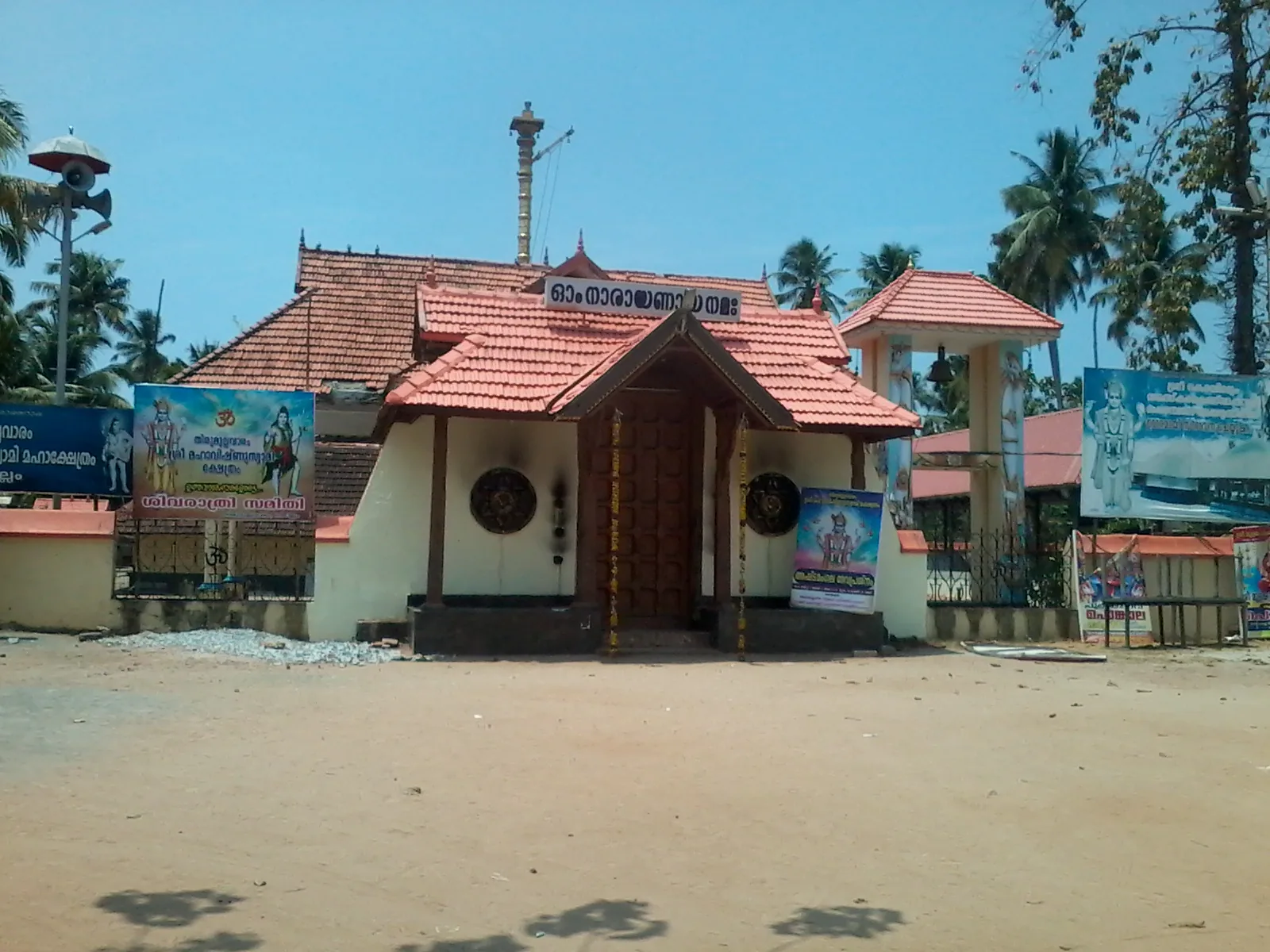
The beach is named after the temple, not the other way round. In Kerala place-names the honorific "Thiru" marks a sacred spot, and it is the Sree Maha Vishnu Swami temple that fixes the name to this stretch of coast.
Two things to get right before you go looking for it. It is not on the sand — it stands about two hundred and eighty metres inland, east of the shore, a few minutes' walk. And it is a Vishnu temple. It is very often called a Krishna temple, including by us until recently, and no source we can find supports that.
Two gods, facing away from each other
The genuinely unusual thing about this shrine is that it enshrines two major deities, given equal reverence, facing in opposite directions: Vishnu and Shiva. Devi, Dharma Sastha, Murugan and Rakshas are here as sub-deities.
Two reputable sources describe the arrangement and they disagree about which god faces which way, so we are not going to print an orientation. But you do not have to take the doubling on trust, because it is visible in a single photograph of the entrance: the board over the gateway reads ഓം നാരായണായ നമഃ — Om Narayanaya Namah, a Vishnu mantra — while a banner on the compound wall advertises ശിവരാത്രി, Shivaratri.
Both gods, one compound, one frame. The temple has a gold-plated dwajam, the flagstaff, and it is administered by the Travancore Devaswom Board.
Fresh water, three hundred metres from the sea
The compound holds a temple tank, and the tank holds fresh water — a few hundred metres from the Arabian Sea, on a sand coast. Locally this is treated as a small miracle, and you will hear it presented that way.
It is also perfectly explicable, and the explanation does not diminish it. Rainwater percolating into a sand barrier is less dense than salt water, so it floats on the saline groundwater beneath as a lens. Dig into that lens and you get fresh water; dig too deep, or draw too hard, and you pull the salt up into it. Coastal communities across the world have lived off exactly this, and knowing how it works makes the tank more interesting rather than less.
A building with no date
The temple is described everywhere as ancient. It is said to be one of seven founded by Parashurama, the sage who in tradition raised Kerala from the sea by throwing his axe.
We are happy to record that as living tradition, and we will note without sneering that no source we have found actually produces the list of seven. The well-attested Parashurama traditions in Kerala are different sets entirely — the 108 Shiva temples, the 108 Durga temples, the Divya Desams, of which this is not one.
And that is the pattern for the whole record. No inscription. No copper plate. No gazetteer entry. For a building whose age is asserted in every description of it, there is not one dated stone.
Except for one morning
There is exactly one firmly dated event in the temple's history, and it is 26 December 2004.
The Indian Ocean tsunami reached this coast that morning and damaged the wall of the temple pond. Casualties here were minimal, which is its own mercy. But the fact stands oddly and completely: in a shrine with no inscription and no documented foundation, the single event anyone can put a date on is the day the sea came over the wall and cracked the tank that had always held fresh water.
The temple's own festival, Thiruvona Maholsavam, runs for ten days from the Rohini to the Atham nakshatra, with a reported forty-plus caparisoned elephants and the sequence of flag-hoisting, the Thiruvabharana procession, the Pallivetta and the Arattu. Sources disagree on which Gregorian month that lands in, so ask locally — and note that the Arattu, the concluding ritual bath, takes the deity down to the same sea.
Frequently asked questions
Is the Thirumullavaram temple a Krishna temple?
No, and this is a common error we made ourselves. It is the Sree Maha Vishnu Swami temple — a Vishnu shrine. No source we can find supports the Krishna attribution.
Is the temple on the beach?
No. It stands about 280 metres inland, east of the shore — a few minutes' walk, not a shrine on the sand.
What is unusual about the deities?
Two major deities are enshrined with equal reverence and face in opposite directions: Vishnu and Shiva, with Devi, Dharma Sastha, Murugan and Rakshas as sub-deities. Sources disagree on which faces which way, so we do not state an orientation.
Why is the temple pond fresh when the sea is so close?
Because rainwater soaking into a sand barrier floats as a lens on top of the denser saline groundwater beneath. It is locally regarded as miraculous and it is also straightforward hydrology — the two readings sit together comfortably.
How old is it?
Nobody can say. There is no inscription, no copper plate and no gazetteer entry. The tradition that it is one of seven temples founded by Parashurama is widely repeated, but no source produces the list of seven. The only firmly dated event in its record is 26 December 2004, when the Indian Ocean tsunami damaged the wall of the temple pond.