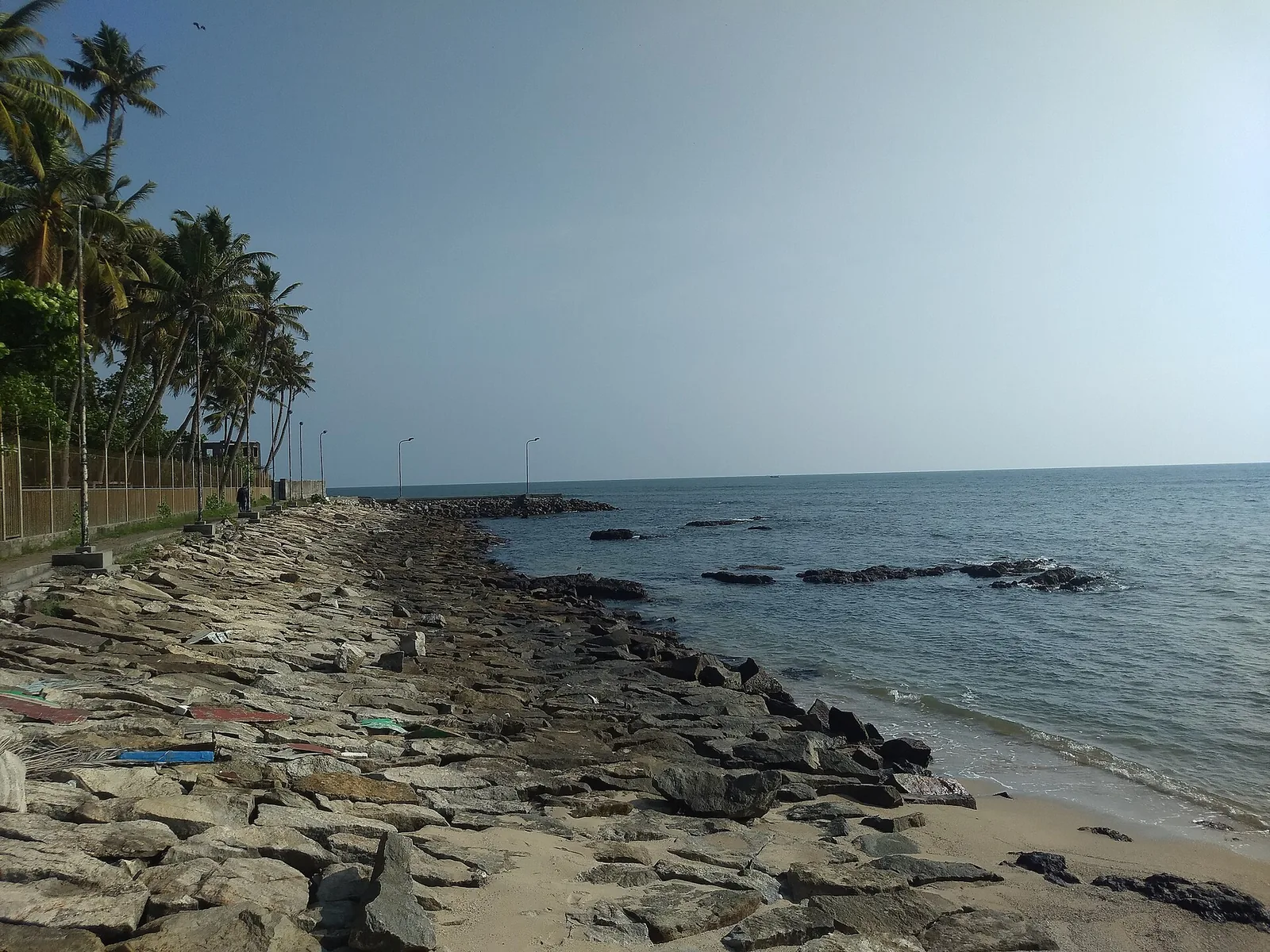
Thirumullavaram is marketed as the quiet beach — the local one, the shaded one, the alternative to the crowds in town. For three hundred and sixty-four days a year that is a fair description.
On the new moon of the Malayalam month of Karkidakam it becomes something else entirely, and the arithmetic of what happens here is worth setting out plainly, because it is genuinely hard to believe.
The numbers do not fit
The mapped shoreline of this beach is about two hundred and ten metres long. Wikipedia describes it, conservatively, as "100+ metres".
The Kerala High Court's expected turnout for Karkidaka Vavu on 12 August 2026 was around two lakh — two hundred thousand people.
They do not arrive across the day. Bali tharpanam is performed in the pre-dawn window, so effectively everybody comes at once, and every one of them has to reach the water, make the offering, and get out again. On a shore where, as the photographs show, most of the waterline is loose granite revetment.
What the court actually did
On 6 August 2026 — six days before the rite — a bench of Justices Raja Vijayaraghavan V and K V Jayakumar rejected the Travancore Devaswom Board's layout plan, finding that "the dimensions of the proposed sheds and the pathways earmarked for pilgrim movement have not been specifically identified."
The Board was ordered to produce a fresh plan, drawn to scale, showing the precise location, dimensions and capacity of every shed; the pedestrian corridors; the ambulance routes; the police and medical control rooms; the fire-safety posts; the toilets; and the water points.
The court's stated objective is worth quoting, because it is not written in the language of crowd control. Pilgrims should be able to "enter…perform the rituals, proceed for the ritual bath and thereafter exit the area in a safe, orderly and seamless manner."
Three separate organisations build the sheds, and the order had to name and coordinate all three: the Travancore Devaswom Board, the Balitharpanam Bhoomi Samrakshana Trust, and the Vishwa Hindu Parishad. On the day, Marine Enforcement, Fisheries, Fire and Rescue and the Police all deploy — specifically because the ritual requires people to walk into the sea.
Getting there at two in the morning
The KSRTC ran roughly a hundred special buses to bali tharpanam venues across Kerala in 2026, with departures starting at two in the morning. Thirumullavaram was among the named destinations.
That detail is the one to hold on to. People travel through the night, on a state bus, in the monsoon, in order to be standing in the sea at first light on one particular morning.
What they are doing
Bali tharpanam is an offering to the dead. Rice, sesame, water and tulsi are given at the water's edge so that the souls of departed ancestors may attain liberation. It is performed on the new moon of Karkidakam, the last and hardest month of the Malayalam year — traditionally the season of scarcity, rain and illness.
It is a mourning rite, not a spectacle, and the logistics above matter precisely because of that. A court sitting in Kochi went through a shed-by-shed layout of a two-hundred-metre beach in order that two hundred thousand grieving people could stand in the sea, say what they had come to say, and get home safely.
If you are visiting at that time of year: don't, unless you are coming for the rite. And if you are coming for the rite, note that the date moves with the lunar calendar every year — 12 August in 2026 — so confirm it rather than assuming.
Frequently asked questions
What is Karkidaka Vavu Bali?
An offering to departed ancestors — rice, sesame, water and tulsi given at the water's edge, followed by a ritual bath — performed on the new-moon day of the Malayalam month of Karkidakam, usually in July or August. Thirumullavaram is one of Kerala's major venues for it.
How many people attend at Thirumullavaram?
The Kerala High Court worked to an expected figure of about two lakh — two hundred thousand — for 12 August 2026, on a shore roughly two hundred metres long, with almost everybody arriving in the same pre-dawn window.
Why was the High Court involved?
On 6 August 2026 a bench of Justices Raja Vijayaraghavan V and K V Jayakumar rejected the Travancore Devaswom Board's layout plan for the event, holding that the shed dimensions and pilgrim pathways had not been specifically identified, and ordered a fresh plan drawn to scale showing sheds, corridors, ambulance routes, control rooms, fire posts, toilets and water points.
How do people get there?
The KSRTC ran around a hundred special buses to bali tharpanam venues in 2026, with services starting at 2 am so that pilgrims could reach the shore before dawn.
When is it next?
The date moves with the lunar calendar — it fell on 12 August in 2026. Confirm the year's date locally rather than assuming a fixed month.