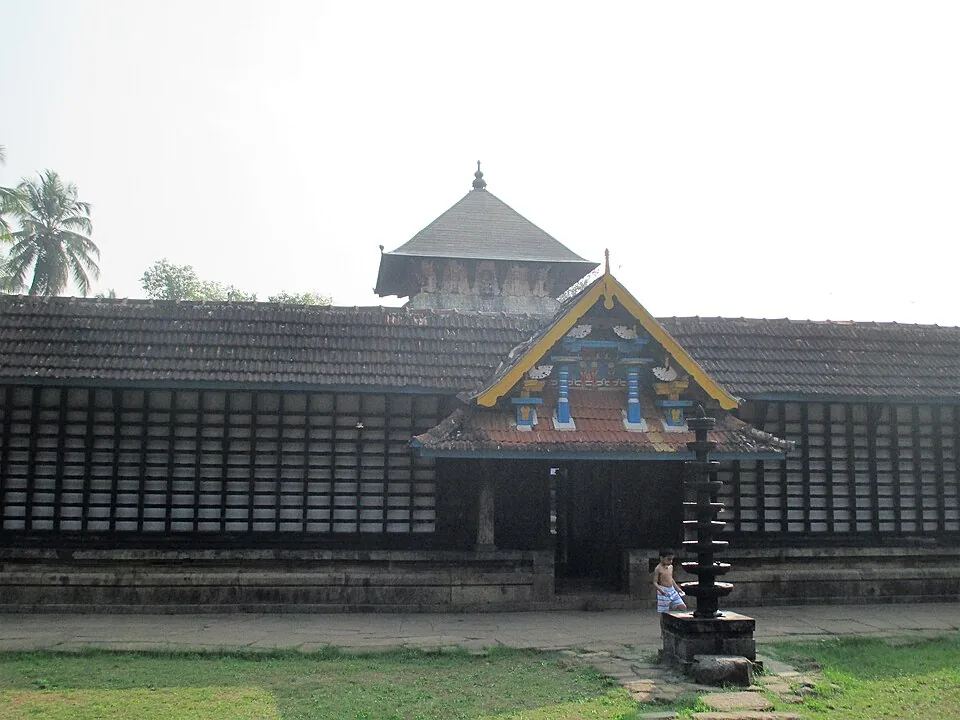
On the banks of the Bharathapuzha at Tirunavaya stands a temple with an unusual name and an even more unusual setting: Thirunavaya Navamukunda Temple. Navamukunda means “the ninth Mukunda” — the ninth form of Vishnu — and the reason for that number is one of the strangest and most beautiful origin legends in Kerala.
The nine yogis and the ninth god
Legend tells of nine wandering holy men, the Navayogis, who came to this riverbank determined to install their god. One by one they consecrated an idol of Vishnu — and one by one, eight of them sank straight down into the earth and vanished, the ground swallowing each god as soon as it was set. Only when the ninth idol was placed did it hold; even then it began to sink, and was arrested only at the knees. That ninth Vishnu, caught halfway into the earth, became Navamukundan, and the place took the name Thiru-navaya, sacred place of the nine.
Three gods across one river
The setting is rarer still. Thirunavaya is not one temple but the heart of three: Vishnu on the north bank as Navamukundan, and, facing him across the Bharathapuzha at Tavanur, temples of Brahma and Shiva. To have all three of the Hindu trinity — creator, preserver and destroyer — gazing at one another across a single sacred river is a configuration found almost nowhere else, a Trimurti sangama. It is little wonder the temple is also counted among the 108 Divya Desams, the holiest abodes of Vishnu in the Tamil devotional tradition.
The elephant and the goddess of flowers
A second legend explains the god’s tender fame. It is said that both the goddess Lakshmi and Gajendra, the king of elephants, came to worship Vishnu here, each gathering lotuses from the same nearby lake. As the flowers ran short between the two devotees, the elephant appealed to the lord — and Vishnu, moved, seated Lakshmi beside him and accepted the elephant’s devotion, honouring the humble creature’s love as fully as the goddess’s. It is the local echo of the great Gajendra Moksha story, in which Vishnu rushes to save an elephant seized by a crocodile — devotion answered without delay.
A riverbank as holy as Kashi
Like Thirunelli in the mountains and Varanasi in the north, the sands of Thirunavaya are held to be a place where the living settle their debts to the dead. Its banks are considered as sacred as Kashi for ancestral rites, a Dakshina Gaya, and on Karkidaka Vavu — the new-moon day of the monsoon month — Hindus from across northern Kerala gather here at dawn to perform bali tarpana for their forefathers, seeking release for departed souls. The trinity across the water is believed to make the rite especially potent.
Where Kerala’s kings once clashed
This same riverbank was, for centuries, the stage of the Mamankam — the vast twelve-yearly festival at which the Zamorin of Calicut presided and the suicide-warriors of Valluvanad came to try to kill him. The blood and grandeur of that history soaked into these sands long ago; today they are quiet, given over to prayer and remembrance. Standing where the three gods face each other across the slow brown river, it is easy to feel the enormous weight of the past this modest place carries.
Visiting Thirunavaya
Thirunavaya lies near Tirur in Malappuram district, on the Bharathapuzha. It is busiest at Karkidaka Vavu, when the banks fill for the ancestral rites; on other days it is peaceful. Details are on the Thirunavaya place page; more of the district is on the Malappuram hub.
Frequently asked questions
Why is it called Navamukunda temple?
Navamukunda means “the ninth Mukunda” (a form of Vishnu). Legend holds that nine yogis each tried to install an idol on the riverbank; the first eight sank into the earth, and the ninth stopped sinking at the knees and remained — becoming the enshrined Navamukundan.
What are the three temples at Thirunavaya?
Thirunavaya has Vishnu (Navamukundan) on the north bank of the Bharathapuzha, and temples of Brahma and Shiva across the river at Tavanur — a rare Trimurti sangama where all three of the Hindu trinity face one another across a single sacred river.
Why do people perform ancestral rites at Thirunavaya?
The banks of the Bharathapuzha at Thirunavaya are considered as holy as Kashi for ancestral rites (a Dakshina Gaya). On Karkidaka Vavu, the monsoon new-moon day, Hindus from across northern Kerala gather to perform bali tarpana for their ancestors.
Is Thirunavaya linked to the Mamankam?
Yes. The banks of the Bharathapuzha at Thirunavaya were the site of the Mamankam, the great twelve-yearly festival presided over by the Zamorin of Calicut, to which the suicide-warriors (chavers) of Valluvanad came.