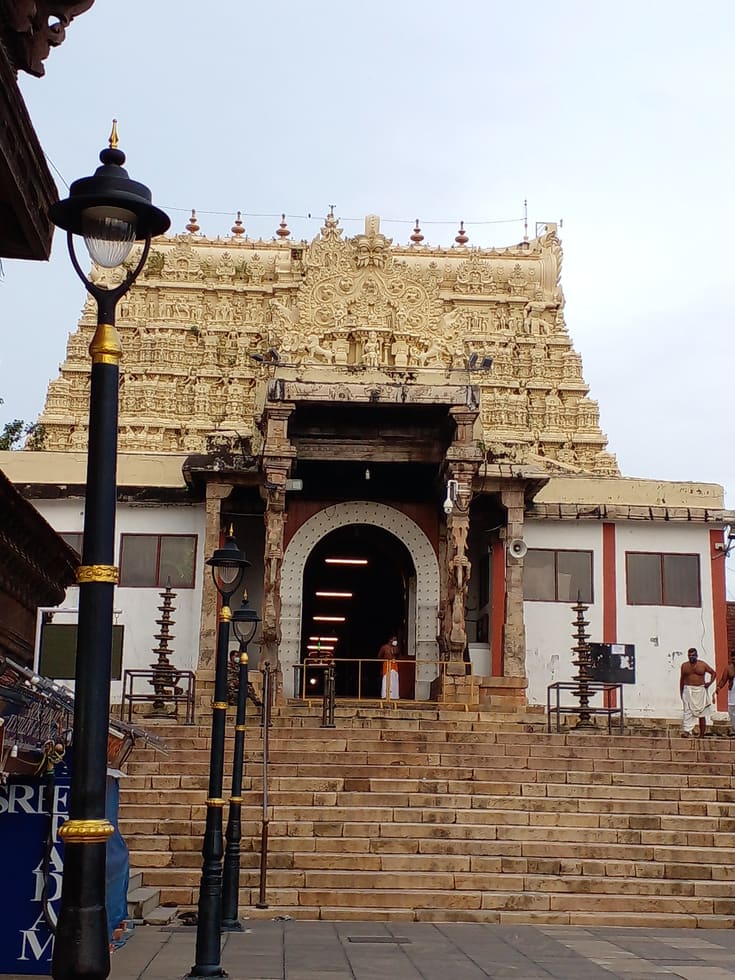
Thiruvananthapuram in 2 days works best when each day has one centre. That is because the city's best places sit in three separate clusters: the old fort quarter at East Fort, the museum and zoo grounds on the hill to the north, and the beaches beyond the city. Two of those clusters fit easily into a first day, since the fort quarter rewards an early start and the museum hill fills an afternoon. That leaves the second day free for the sea, which is how most visitors end up enjoying Thiruvananthapuram rather than rushing through it.
Day 1 morning: East Fort and the god who owned a kingdom
The morning starts where the city itself started, at the Sree Padmanabhaswamy Temple in East Fort. In January 1750 King Marthanda Varma gave all of Travancore to the god Padmanabha and ruled on as his servant. That is why the city grew around this temple and why the story of that gift explains so much of what you see nearby. The doors open at 3:15 am and close at noon, so worshippers who come early find the calmest hours of the day. Entry is for Hindus, and men wear a mundu or dhoti with no shirt while women wear a sari, set-mundu, half-sari or skirt and blouse. Visitors in trousers or a churidar simply rent a dhoti at the entrance and wrap it over them, so nobody needs to arrive dressed for the temple.
Because the kings saw themselves as the god's servants, they built their homes right beside him, and that is why Kuthiramalika Palace stands at the edge of the temple tank. Maharaja Swathi Thirunal had it built in the 1840s, and 122 carved wooden horses run along its eaves, which gives it the name Mansion of Horses. The king composed music here within sight of the temple. As the Kuthiramalika story tells, the palace and the shrine make one short, connected visit rather than two separate stops.
A few minutes' walk away, the fort quarter has one more temple with an unusual owner. The Pazhavangadi Ganapathy Temple belongs to the Indian Army's Madras Regiment, because soldiers carried its small idol here when the capital moved to the city in 1760. The steady sound of coconuts breaking on stone outside it is the last thing most people hear before they leave East Fort for lunch.
Day 1 afternoon: the museum hill and the zoo
After lunch the route moves north to the green hill where the museum, the art gallery and the zoo share one large park. The Napier Museum opens from 10 am to 4:30 pm, Tuesday to Sunday, but only from 1 pm on Wednesday and not at all on Monday. So a Wednesday afternoon still works while a Monday does not. Robert Chisholm designed the building in 1880 with double walls that keep its halls cool without any machine. He borrowed its layered roofs from Kuthiramalika, which is why the morning's palace and the afternoon's museum look like relatives. The Napier Museum story follows how that design came about.
The Thiruvananthapuram Zoo opened beside the museum in 1859 to draw crowds to it, and it still does that job today. It opens at 9 am from Tuesday to Sunday and keeps about 1,025 animals from 98 species, starting with the lion-tailed macaque and the Nilgiri langur of the Western Ghats. The zoo and the museum together can fill far more than one afternoon. So most people choose the one that interests them more and give the rest of the time to the shaded paths, as the zoo story explains.
When the light softens, the walk continues up to Kanakakunnu Palace, the old royal guest house on its own hillock. Its lawns fill with families and friends on ordinary evenings, so it makes a quiet end to a day that began before dawn at the temple. Visitors who prefer the sea for sunset take a short ride west instead to Shanghumukham Beach, where Kanayi Kunhiraman's giant concrete mermaid lies on the sand beside the airport.
Day 2: Kovalam or Varkala, but not both
The second day belongs to one stretch of coast. Kovalam lies about 16 km south of the city while Varkala lies to the north. Trying both in a day turns a beach day into two long drives. Kovalam suits travellers who want a shorter ride and a choice of three crescent beaches in a row. Lighthouse Beach is the busiest of them, and its striped tower above the rocks has guided ships into Vizhinjam harbour since 20 May 1972. Lifeguards watch the main beaches and raise flags when the undercurrents are strong, so swimmers stay between the flags and leave the water when the warning comes.
Varkala gives a very different day, because there the beach lies below a long red cliff. That cliff runs for about 4 km in three parts: the North Cliff, the South Cliff and the Edava Cliff. Most visitors spend the morning on the sand of Papanasam Beach and the evening on the cliff path above it, where cafés look out over the water. The Varkala cliff story explains why that cliff edge is slowly moving, which is also why the path keeps a safe distance from it.
Whichever coast you choose, the city's international airport sits only about 14 km from Kovalam, so a late flight still leaves room for a full day by the sea. Travellers who would rather stay in town swap the beach for a longer museum day or an evening at Kanakakunnu. Those with a third day add the temples and villages described in the Thiruvananthapuram district guide.
Frequently asked questions
Is two days enough for Thiruvananthapuram?
Two days covers East Fort, the Padmanabhaswamy Temple, Kuthiramalika, the Napier Museum and zoo, and one beach. A third day adds Ponmudi, Poovar or the second coast.
Can non-Hindus visit the Padmanabhaswamy Temple?
Entry is for Hindus only. Other visitors spend the morning around East Fort, Kuthiramalika Palace and the Pazhavangadi Ganapathy Temple.
Is the Napier Museum open on Monday?
No. The museum opens Tuesday to Sunday from 10 am to 4:30 pm, and from 1 pm on Wednesday.
Kovalam or Varkala from Trivandrum?
Kovalam is about 16 km south and has three beaches in a row. Varkala lies to the north and has a beach below a 4 km cliff, so most people pick one.