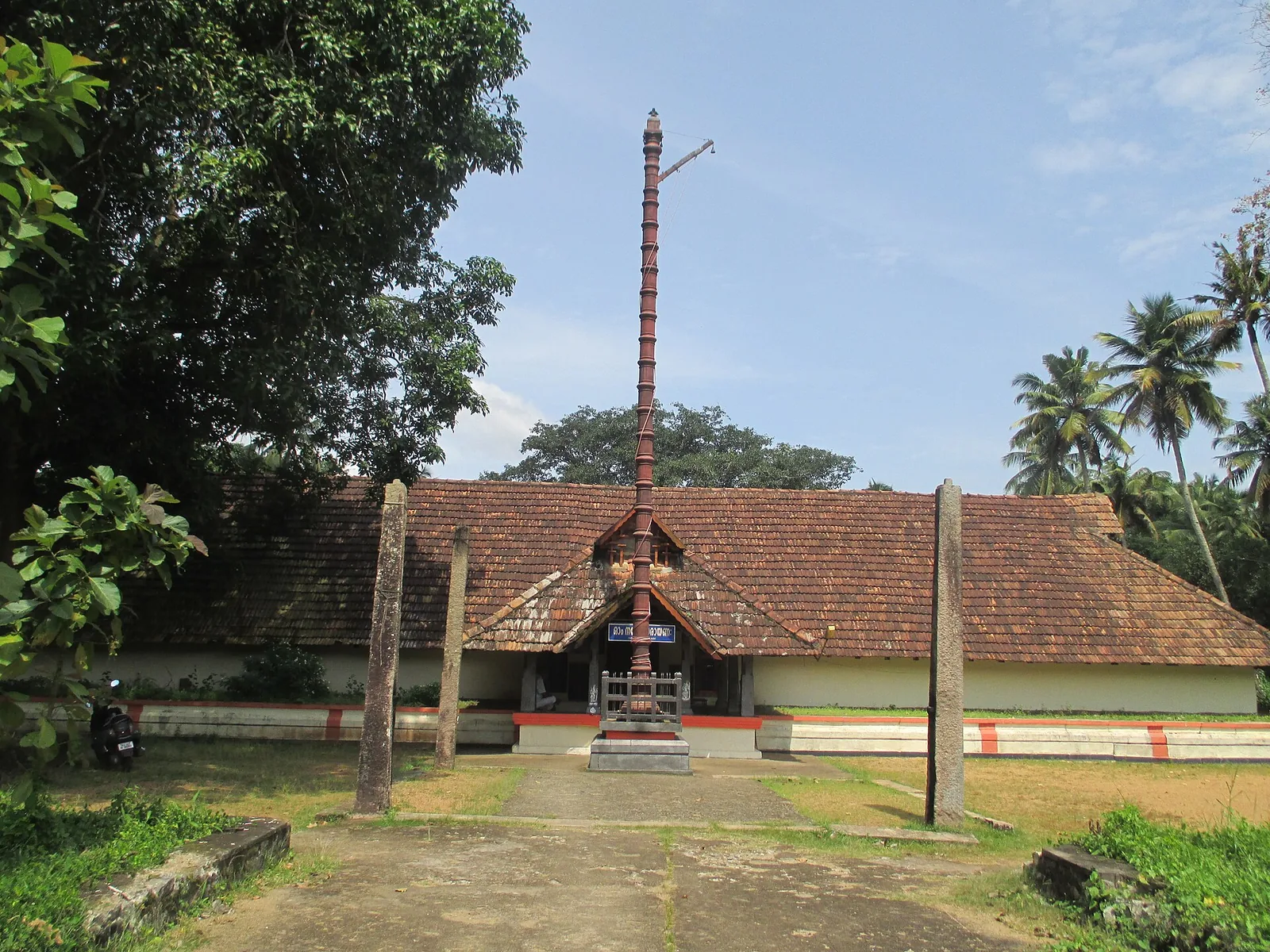
Most temple foundation stories are about a discovery — a bleeding stone, a cow giving milk over a rock, a sage in the forest. The one attached to Thrichittatt Maha Vishnu Temple at Mundankavu, a kilometre north of Chengannur, is about guilt, and it is the more interesting for it.
What happened at Kurukshetra
Drona was the teacher of both sides. While he held his weapons, the Pandavas could not beat him, and the only way to make him lay them down was to make him believe his son Ashwatthama had been killed. The difficulty was that Drona would not believe it from anyone — except from Yudhishthira, the eldest of the five, whose whole standing rested on the fact that he had never in his life told an untruth.
So Yudhishthira said it. Drona put down his arms and was killed. And the tradition at Chengannur holds that afterwards the eldest Pandava came south, to the bank of the Chittar, a tributary of the Pampa, and did penance at this temple until the sin of that one sentence left him.
Why the story is worth keeping
It is a strange thing for a temple to be famous for. A shrine founded on a victory, or a miracle, or a king’s vow, is telling you something about power. A shrine founded on a man expiating a single lie is telling you something else, and the belief attached to it follows the same shape: that to come here, look at the tank and bow to the god is to be freed of the untruths you have told and the wrongs you have done up to that moment. Not future ones. The offer is retrospective and it is bounded, which is a more careful piece of theology than the genre usually manages.
It also sits oddly and well against the character of the place. Thrichittatt is not grand. It is a low sweep of tiled roof over ochre walls behind two granite pillars, with a plain timber flagstaff and grass coming up through the paving, a kilometre from a station on one of the busiest pilgrim routes in Kerala. Nothing about it performs the weight of the story it carries.
The god of those who came first
The deity’s name belongs to the same legend from the other side. He is Imayavarappan — the imayavar, the devas, are held to have reached this place and worshipped here before Yudhishthira arrived, so the god is the lord of those who came before. One account pushes it further and says the devas built the temple themselves, on the bank of the Chittar, before mankind existed, and that what Yudhishthira did in the Dvapara Yuga was not to found it but to restore it.
The image is worth looking at if you get darshan. It stands, faces east, and has four arms: the Panchajanya conch in the upper right hand, the Sudarshana discus in the upper left, a lotus in the lower right — and the lower left hand empty, where a Vishnu image would normally carry the Kaumodaki mace. The English and Malayalam sources agree on the conch and the discus, and that placing is the reverse of the arrangement most often described. We are not going to tell you it is the only image in India like that, because no source we can check says so.
And the brothers who went elsewhere
Thrichittatt is one of five. Each of the Pandavas is said to have installed a deity at a different temple in this stretch of the Pampa valley: Yudhishthira here, Bhima at Thripuliyoor, Arjuna at Aranmula, Nakula at Thiruvanvandoor, Sahadeva at Thrikodithanam. Thrichittatt is generally called the first of the five, which is a statement about the legend’s order — Yudhishthira was the eldest — rather than about which building is older. Nobody knows which building is older.
Where the sources genuinely part company is when. The Malayalam account puts it during the exile: the five hid on a hill near Chengannur called Pandavan Para, and went out from there to worship. The English account puts it decades later, after the war, when the brothers crowned Parikshit and left on pilgrimage. A third version has them worshipping the images throughout their reign and installing them only at the end of it, and a fourth brings in the sage Bhrigu, who after Krishna’s death urges them to consecrate temples here so that daily offerings can be made — by the brothers, and by the people who had sheltered them in exile.
Four versions, one roll-call. We report the versions rather than choosing between them, and we note that on the question people expect to be disputed — which brother, which temple — the sources are in complete agreement.
Frequently asked questions
What lie did Yudhishthira tell?
That Ashwatthama was dead, so that Drona — Ashwatthama’s father and the teacher of both sides — would lay down his weapons and could be killed. Yudhishthira had never told an untruth before, which is precisely why Drona believed him.
What does Imayavarappan mean?
The lord of the imayavar — the devas — who are held to have come to this place and worshipped here before Yudhishthira did. The temple is also called Thrichittattu, Thricchittattu and Thiruchenkundrur.
Is Thrichittatt older than the other Pandava temples?
Nobody knows. It is usually called the first or primary of the five, but that reflects Yudhishthira’s seniority among the brothers and the order of the traditional list, not any dating of the buildings. There is no record of when any of them was built.
Do the sources agree on which Pandava built which temple?
Yes. The English and Malayalam accounts give the identical assignment, and it matches what this site has long published on the Aranmula page. What they disagree about is the occasion — during the exile, during the reign, or on a pilgrimage after crowning Parikshit.