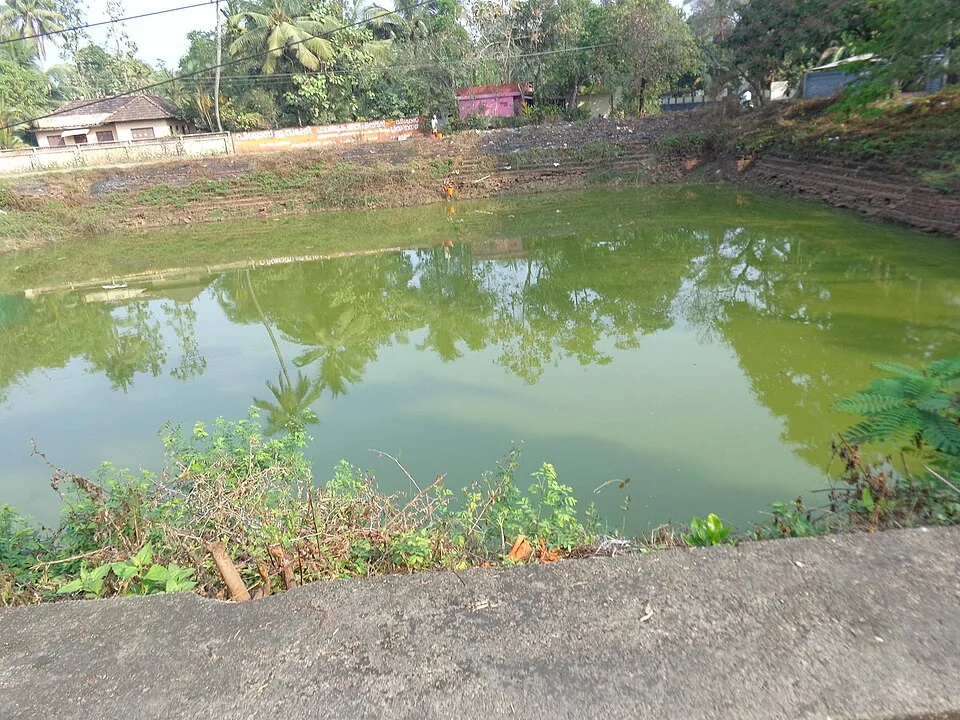
At most Kerala temples the tank is where you wash before you go in. At Thrichittatt the tradition makes a much larger claim: that worship at the water is the equal of worship in the sanctum, and that a darshan here is not complete until you have done both.
Two names, one legend
The claim comes out of the founding story, and the tank’s two names are the two halves of it. Yudhishthira, having bathed, is said to have immersed the image in this pond before installing it — and from that immersion the pond is Amrutha Pushkarani. Then he filled his conch with its water to perform the first puja after the installation — and from that the pond is Shankha Theertham, the conch ford. The water was used to consecrate the god, so the water is not preliminary to the shrine. It is part of it.
That logic is unusually explicit. Plenty of temple tanks are held sacred; not many are held to be liturgically equivalent to the sanctum, with a stated rule that the visit is unfinished without them.
And then you look at it
Here is where honesty is worth more than atmosphere. Go round to the tank and you will find a broad green pond with earth banks, a house or two and some scrub on the far side, rubble along one edge, and a low boundary wall carrying painted lettering. It is a working village pond. There is no cut-stone ghat sweeping down to the water, no colonnade, nothing that looks like half of a temple.
We are showing it anyway, with a caption, because the alternative is worse. A page that tells you this water ranks with the sanctum and then shows you a photograph of something else has told you a small lie about a real place. And the gap between the claim and the appearance is genuinely the most interesting thing about the tank: it is a reminder that in a living temple tradition, sanctity is a matter of what happened here and what is done here, not of masonry.
What to actually do
Not much, and that is the point. Walk out to the tank after darshan rather than before, since the tradition frames it as the second half rather than the preparation. Stand at the water. If you are doing the Pancha Pandava circuit, this is the stop that most rewards not hurrying, because there is nothing here to photograph and nothing to buy — the whole content of the place is a story about a conch being filled.
And take the belief attached to the temple with you when you go: that to come here, look at the tank and bow to the god is to be freed of the lies told and wrongs done up to that moment. Whatever you make of it, it is a considerably more thoughtful offer than most sacred water in the world is asked to carry.
Frequently asked questions
Why does the tank have two names?
Amrutha Pushkarani from Yudhishthira immersing the image in it before installation; Shankha Theertham from his filling his conch with its water for the first puja afterwards. Both names describe the same act of consecration.
Do I have to visit the tank?
Tradition holds that darshan at Thrichittatt is incomplete unless you worship at the tank as well as in the sanctum, so if you are visiting devotionally, yes. It is a short walk within the temple grounds.
Is it a scenic spot?
No, and we would rather say so. It is a plain green village pond with earth banks and a slogan-painted wall on one side. Its importance is entirely traditional, not architectural or scenic.
Can I bathe in it?
Treat it as a temple tank in active religious use and follow local practice rather than assuming — ask at the temple. It is not maintained as a bathing ghat for visitors.