Onam is the least temple-centred of Kerala’s great festivals. It happens at home: the pookkalam laid out at the doorstep, the sadya on a banana leaf, the family gathering, the boat races and the games. Millions of Malayalis observe it every year without going near a shrine.
And yet it has a temple, and the temple is Thrikkakara, because Thrikkakarappan — the clay figure set up in all those homes — is named for the lord of this place.
What the festival looks like here
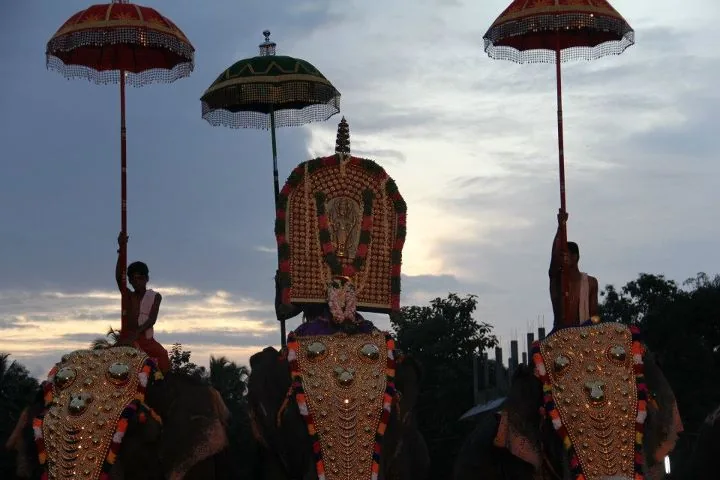
The Onam season is the temple’s great period, running across the festival days rather than a single afternoon, and it follows the Kerala pattern with the full apparatus: daily poojas building through the days, caparisoned elephants, percussion, processions, and the aarattu — the concluding procession that carries the deity to water — as the closing act.
What makes it distinctive is the relationship with everything else going on. Elsewhere the festival is domestic and dispersed. Here it is concentrated and public, and the crowd is a mix of people making a specific pilgrimage and local families who treat this as their own temple having its biggest week.
- Onam dates follow the Malayalam calendar and shift each year — confirm before booking anything around them.
- The temple is in a suburb of Kochi and is straightforward to reach, but Onam traffic across the city is not.
- Expect crowds. This is the temple at its fullest, which is both the reason to come and the reason to be patient.
- Aarattu, the concluding procession to water, is the closing set piece.
- Active Hindu temple: inner-area entry generally restricted to Hindus, dress code at the gate, no photography in the sanctum.
What to know before you stand in it
The story underneath the festival is not a triumph. Mahabali was an asura king remembered for a reign so just that there was neither falsehood nor want in it, and the gods, alarmed by his stature, asked Vishnu to deal with him. Vishnu came not as a warrior but as a small boy asking for three paces of ground — and then filled the universe with two of them.
Mahabali, having promised, offered his own head for the third. He is sent below, and granted one visit a year.
So when the drums are going and the elephants are lined up, remember what is being celebrated: a good king’s annual parole. Kerala’s national festival is a homecoming for someone who lost, and the state has never much pretended otherwise.
Outside Onam
The rest of the year it is quiet — a suburban temple with the ordinary Kerala rhythm of early morning poojas, a long midday closure and an evening reopening until the night pooja. That is a perfectly good time to visit if what you want is the place rather than the crowd, and it is much easier to actually look at.
Either way, go knowing that the small clay pyramid in a few million Kerala courtyards is pointing here.
Frequently asked questions
Is Onam a temple festival?
Mostly not — it is celebrated at home across Kerala with the pookkalam, the sadya and family gatherings, and millions observe it without visiting a shrine. But it does have a temple: Thrikkakara, because the household Thrikkakarappan figure is named for the lord of this place.
What happens at Thrikkakara during Onam?
The temple’s great season runs across the festival days with the full Kerala apparatus — daily poojas building through the days, caparisoned elephants, percussion, processions, and the aarattu, the concluding procession that carries the deity to water, as the closing act.
When is Onam?
Dates follow the Malayalam calendar and shift each year, so confirm before planning travel around them. Note also that Onam traffic across Kochi is heavy even though the temple itself is easy to reach.
What is aarattu?
The concluding procession of a Kerala temple festival, in which the deity is carried to water. At Thrikkakara it is the closing set piece of the Onam season.
What is Onam actually celebrating?
The annual return of Mahabali, an asura king remembered for a reign so just there was neither falsehood nor want. Vishnu came as the boy Vamana, asked for three paces, covered the universe in two, and Mahabali offered his own head for the third — and was granted one visit a year. It is a homecoming for someone who lost.
Is it worth visiting outside Onam?
Yes, if you want the place rather than the crowd. Outside the season it is a quiet suburban temple with the ordinary Kerala rhythm of early poojas, a long midday closure and an evening reopening — and it is far easier to actually look at.