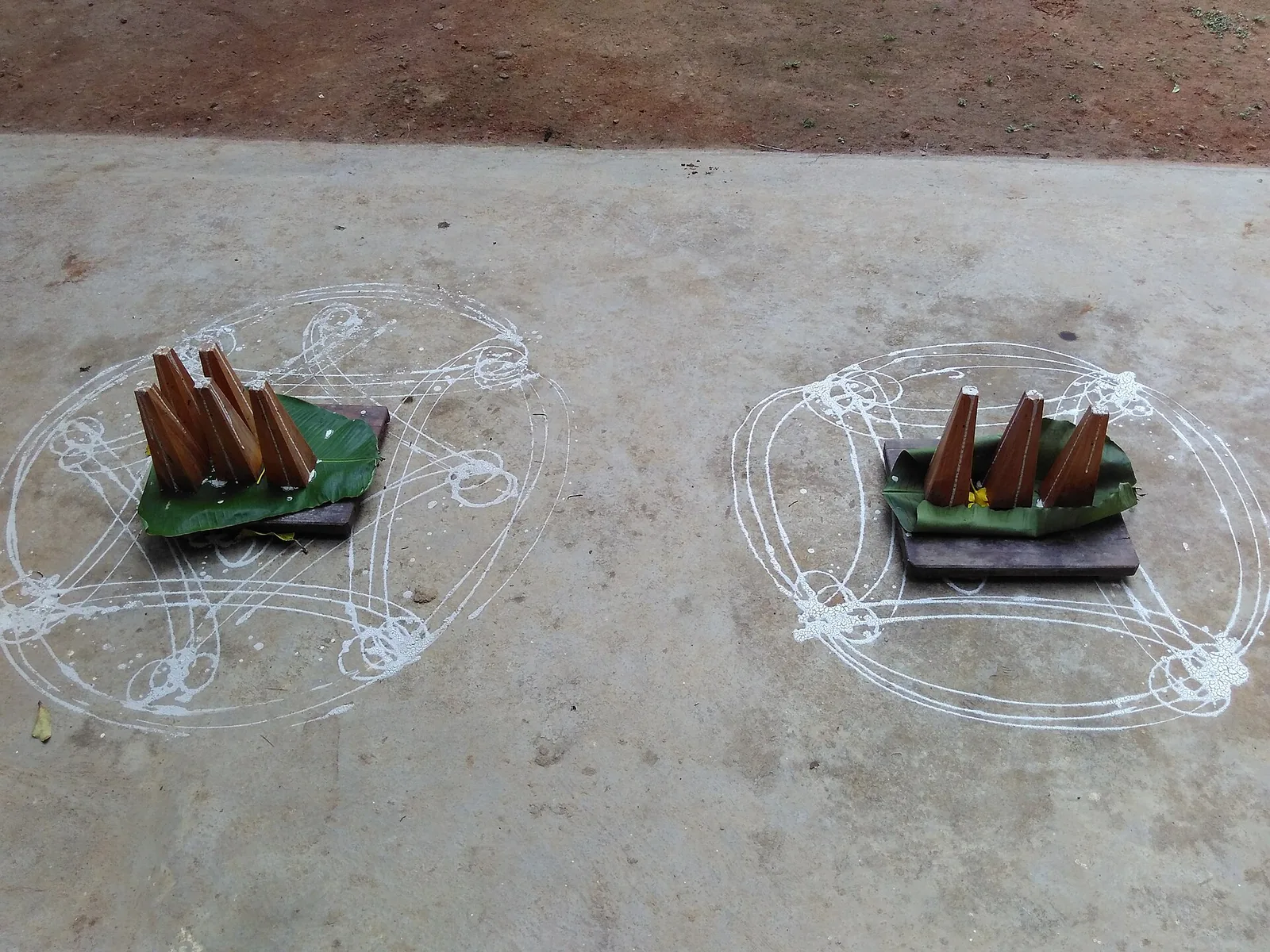
Every Onam, in households across Kerala, a small pyramidal figure of clay is made or bought, set up in the courtyard or the front room, decorated, and given offerings. It is called Thrikkakarappan.
The name means the lord of Thrikkakara. It refers to a specific temple, in a suburb of Kochi, that most of the people setting up the figure have never visited: the Thrikkakara Vamanamoorthy temple.
Why here
Because this is where the story is supposed to have happened. Vishnu came as Vamana, a small brahmin boy, to the sacrifice of the asura king Mahabali; asked for as much land as he could cover in three steps; and then grew. The legend places the setting of that foot at Thrikkakara, and the name is read as deriving from it — the sacred foot, the place of the foot.
What follows is the reason Kerala has Onam at all. Mahabali, having given his word, offers his own head for the third step and is consigned to the underworld, but is granted permission to return once a year to visit the people he ruled. Onam is that visit. The whole festival is a homecoming for a defeated king who was loved.
So the clay figure in the courtyard is not decoration. It is the household preparing for a guest, and the guest has a home address, and the address is this temple.
- One of a small number of temples in Kerala where Vishnu is worshipped specifically in the Vamana form.
- The Onam connection is not general: the household Thrikkakarappan figure is named directly for this temple.
- The temple was in a dilapidated state until the nineteenth century and was later reconstructed, following an Archaeological Department report and the request of devotees.
- Onam is the temple’s great season, when it is at its busiest and most worth seeing.
- An active Hindu temple: entry to inner areas is generally restricted to Hindus.
The thing that surprises people
A temple this central to Kerala’s national festival was, for a long stretch, a ruin. Accounts describe it as dilapidated until the nineteenth century, and its reconstruction as coming later, prompted by an Archaeological Department report and the petition of devotees.
That is worth sitting with. The clay figure kept being made in millions of homes, every year, named after a temple that had fallen down. The ritual outlived the building, and then eventually pulled it back up.
Going
Onam is the obvious time and the temple is at its fullest then, which cuts both ways — you will see it at its most alive and you will see it in a crowd. Outside the season it is a quiet suburban temple with the standard Kerala rhythm of early poojas, a long midday closure and an evening reopening.
Either way, go having understood what the little clay pyramid in every Kerala house is actually pointing at. It changes the visit from a temple stop into an arrival.
Frequently asked questions
What is Thrikkakarappan?
The small pyramidal clay figure set up in Kerala homes during Onam, decorated and given offerings. The name means the lord of Thrikkakara and refers directly to the Vamanamoorthy temple at Thrikkakara near Kochi, where the Vamana legend is said to have taken place.
Why is Thrikkakara connected to Onam?
Because the legend places Vamana’s arrival and the setting of his foot here. Mahabali gave his word, offered his head for the third step, was consigned to the underworld and was granted leave to return once a year to see his people — and Onam is that visit. The temple is, in effect, the address of the story.
What is special about the deity?
It is one of a small number of temples in Kerala where Vishnu is worshipped specifically in the Vamana form, rather than in his more commonly worshipped avatars. That specificity is what ties the household Onam figure to this particular place.
Was the temple ever ruined?
Yes. Accounts describe it as being in a dilapidated condition until the nineteenth century, with reconstruction coming later at the request of devotees and following an Archaeological Department report. The household ritual continued across the whole period the building was down.
When should I visit?
Onam is the temple’s great season and it is at its fullest and most alive then, though also at its most crowded. Outside the season it is a quiet suburban temple with the usual Kerala rhythm of early poojas, a long midday closure and an evening reopening.
Can non-Hindus enter?
As at most active Hindu temples in Kerala, entry to the inner areas is generally restricted to Hindus. Expect a dress code at the gate regardless, and follow what staff tell you on the day.