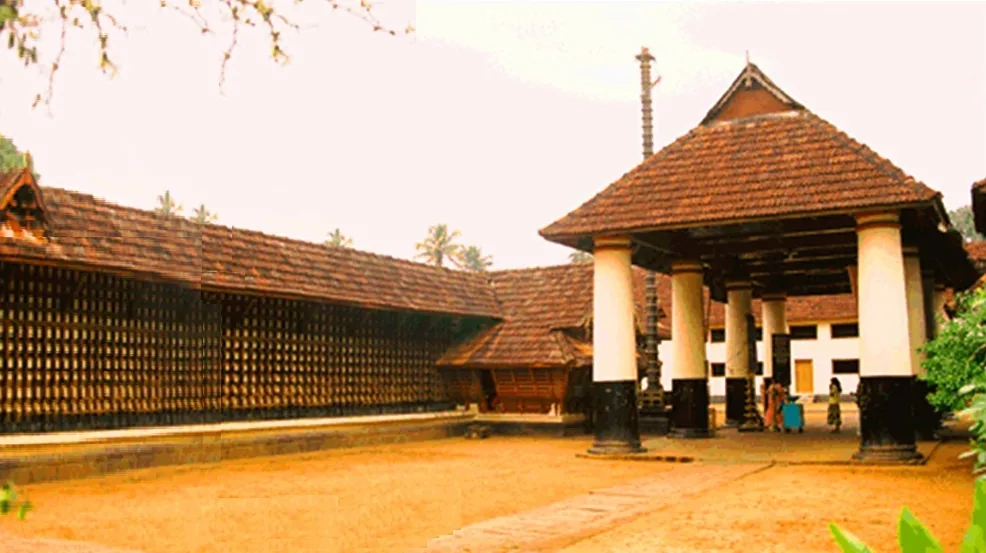
Everyone driving east from Kochi to the bird sanctuary passes Kothamangalam, and almost nobody stops. A few kilometres off that road, on a riverbank, the Thrikkariyoor Mahadeva temple sits with two claims attached to it that are much larger than the building. They sit at completely different levels of evidence, and the honest thing is to keep them apart.
Claim one: the last of the 108
The 108 Shivalayas belong to the Parasurama cycle, which is Kerala’s own foundation myth. Parasurama, the axe-wielding sixth avatar of Vishnu, is said to have won the land from the sea: granted a boon by Varuna, he threw his axe from Gokarna and received all the ground it flew over as far as Kanyakumari. Across the land he raised he is said to have consecrated 108 temples to Shiva.
Thrikkariyoor’s distinction within that tradition is not that it is on the list. It is that it is held to be the last of them — the closing consecration, the end of the sequence.
This is myth and it should be read as myth. The Parasurama story is a foundation narrative rather than a chronicle, and the 108 lists vary between sources. What it tells you truthfully is how this small temple has been ranked in Kerala’s religious imagination for a very long time, which is a real fact about people even if it is not a fact about masonry.
Claim two: Karuvoor, and the Cheras
The second claim is historical, and unlike the first it is genuinely argued. Thrikkariyoor — appearing in the older material as Karuvoor or Karaorai — is held by local historical tradition to have been a headquarters of the early Cheras, and by some accounts the capital of one of the Cheraman Perumals, the rulers of old Kerala. Kerala scholars including Prof. Joseph Mundassery and V. Kanakasabhai have been cited in support of the identification, and the argument has never been settled.
The geography is at least suggestive. Eastern Ernakulam sits on the route between the coast and the Ghat passes into Tamil country, which is exactly where an early Chera seat would want to be, and the river running past the temple connects to the village of Karur in Kothamangalam — a name that has kept the argument alive on its own.
- Devotional: the last of the 108 Shivalayas consecrated by Parasurama. Tradition, not history — and the lists vary.
- Historical: a headquarters of the early Cheras, possibly a Cheraman Perumal capital. Seriously argued, not established.
- Older names recorded for the place include Karuvoor and Karaorai.
- Local accounts describe Brahmin settlement in the Kothamangalam area from an early date, and a decline following a Pandya attack around the 8th–9th centuries.
- The deity is Thrikkariyurappan. Maha Shivaratri is a principal observance; the annual utsavam falls in Meenam, roughly March–April, ending with arattu at the river.
The evidence, though, is traditional and circumstantial rather than epigraphic. We present it as a claim that is seriously made and not conclusively established — which is both the honest position and a more interesting one to arrive with than a settled answer would be. A temple that might have stood at the centre of Chera power is a better thing to stand in than a temple that definitely did not.
What you will actually find
A compact Kerala temple by the water, with the usual arrangement of sanctum, prakaram and outer wall, and none of the scale of Ernakulam’s marquee shrines. No interpretation panel, no guide, no shop. If you arrive without knowing what you are looking at, it reads as an ordinary village temple — which is precisely what everyone driving past assumes it is.
The relationship with the river is the reason the temple is where it is, and walking down to the bank is a more useful five minutes here than another circuit of the prakaram. Kerala temples of this age are sited on water for practical and ritual reasons alike, and the arattu that concludes the annual festival ends there.
Getting the timing right
The rhythm is the standard Kerala one: an early opening for the morning poojas, a long closure across the middle of the day, and an evening reopening until the night pooja. That midday shut is what catches out day visitors from Kochi, who tend to arrive at exactly the wrong hour after a slow drive through Perumbavoor. Make it the first stop of the day, not the last, and put Bhoothathankettu and the bird sanctuary after it.
On entry: we have not verified this temple’s own policy on non-Hindu visitors and will not guess. Kerala temples vary. Ask before travelling if it matters to you, and expect a dress code at the gate regardless — mundu for men with upper garments generally removed in the inner areas, saree, set-mundu or salwar for women, footwear and leather left outside, no photography in the sanctum.
Frequently asked questions
Was Thrikkariyoor a Chera capital?
It is claimed and it is not proven. Local historical tradition holds that the settlement — recorded also as Karuvoor or Karaorai — was a headquarters of the early Cheras and possibly the capital of one of the Cheraman Perumals, with scholars including Prof. Mundassery and V. Kanakasabhai cited in support. The case rests on tradition and circumstantial evidence rather than settled epigraphy.
What are the 108 Shivalayas?
A set of 108 Shiva temples that devotional tradition holds were consecrated across Kerala by Parasurama, the avatar credited in myth with raising the land from the sea. Thrikkariyoor’s distinction is that it is counted as the last of the 108 — the closing consecration. The lists vary between sources; this is devotional classification, not history.
What is the Parasurama legend?
That Parasurama, the axe-wielding sixth avatar of Vishnu, was granted a boon by Varuna, threw his axe from Gokarna and received all the land it flew over as far as Kanyakumari — the land becoming Kerala. Across it he is said to have consecrated 108 temples to Shiva. It is Kerala’s foundation myth, not a chronicle.
What is the temple’s deity and festival?
The deity is Thrikkariyurappan, a form of Shiva. Maha Shivaratri is a principal observance, and the annual utsavam falls in the Malayalam month of Meenam, roughly March to April, running several days on the usual pattern of flag-hoisting, daily processions and a concluding arattu at the river. Dates follow the Malayalam calendar and shift each year.
Can non-Hindus enter Thrikkariyoor temple?
We have not verified this temple’s own policy and will not guess. Kerala temples vary — some admit visitors of any faith, some restrict the inner sanctum, some admit only Hindus. Ask before travelling if it matters to you, and expect a dress code at the gate regardless.
When should I visit?
In the morning. The temple follows the standard Kerala rhythm of early poojas, a long midday closure and an evening reopening, and day visitors driving out from Kochi routinely arrive during the closure. Make it the first stop and put Bhoothathankettu and the Thattekkad sanctuary after it.