Kerala produces a particular kind of local custom that sounds invented until you find that everyone in the town takes it for granted. Kothamangalam has one of the best of them.
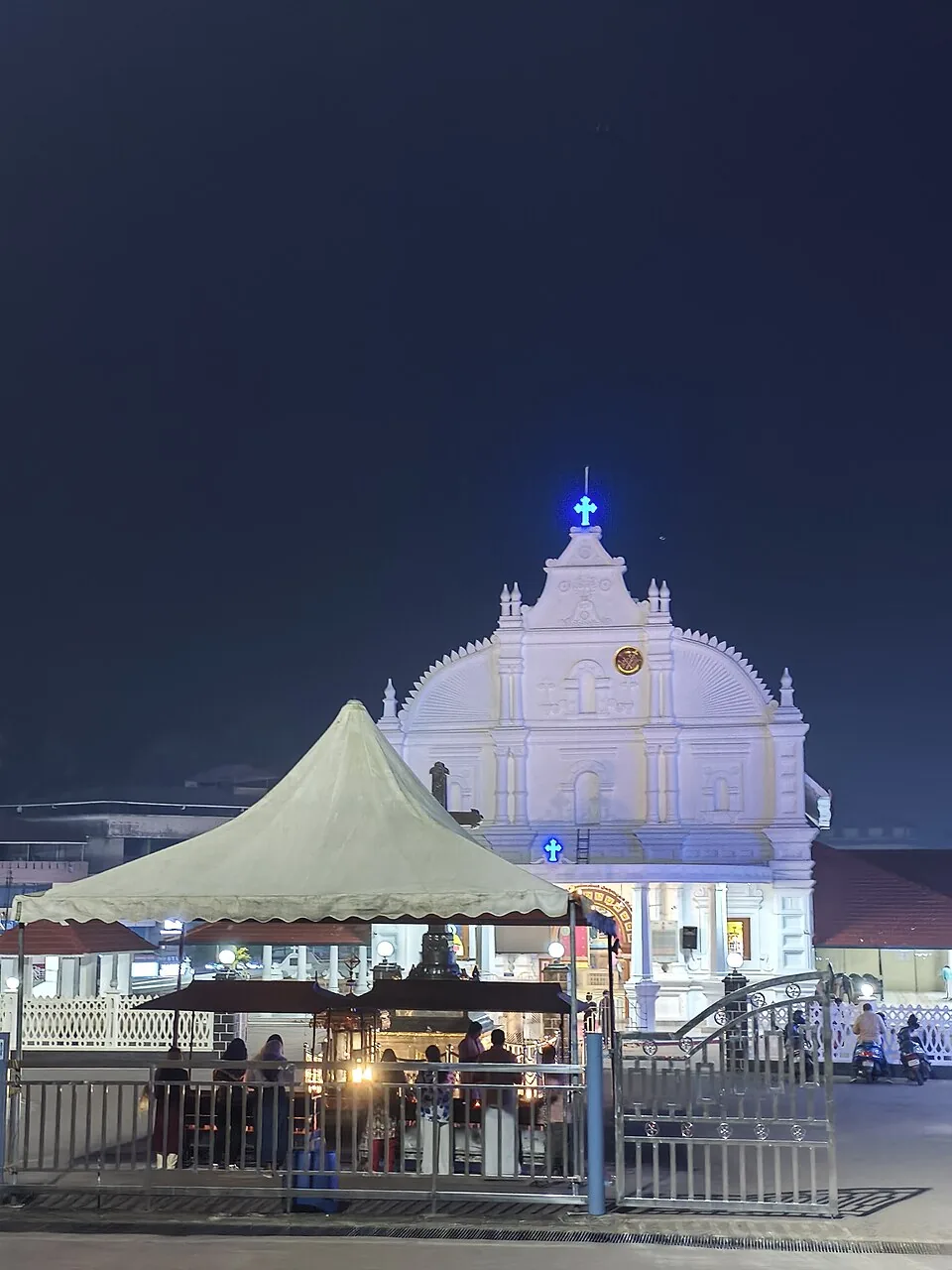
A strong local belief holds that the festival at the Marthoman Cheriyapally — the Jacobite Syrian church in the town — will not commence until the para and the lantern from the Thrikkariyoor Mahadeva temple have reached the church.
What a para is
The para is the traditional Kerala measure for grain — a wooden vessel of a fixed volume, heaped with rice and decorated, that is offered at temples and carried in procession. It is one of the most ordinary and most loaded objects in Malayali religious life: a unit of measurement that became a form of offering. Alongside it, a lantern; light carried from one place to another, which is a gesture every religious tradition in the state understands without translation.
So the arrangement is this. A Hindu temple sends a measure of grain and a lamp across town, and a Syrian Christian church waits for them before beginning its own feast.
The two institutions
Thrikkariyoor is not a minor shrine. Devotional tradition counts it among the 108 Shivalayas of Kerala and holds it to be the last of them consecrated by Parasurama — the closing entry on the list rather than one in the middle — and local historical tradition makes the settlement a seat of ancient Chera power.
The Marthoman Cheriyapally is not minor either. It is a Malankara Jacobite Syrian Orthodox church believed to have been established in 1455 by eighteen families, and it holds the tomb of Mar Baselios Yeldo. Its great feast, the Kanni 20 Perunnal, falls at the start of October, and it draws pilgrims well beyond the town.
- Local belief: the Cheriyapally festival does not commence until the para and lantern arrive from Thrikkariyoor temple.
- The para is the traditional Kerala grain measure, heaped and decorated, used as a temple offering.
- Marthoman Cheriyapally, Kothamangalam: Malankara Jacobite Syrian Orthodox, believed established 1455 by eighteen families.
- Its principal feast, Kanni 20 Perunnal, falls around 2–3 October and commemorates Mar Baselios Yeldo, whose tomb is there.
- Thrikkariyoor Mahadeva temple: counted in tradition as the last of the 108 Shivalayas consecrated by Parasurama.
Why this is worth going out of your way for
Kerala talks about communal harmony a great deal, and much of the talk is boilerplate. This is not boilerplate. It is a specific, operational dependency: one community’s festival calendar formally waits on an object arriving from another community’s temple. Nobody designed it as a gesture. It is simply how the town’s year has been ordered, and it has survived long enough that people state it as a fact rather than as an achievement.
It also tells you something true about how Kerala’s religions actually sit together, which is not as separate blocks but as neighbours with shared calendars, shared processional grammar and, frequently, shared families. The para and the lantern are not a metaphor for that. They are the thing itself, being carried down a road.
Seeing it, and the honest caveats
Customs like this are living arrangements, not published timetables. The details — who carries what, on which day, along which route — are held locally and can change, and a visitor turning up expecting a scheduled spectacle may find something much quieter than they imagined, or may find it has already happened. Ask in Kothamangalam rather than assuming, and treat both the church feast and the temple’s own utsavam as occasions belonging to their communities first.
If you are driving east from Kochi towards Bhoothathankettu and Thattekkad, Thrikkariyoor is a short detour off a road you are already on. Go in the morning, before the long midday closure, and carry the story with you: the town you have just driven through has an arrangement about a bowl of rice and a lamp that is older than most countries.
Frequently asked questions
What is the para and lantern custom at Kothamangalam?
A strong local belief that the festival at Marthoman Cheriyapally, the Jacobite Syrian church in Kothamangalam, does not commence until the para and lantern from the Thrikkariyoor Mahadeva temple reach the church — a Hindu temple’s offering formally opening a Christian feast.
What is a para?
The traditional Kerala measure for grain: a wooden vessel of fixed volume, heaped with rice and decorated, long used as a temple offering and carried in procession. It is a unit of measurement that became a form of devotion.
What is Marthoman Cheriyapally?
A Malankara Jacobite Syrian Orthodox church in Kothamangalam town, Ernakulam district, believed to have been established in 1455 by eighteen families. It holds the tomb of Mar Baselios Yeldo, and its principal feast, the Kanni 20 Perunnal, falls around 2–3 October.
Why is Thrikkariyoor temple significant?
Devotional tradition counts it among the 108 Shivalayas of Kerala and holds it to be the last of them consecrated by Parasurama, and local historical tradition makes the settlement a seat of ancient Chera power. It is a small temple carrying two very large claims.
Can visitors watch the para and lantern being carried?
It is a living local arrangement rather than a published tourist event, and the details are held locally and can change. Ask in Kothamangalam rather than assuming a schedule, and treat both the church feast and the temple’s own festival as occasions that belong to their communities first.
Is Thrikkariyoor worth a detour on the way to Thattekkad?
Yes. It is a short detour off a road most visitors already drive, and it is the only site of real antiquity along it. Go in the morning — Kerala temples close for a long midday stretch, and day visitors from Kochi routinely arrive at exactly the wrong hour.