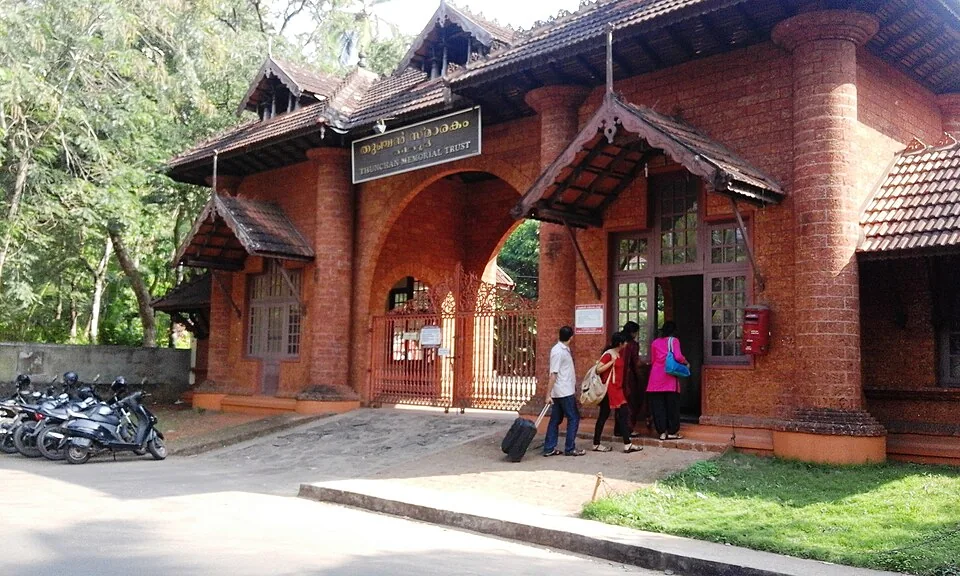
Look at a Malayalam shop sign and the first thing you notice is that almost nothing in it is straight. The letters loop. There is a reason, and it is sitting in a case at Thunchan Parambu: a palm leaf with writing scored into it, and beside it the iron stylus that did the scoring. A straight stroke drawn across a palm leaf follows the grain and splits it. Curves do not. Every writing system that grew up on palm leaf in south India ended up round, and Malayalam kept the shape long after it moved to paper.
The script he settled on
Malayalam was written in Vatteluttu before Ezhuthachan, and Vatteluttu had no comfortable way of carrying Sanskrit sounds. He wrote instead in the Grantha-derived alphabet, and because his poems were read in ordinary houses for centuries, that is the alphabet that stuck. The practical effect is that a single set of letters could carry both the spoken language and the Sanskrit vocabulary it was taking in. That is the concrete content of the title he is given.
The bird that tells the story
His two undisputed works, the Adhyatma Ramayanam and the Mahabharatam, are kilippattu — parrot-songs. In the form, the poet does not narrate. He calls a parrot and asks it to tell the story, and every section opens by doing so again. He took the convention from older Tamil verse and turned it on the Sanskrit epics. It is a strange and durable device: the poem is always someone else’s account, delivered by a bird, which lets the poet stand slightly aside from what he is retelling.
A stone parrot stands on the grounds under a canopy of its own, tall enough to reach an adult’s shoulder.
What is his and what is argued over
Those two works are agreed. A longer list has been attributed to him and is still argued about — the Brahmanda Puranam, the Uttara Ramayanam, the Devi Mahatmyam, the Harinama Kirtanam among them. His dates are argued about too, from the fifteenth century to the seventeenth, with 1495 to 1575 the most-quoted estimate. Even the name is uncertain: Thunchan means the youngest, and Ramanujan and Krishnan are both offered for what it was attached to.
- The literature museum opened in October 2008 and sets out the growth of Malayalam in clips, soundtracks, paintings and photographs.
- The Grandhapura beside it holds the palm-leaf manuscripts; the research library holds about 15,000 books and 120 manuscripts.
- The iron stylus said to be the poet’s own is kept here and is carried in procession at the Thunchan festival.
- The Ezhuthachan Puraskaram, Kerala’s highest literary award, was first given in 1993.
Frequently asked questions
What is a kilippattu?
A parrot-song: a poetic form in which the poet asks a parrot to tell the story and the bird narrates. Ezhuthachan took it from older Tamil verse and used it for the Ramayana and the Mahabharata in Malayalam.
Did Ezhuthachan invent the Malayalam alphabet?
No, but he settled it. He wrote in the Grantha-derived script rather than the older Vatteluttu, and because his poems were read so widely that script became the one Malayalam uses.
Why are Malayalam letters rounded?
Because they were scored into palm leaf with an iron stylus. A straight stroke splits the leaf along its grain; curved ones do not. The shape survived the move to paper.