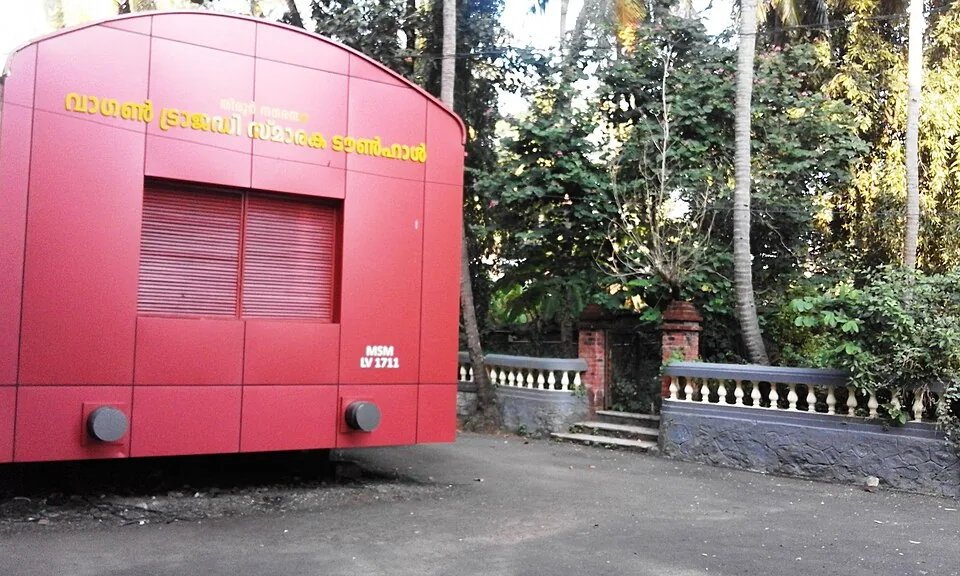
You come round the corner on Railway Station Road and there is a goods van standing at the roadside in signal red, two storeys of it, with buffers modelled on the corners and MSM LV 1711 lettered in white on the lower panel. It is not an exhibit. It is the town hall.
The night of 19 November 1921
The Malabar rebellion had begun in the Ernad and Valluvanad taluks that August and was being suppressed with mass arrests. By November the district jails were full, and about a hundred prisoners — peasants, of whom four were Hindus and the rest Mappila Muslims — were ordered moved 140 kilometres south to Podanur, near Coimbatore. The transport was ordered and supervised by Richard Harvard Hitchcock, District Superintendent of Police for Malabar.
Prisoners on this line were normally moved in open carriages. The van used that night was a closed one, wagon 1711 of the Madras and Southern Mahratta Railway, and the accounts describe its remaining gaps stopped with sand and wire and the body freshly painted over. It was coupled to a Madras-bound passenger train that left Tirur at about a quarter past seven in the evening, and it ran through Shoranur and Olavakkode to Podanur Junction, arriving around half past twelve.
When the doors were opened the men inside had asphyxiated. The survivors were carried out and sent on to Coimbatore, and more died there.
The numbers have never settled
English-language accounts give seventy dead — sixty-four in the wagon and six afterwards in hospital. Malayalam accounts more often give sixty-four as the official count and put the number of men shut in as high as a hundred and twenty-two. Centenary reporting described more than a hundred detained and sixty-four dead of asphyxiation; a newspaper account from 2018 gave sixty-seven of ninety. The date moves too, for a simple reason: the train left on the evening of the 19th and the doors were opened after midnight on the 20th.
What is not in dispute is the finding. An inquiry held that the maker of the wagon, the transport officer and the sergeant had all been negligent in using a closed van instead of an open one. All of them were acquitted.
One man wrote it down
Connolly Ahmad Haji came out of the wagon alive and published his account of it, titled simply Wagon Tragedy, in 1981 — sixty years later. The sentence of his that is always quoted is the moment he found out he was not dead: someone poured cold water into the wagon, his body shivered, and only then was he found to be alive.
What the town did about it
The bodies were brought back up the same line they had gone down. Forty-four were buried at the Korangath Juma Masjid and eleven at the Kot Juma Masjid, both within the town. The town hall was then built as the memorial, in the shape of the wagon — and so were libraries and school blocks elsewhere in Tirur, so the form recurs through ordinary civic architecture rather than standing once as a monument.
- The station is half a kilometre by road, three hundred metres in a straight line. It is the oldest working railway station in Kerala.
- The memorial statue stands a few paces from the hall.
- The two graveyards are places of worship in daily use. Visit them quietly and dressed for a mosque.
- There is no interpretation at any of it. Read first, or the hall is only an odd shape.
Still argued about
What the rebellion was is not settled. One reading holds it a peasant rising against British power and the landlord system that underwrote it, in which religion supplied the organisation rather than the motive; another holds it a communal outbreak that happened to be aimed at a colonial state. In August 2021, the centenary year, a committee of the Indian Council of Historical Research proposed removing 387 Mappila names from the national Dictionary of Martyrs of India’s Freedom Struggle on the second reading. Three years earlier a mural of the tragedy painted at Tirur station had been painted over within days after complaints. The town’s own position has never been in doubt: it built the memorial, and it holds the commemoration every November.
Frequently asked questions
What was the wagon tragedy?
On the evening of 19 November 1921 about a hundred Mappila prisoners were shut into closed goods wagon 1711 of the Madras and Southern Mahratta Railway at Tirur station and sent to Podanur because the Malabar jails were full. They asphyxiated on the way.
How many died?
The accounts differ. English sources give seventy — sixty-four in the wagon and six later in hospital. Malayalam accounts often give sixty-four as the official count and put the number of prisoners as high as a hundred and twenty-two.
Where are the dead buried?
Forty-four at the Korangath Juma Masjid in Tirur and eleven at the Kot Juma Masjid.