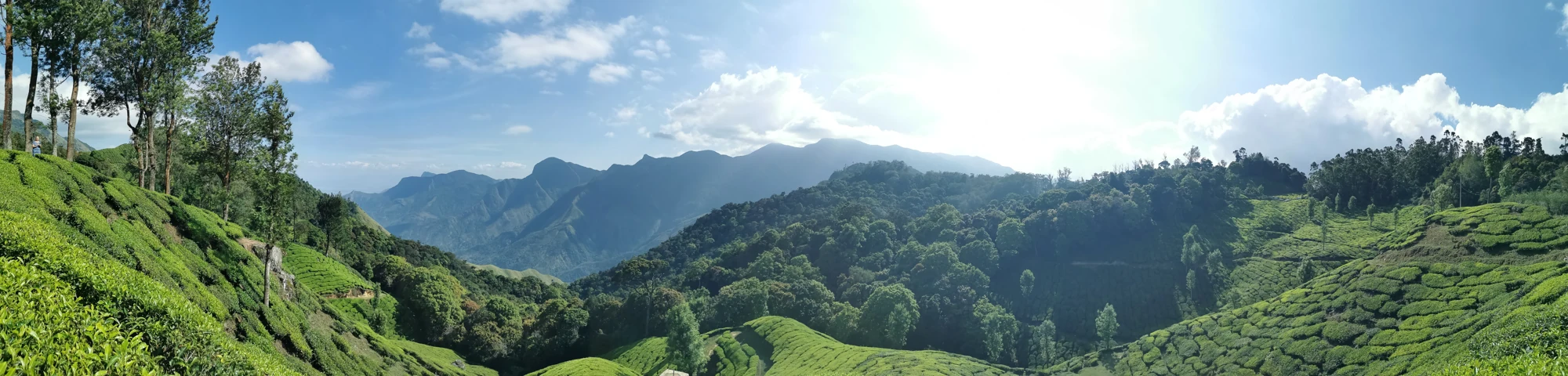
A station usually suggests a platform, a timetable and somewhere to board. At Top Station, the name survives in a landscape where visitors now arrive by road and walk towards a valley view. The missing railway is the reason to pause over the name. This was a transfer point in a journey made by tea, connecting the cultivated high ranges with the much lower country to the east.
Tea needed a route out of the hills
The tea slopes on the approach show only the first part of that journey. A crop grown in the uplands still had to leave them after processing. Moving a valuable load through sharply folded country was a practical problem: the straight line visible across a valley was quite different from a route that a loaded vehicle could follow. Top Station’s position on the highland edge made it a useful point for changing the means of transport.
Kerala Tourism’s account of the Kundala Valley Railway describes an early monorail carriage system assisted by bullocks, followed by a light railway in 1908. The sequence matters because photographs and retellings often compress different stages into one picturesque “old railway”. The railway was part of a changing goods network, built around the movement of tea rather than a sightseeing excursion.
Top Station and Bottom Station belonged to one journey
At the upper terminus, tea continued by ropeway towards Kottagudi, known in this transport story as Bottom Station. It then travelled onwards towards Tuticorin, now Thoothukudi, on the coast. The paired names described a relationship between two levels of the route. They did not identify neighbouring passenger stops separated by a short walk.
Look into the valley with that change of level in mind. Successive ridges interrupt the apparent descent, while the scale of the wooded slopes makes the engineering problem clearer. The view helps explain why a ropeway could serve the transfer. It does not establish the exact alignment of every cable or tower: a visitor should not identify an ordinary path or a piece of old metal as railway infrastructure simply because it lies nearby.
The flood that left a place name behind
The railway suffered devastating damage in the flood of 1924 and was not rebuilt. Kerala Tourism describes ropeway transport taking a larger role afterwards. The break between these stages is important. Saying that tea once passed through Top Station is sound; imagining the entire old network continuing unchanged until the modern road arrived would erase the disruption that altered it.
For a tangible continuation of the story, the Munnar Tea Museum interprets railway memorabilia, including a wheel associated with the former system. That is a separate town visit. At Top Station itself, the surviving connection is most immediately legible in the name, the tea-country approach and the abrupt difference between upland and valley.
Read the landscape in that order: cultivated slopes, transfer point, lower country. A viewpoint stop then becomes more than a search for a wide photograph. The same terrain that gives the visit its drama also explains why this place once mattered to the everyday business of moving tea.
History: Kerala Tourism’s Kundala Valley Railway account.
Plan the visit: Top Station.