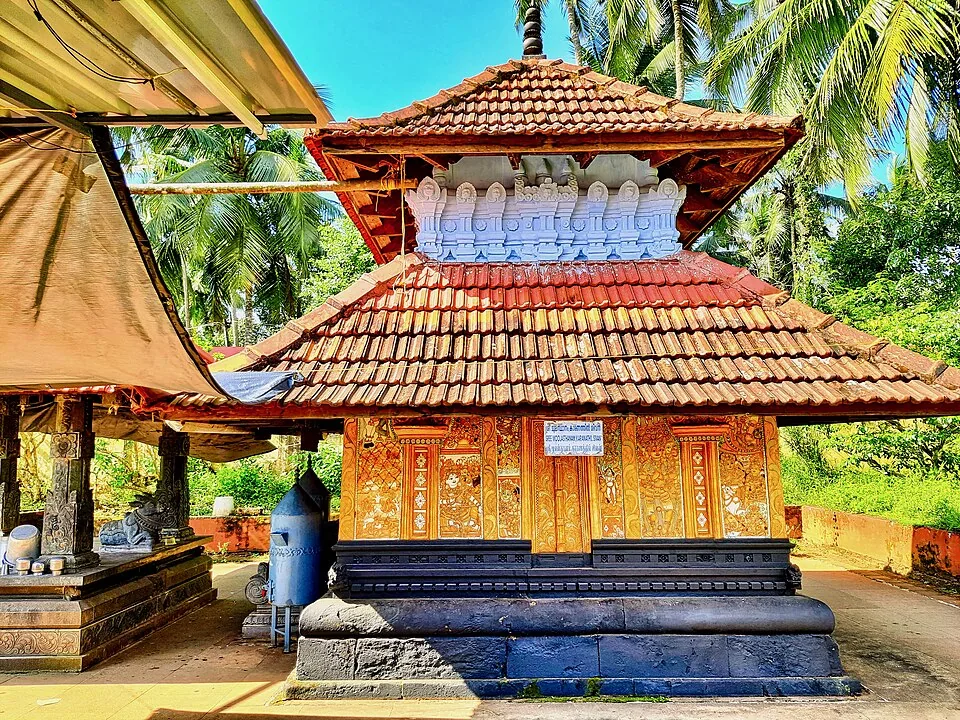
Kerala builds its Shiva temples facing east, towards the sunrise, almost without exception. Triprangode, eight and a half kilometres south of Tirur station on the Alathiyur–Codacal road, faces west. The tradition holds that the god turned that way to meet Death, and the temple was built facing the direction he turned.
The boy who was promised sixteen years
A sage called Mrikandu and his wife Marudvati had no child and did penance until Shiva offered them a choice: an ordinary son who would live a long and unremarkable life, or an exceptional one who would die at sixteen. They chose the second, and Markandeya was born.
The boy grew up devoted to Shiva and learned the Mahamrityunjaya mantra, the Rigvedic verse addressed to the conqueror of death and still recited across India for the sick and the dying. On the day he turned sixteen, Yama came for him. Markandeya ran to the temple and threw his arms round the linga, and when Yama’s noose came down it went round the stone and the boy together.
The linga split open with a roar and Shiva came out of it in a form of fire and struck Yama down with his trident. That form is Kalasamharamurti — the destroyer of time — and it is the name the photographic record of this temple is filed under. The gods then had to argue him out of it: with Death dead, nothing on earth would end, and they asked for Yama back. Shiva revived him.
So the temple commemorates a killing that was undone, which is why it is a place people come to when they are frightened for someone’s life rather than a place of triumph. There is no shrine to Yama anywhere in it.
What the enclosure holds
About six acres, with nine shrines in it. The main sanctum is a dvitala vimana — two storeys — on a gajaprishta plan, rounded at the back, facing west over a linga held to have appeared of itself. Four more Shiva shrines stand within the walls, one of them the Karanayil temple, whose own board names it Sree Moolasthanam Karanayil Sivan: the original seat, the place the deity was before the present temple existed. Three further shrines mark the steps Shiva is said to have taken to reach Yama, which is an unusual thing to build — the temple has laid out the choreography of its own legend in stone.
The detail worth slowing down for is in the timber and the plaster rather than the stone. The mandapam has a carved wooden ceiling coffered into panels with a rosette in each. There are Kerala murals on the shrine walls in the ochres, reds and whites of the tradition, and a white stucco frieze of small seated figures under the gables. A stone image of Shiva as Mrityunjaya carries damage from Tipu Sultan’s Malabar campaigns.
- Santhikkulam, where the priests bathe.
- Vellottukulam, out by the fields.
- The pond at the south-western corner, where the trident is said to have been washed.
- One in front of the Karanayil shrine.
- The large public pond on the north-eastern side.
How old it is
The fabric is described as ninth-century, and inscriptions of the later Chera ruler Goda Ravi Varma, of the tenth century, have been recovered from the site. A fifteenth-century Sanskrit messenger-poem, Uddanda Sastrikal’s Kokila Sandesha, already names Triprangode among the major destinations of this region — being on that itinerary five hundred years ago is a firmer statement of standing than any modern listing.
Frequently asked questions
Why does Triprangode face west?
Tradition holds that Shiva turned west to meet Yama when Death came for the boy Markandeya, and the shrine was built facing the direction he turned. Kerala Shiva temples are otherwise almost always entered from the east.
Is Triprangode the same as Trikkandiyoor?
No. They are two separate ninth-century Shiva temples about seven kilometres apart with different legends, and the names are confused constantly. Trikkandiyoor is east-facing and belongs to the Parasurama circuit.
How far is it from Tirur?
8.8 km by road from Tirur railway station, on the Alathiyur–Codacal road. The figure usually published is ten kilometres.