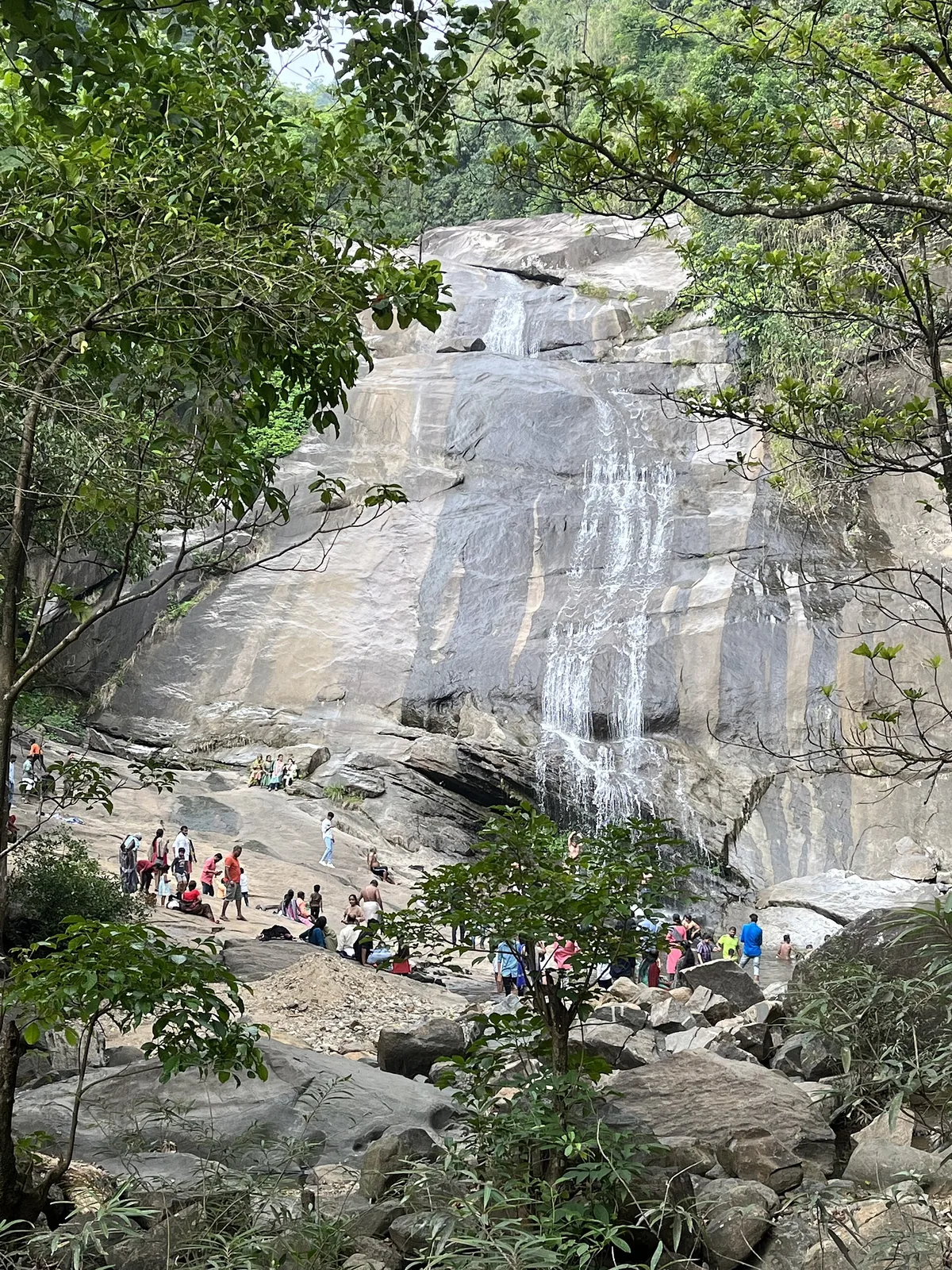
Most people come to Tusharagiri for falling water and leave having seen only falling water. This is a shame, because the falls are the least reliable thing about the site — dry in a hot April, dangerous in a heavy June — while the forest they sit in is interesting in every month of the year. The clearest demonstration of that arrives in early July, when the trees around the eco-tourism centre and the neighbouring smallholdings start producing fruit in the wrong place: not at the tips of branches, but in dense red clusters hanging directly off the trunks.
A tree that fruits on its own trunk
The tree is Baccaurea courtallensis, known in Malayalam as mootipuli or mootippazha, an evergreen species of the Western Ghats. The habit that gives it its name is cauliflory — flowering and fruiting on the woody trunk and main stems rather than on new growth. It is common enough in wet tropical forests worldwide and startling every time you see it, because it inverts the shape a tree is supposed to have. A mature mootipuli in season looks as though someone has garlanded it. Under a thick red skin the fruit holds translucent white segments, and the taste runs sweet and sour at once.
In July 2026 Kerala’s press reported the mootipuli in heavy fruit right across the Thusharagiri eco-tourism area and the farmland around it, drawing visitors specifically to look at and photograph the trees. The report named the places the fruiting was best around — the Irattumukkam, Mazhavilchattam and Thumbithullumpara falls, and Thonikkayam — which is a useful reminder that the site’s named points are as much forest landmarks as water ones. It also noted the going rate for the fruit in the forest areas of neighbouring Karnataka, quoted by officials there at ₹150 a kilogram.
The fruit is not only a curiosity for tourists. Langurs, macaques and bears eat it, which is a fair summary of who else is using this forest. It has long been eaten by Adivasi communities and by people working the forest, and has more recently found a following among hill-area households for its digestive properties. A wild fruit that is simultaneously a bear food, a traditional food and an emerging local commodity is a good short lesson in what a Western Ghats forest edge actually is — not a wilderness with people looking in from outside, but a shared resource with many claimants.
Butterflies on wet stone
The insect life is easier to see and, for a patient visitor, more rewarding. Damp rock and wet sand beside the Chalippuzha attract mud-puddling butterflies, which gather at the edge of drying pools to take up salts and minerals — swallowtails especially, in mixed groups, wings half-open on the wet stone. Photographs of exactly this behaviour at Tusharagiri have been freely licensed since 2016, categorised under the Papilionidae of Kozhikode district. If you find a patch of wet sand near the lower fall on a bright morning after rain, stand still for two minutes before you decide there is nothing there.
The Malayalam Wikipedia entry for the falls credits the surrounding forest with around forty-five butterfly species, and mentions the Travancore Evening Brown among them, a Western Ghats endemic once thought lost for decades. That specific claim needs care: the well-documented rediscovery of Parantirrhoea marshalli, after Fraser’s 1930 record, was made in the Periyar Tiger Reserve area in the early 1990s, several hundred kilometres to the south, and we could not find a published record placing it at Tusharagiri. Treat the species list as local enthusiasm rather than a checklist, and the general point — that this is a genuinely butterfly-rich forest edge — as sound.
The grandmother tree, and how numbers grow
The most-photographed living thing on the site is a tree with a hollow trunk, known as the Thanni Muthassi, the Thanni Grandmother — a Terminalia bellirica, the bedda nut tree, big enough at the base for three people to sit inside. The entrance signboard marks it at 150 metres from the gate, closer than any of the waterfalls, and it is worth the two-minute detour. Its age, though, is a small case study in how numbers grow: Kerala Tourism’s eco-tourism page describes it as believed to be 400 years old, while the contributor who photographed it in 2011 described it as roughly 120. Nobody appears to have cored it.
Why the biodiversity is here
Around all of this sits the real reason: the site is a boundary. Below the gate is eighty years of smallholder rubber, pepper and nutmeg; above it, evergreen forest running east towards the Vellarimala ridge and the Wayanad plateau. Forest edges are disproportionately rich in species because they hold both communities at once, and they are also disproportionately fragile, because they are where the clearing stops for now rather than where it stopped forever. Standing at Tusharagiri you are standing on that line.
It changes how you use a visit. If you have come only for the water, your trip is hostage to the month and the rainfall, and roughly half the year will disappoint you. If you have come for the forest, the calendar opens up: mootipuli in early July; butterflies on wet rock through the post-monsoon; birds, langurs and the shifting sound of the canopy at any time; the Thanni tree whenever you like. The falls become the best of several things on offer rather than the only one.
It also changes how you behave. This is a Forest Department eco-tourism site with a ticket, hours of roughly 8am to 4pm, and staff, precisely because the forest needs managing against the number of people who want to be in it. Take your litter out. Do not pick the fruit — it is somebody’s crop or somebody’s bear’s dinner. Do not play music. Keep to the path, both because leaving it damages the understorey and because the leeches in the wet months are extremely good at their job.
Kerala has a great many green cascades and photographs of most of them look identical. What distinguishes Tusharagiri is not its water, which is unremarkable and sometimes absent, but the specific piece of Western Ghats forest edge it gives you access to for thirty rupees: a cauliflorous endemic fruiting off bare trunks, swallowtails on wet stone, a hollow bedda nut tree of disputed age, and bears somewhere further up eating the same fruit the tourists are photographing. Come in early July and you will see the point.
Frequently asked questions
What is the mootipuli, and when does it fruit?
Baccaurea courtallensis, a Western Ghats evergreen that fruits cauliflorously — in dense red clusters straight off the trunk and main stems rather than at the branch tips. Early July is the season, and in July 2026 it was reported in heavy fruit across the Thusharagiri eco-tourism area. Langurs, macaques and bears eat it, as do local households.
How old is the Thanni Muthassi tree?
Nobody knows, and the published figures disagree sharply. Kerala Tourism’s eco-tourism page calls it around 400 years old; the contributor who photographed it in 2011 put it at roughly 120. It has not been cored. What is not in dispute is the size: the hollow base will seat three people, and it stands 150 metres from the gate.
Is it worth visiting when the falls are low?
Yes, if you come for the forest rather than the water. This is a forest edge — plantation below the gate, evergreen forest above it — which makes it unusually species-rich. Mud-puddling swallowtails gather on wet rock after rain, the mootipuli fruits in early July, and the Thanni tree is there in any month.