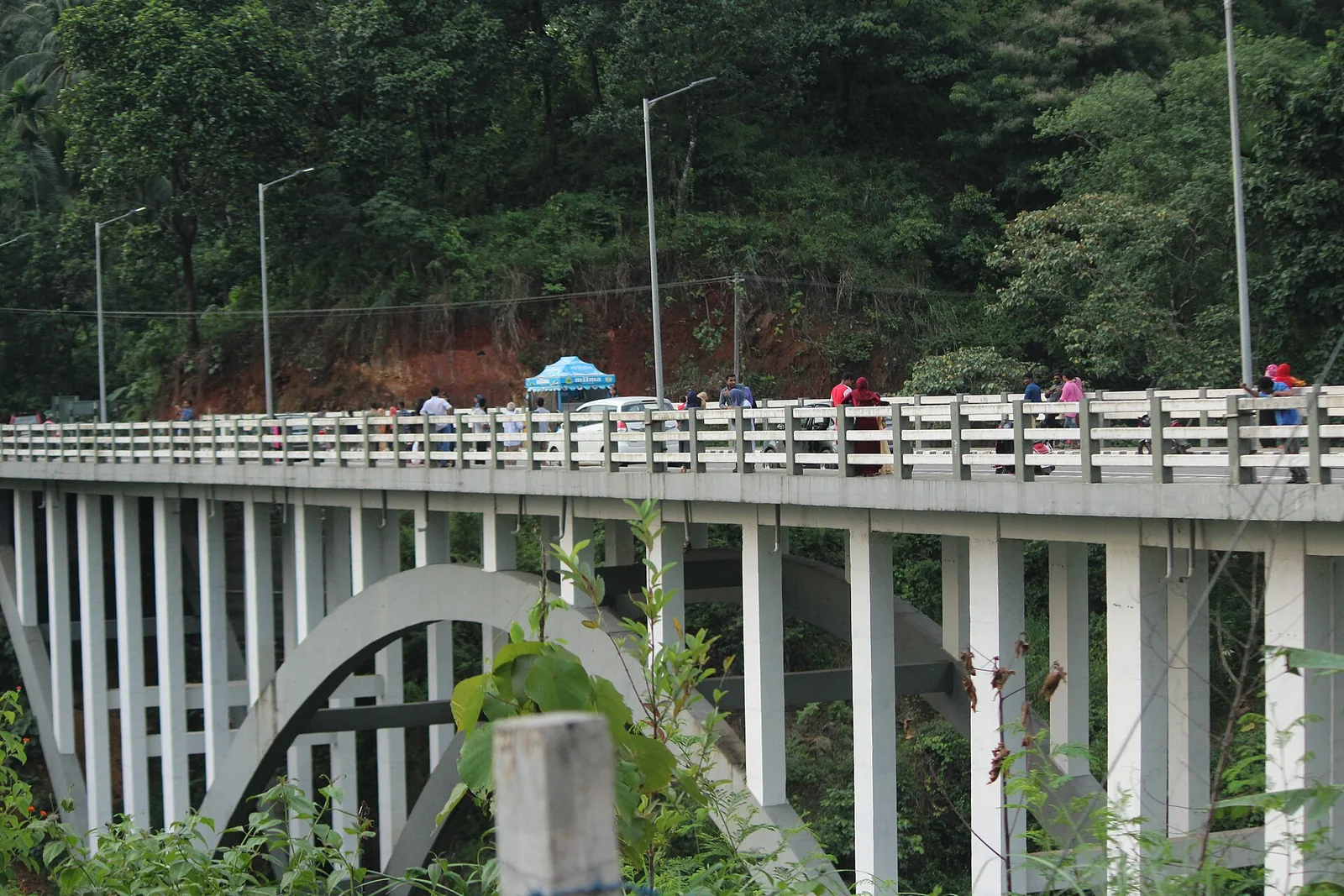
The last half-hour of the drive to Tusharagiri is the part most visitors treat as filler. Past Thamarassery the road climbs into a green corridor of smallholdings — rubber in rows, pepper vines trained up support trees, nutmeg, arecanut, ginger under shade — punctuated by churches, small schools and roadside co-operative societies. It looks timeless in the way that intensively worked tropical countryside always does. It is not. Almost everything in that corridor was made within living memory, by people who arrived here on purpose, and knowing who they were makes the drive far more interesting than the destination signage suggests.
The Malabar migration
From the early 1940s onwards, Syrian Christian families from central Travancore — Kottayam, Pala and the surrounding taluks — began moving north into the forested highlands of Malabar. The pressure behind it was agrarian rather than religious. Land in the south had become scarce and expensive, holdings were being subdivided among heirs until they could not support a family, and the Malabar hills offered forest land at a fraction of the price. A household head who could not leave land to his sons at home could buy enough of it here to leave several.
The dates are unusually well remembered in this particular valley. Local histories record the first migration into Thiruvambady, immediately adjacent to Kodencheri, as beginning in 1942, led by three lawyers from Kottayam district — Joseph Vakeel, K. C. Ninan and Shouryar Mathan. A church followed in 1944, and an upper primary school in 1947. That sequence — land, then church, then school, in about five years — repeated itself across Kodencheri, Koodaranji, Pulloorampara and the surrounding settlements, and it is the reason the road network here radiates from parish centres rather than from older market towns.
Why rubber
It was hard country to take on. The highlands were forest, and clearing them meant felling, burning and planting in ground that had never been cultivated, in a malarial belt, without roads or electricity. The early accounts of the migration are full of failed first seasons, illness, and families who went back. What made those who stayed successful was the crop choice. Rubber, planted young and tapped for decades, turned cleared forest into a long-term income in a way that annual crops could not, and Kerala’s tenancy reforms and the post-war rubber price gave the settlers a stability that the first arrivals had no reason to expect.
That decision is written on the hillsides today. This belt is now among the significant rubber-producing parts of Kozhikode district, and the pattern is one of smallholdings rather than estates — a few acres each, worked by the family that owns them, with rubber as the backbone and pepper, nutmeg, ginger, arecanut and cardamom filling the gaps. It is a very different agricultural landscape from the plantation districts of Idukki or the Nilgiris, where large corporate estates dominate, and it produces very different scenery: fragmented, domestic, close to the road, with a house every few hundred metres.
Three things that follow for a visitor
The first is that the greenery on the approach is not forest, whatever it looks like at speed. Real evergreen forest begins above the falls and is administered by the Forest Department; the green below the gate is a crop, and walking into it means walking into somebody’s plot. The second is that this is one of the best places in Kozhikode district to see spice agriculture at ordinary human scale, from the car window, without paying for a plantation tour.
The third is subtler and has to do with the falls themselves. A destination inside a settled agricultural valley behaves differently from a destination inside a forest. Tusharagiri has a ticket gate, a welcome hall, a car park and tea stalls because there are four panchayats’ worth of people living within a few kilometres who have an interest in the visitors. When Kerala Tourism announced its second development phase for Thusharagiri on 1 February 2007 — ₹8 crore, following an earlier ₹85 lakh — the named beneficiaries were exactly those panchayats: Kodancherry, Puthuppadi, Thiruvambadi and Koodaranji. Eco-tourism here was designed as a local income stream, not as an intervention in an empty landscape.
The same history explains the calendar of the valley. The busiest months at the falls are the post-monsoon and winter ones, which are also the months when the plantations are least demanding; the Christian festival calendar sets the rhythm of the villages you drive through; and the parish churches, several of them now large and modern, are the most conspicuous public buildings for kilometres. A visitor arriving expecting a purely Hindu or purely tribal Western Ghats hinterland will find something considerably more layered — a Christian agrarian frontier settlement, eighty years old, sitting on top of much older forest and forest-edge country.
The other face of it
It is worth being honest that this history has a second face. The Malabar migration was a clearance as well as a settlement. Forest that had supported Adivasi communities and a much lighter human footprint became cash-crop land within a generation, and the ecological and social consequences of that transformation across the Western Ghats have been argued over ever since — most sharply since the Gadgil and Kasturirangan reports, and more sharply again since the landslides of recent years in the hills immediately east of here. None of that is a reason not to visit. It is a reason not to describe the drive as untouched.
The valley’s next transformation is already under way, and it is the same kind of thing: infrastructure remaking access. The Anakkampoyil–Kalladi–Meppadi tunnel on State Highway 83, begun in 2025 with a target of 2029, will connect this side of Kozhikode district to Wayanad without the Thamarassery ghat, cutting the Anakkampoyil–Meppadi distance from around 42 kilometres to under 20. Whatever else that does, it will put a great deal more traffic through a valley that eighty years ago had no road worth the name.
So give the approach the attention it deserves. Slow down through Kodencheri, look at how the pepper is trained, notice the dates on the church foundation stones, and register that the oldest of them is younger than most of the buildings in Kozhikode city. Tusharagiri’s rock is hundreds of millions of years old. Nearly everything else you pass on the way to it was made by people who arrived after 1942.
Frequently asked questions
How old is the plantation landscape around Tusharagiri?
Barely eighty years. It was created by the Malabar migration, in which Syrian Christian families from central Travancore moved north into these forested highlands from the early 1940s in search of affordable land. Local histories date the first party into neighbouring Thiruvambady to 1942, with a church in 1944 and a school in 1947.
Is the green on the drive up actually forest?
Mostly not. Below the eco-tourism gate it is smallholder cash crop — rubber above all, with pepper, nutmeg, ginger, arecanut and cardamom — worked in plots of a few acres by the families who own them. Genuine evergreen forest begins above the falls and is administered by the Forest Department.
Why does Tusharagiri have a ticket gate and facilities?
Because it sits inside a settled agricultural valley rather than an empty one. The eco-tourism operation was designed as a local income stream: when Kerala Tourism announced a second development phase on 1 February 2007, worth ₹8 crore after an earlier ₹85 lakh, the named beneficiaries were the four surrounding panchayats — Kodancherry, Puthuppadi, Thiruvambadi and Koodaranji.