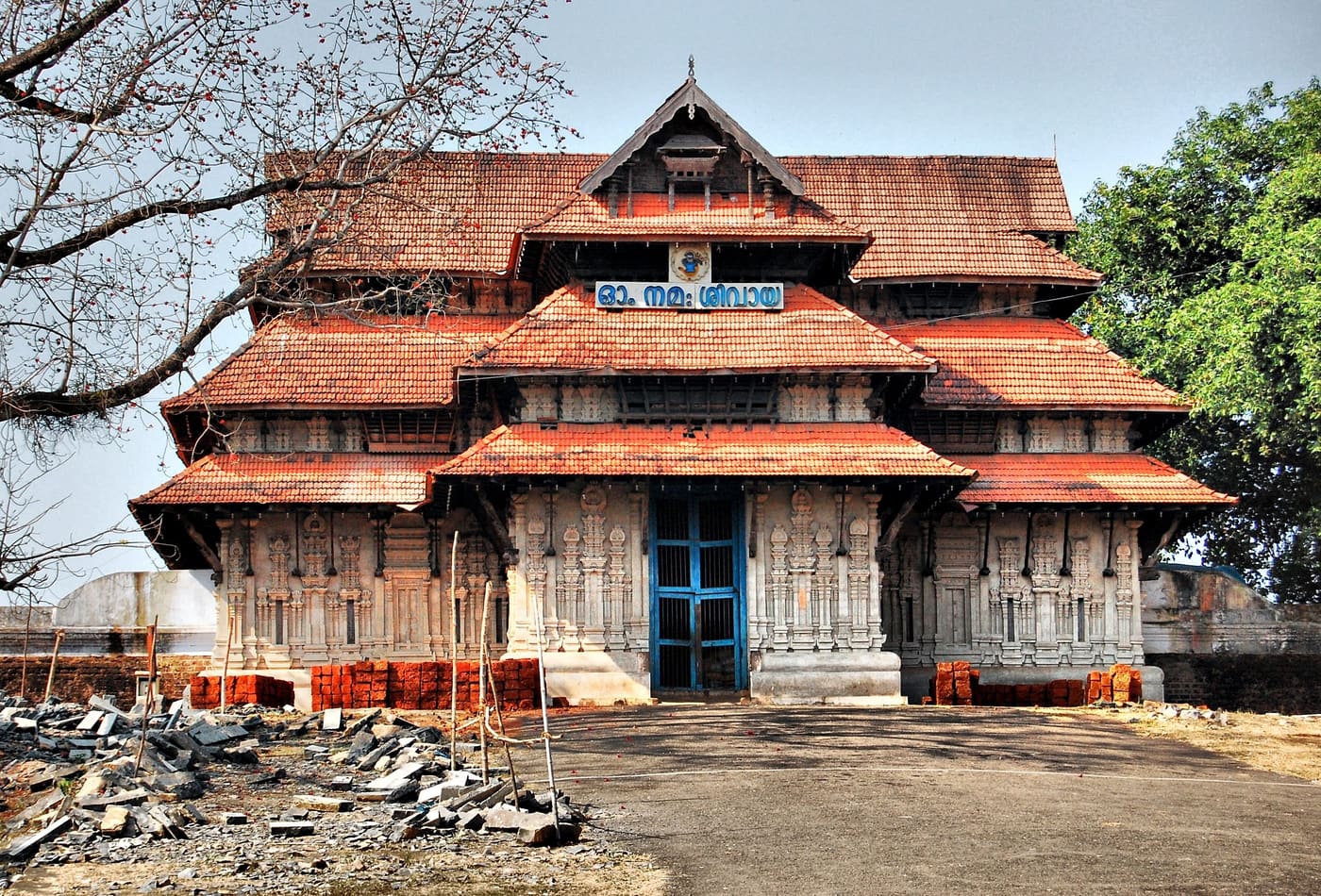
Every road into Thrissur ends up bending around the same green hill, because the city's ring road was drawn around it. Inside that ring, behind a wall that encloses nine acres of trees, stands the Vadakkunnathan temple. Once a person walks through its gate the traffic of the Swaraj Round fades behind them. Kerala Tourism calls it one of the oldest temples in Kerala and one of the largest Shiva temples in the state. The whole city of Thrissur faces inward towards it.
The reason it holds that place begins with a legend about the land itself. Kerala Tourism records the belief that the temple was created by Parasurama, the figure credited with reclaiming Kerala from the sea. So the shrine on the hill is tied to the story of how Kerala came to exist at all. That is why Thrissur treats the temple as its starting point, and why the Thekkinkadu Maidan that surrounds it became the ground for the city's greatest festival.
The temple itself is built only of wood and stone, in the typical Kerala style. That choice of materials is what makes it feel so different from the concrete city outside. Its woodwork is intricately carved, and its murals show scenes from the Mahabharata, so archaeologists and historians come here as much as devotees do. Inside the walls there is also a Koothambalam, the traditional temple theatre of Kerala, where the temple once staged its performing arts.
Wood and paint do not survive centuries on their own, and that is where the temple's modern story begins. A team of archaeologists, craftsmen and artisans worked for more than ten years to restore it, under the guidance and control of the Archaeological Survey of India. They kept the original structure intact, restored the murals, sculptures and woodwork using only organic materials, and followed the same rituals, methods and techniques that the first builders used. Kerala Tourism's October 2016 newsletter reported that this work won the Award of Excellence at the UNESCO Asia-Pacific Awards for Cultural Heritage Conservation. That is why the temple stands today restored to its old glory.
Because it is a living temple rather than a museum, the year inside the walls follows the rituals. In the month of Karkidakam, in June and July, the temple holds the Anayoottu, a feast for elephants on the temple grounds. The chief priest offers the elephants rice, ghee, coconut, jaggery and sugarcane, in the belief that worshipping Ganesha, the elephant-faced god, removes obstacles from life. Thousands of devotees come to watch the elephants eat.
Those same grounds hold the temple's annual festival, the Thrissur Pooram, which Kerala Tourism calls the king of all temple festivals. Every April or May, ten temples led by Thiruvambadi and Paramekkavu bring their deities on caparisoned elephants to Vadakkunnathan. Lakhs of people gather on the ground to see the parasols change and hear the Ilanjithara Melam. For one day and night the quiet hill becomes the loudest place in Kerala, and then it goes back to being a walled grove in the middle of the traffic.
On an ordinary day the temple keeps its own hours. Kerala Tourism lists them as 4 am to 11 am and 5 pm to 8.30 pm. So devotees come early in the morning or in the evening, and the hours between are when the hill is left to the trees. Many visitors then walk out across the maidan to the rest of the city, to the Shakthan Thampuran Palace or to the Basilica of Our Lady of Dolours, both within reach of the Round.
The temple also gave Thrissur its other great day, because the Pulikali tiger dancers of Onam begin by offering coconuts to Ganesha here before they take the Swaraj Round. So the hill that Parasurama is said to have founded sits at the centre of the city's sacred calendar and its street festival alike. The Thrissur city guide shows how to spend a day walking out from it. The temple page for the Vadakkunnathan temple gathers the rest.
Frequently asked questions
Who built the Vadakkunnathan temple?
Tradition holds that it was created by Parasurama, who is credited with reclaiming Kerala from the sea.
What are the Vadakkunnathan temple timings?
Kerala Tourism lists 4 am to 11 am and 5 pm to 8.30 pm.
Why did the temple win a UNESCO award?
A restoration of more than ten years, guided by the Archaeological Survey of India, won the Award of Excellence at the UNESCO Asia-Pacific Awards for Cultural Heritage Conservation.
What is the Anayoottu?
A feast for elephants held on the temple grounds in Karkidakam, June and July.