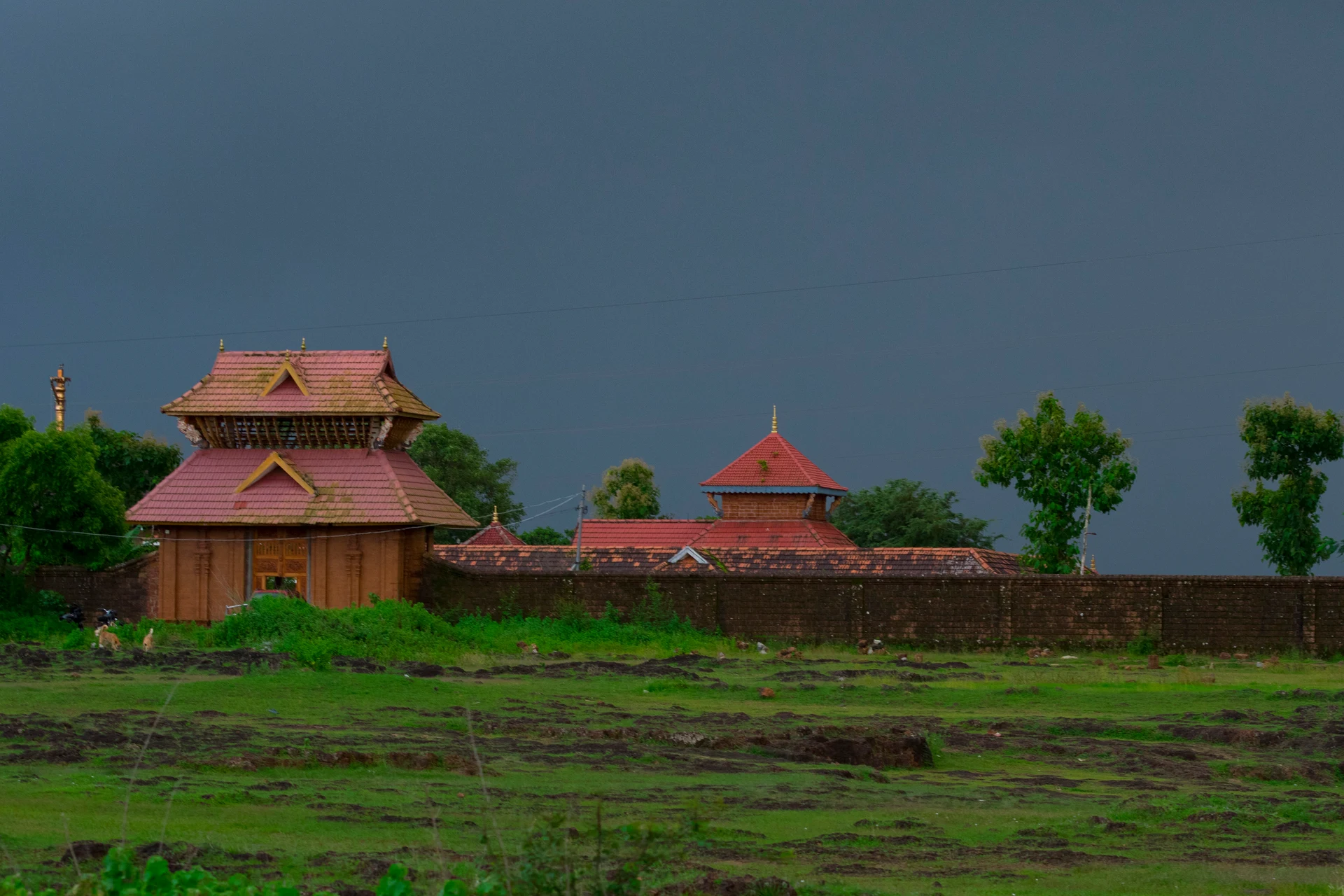
Vadukunda’s enclosure is low enough that the landscape remains present around it. Red-brown laterite walls, tiled roofs and a flagstaff stand against the open ground of Madayipara. In wet-season photographs, grass and shallow water occupy the plateau outside. In a December view, the same wider landscape carries golden grass beneath a clearer sky. The temple’s setting changes markedly without the temple moving at all.
Look down as well as towards the horizon
The plateau surface is a patchwork. Exposed dark rock lies between thin grass, small plants and water-filled depressions. Kerala Tourism’s photographs make this texture visible at walking scale. The apparent openness is not a guarantee of a smooth path: holes, wet rock and uneven ground interrupt it, particularly away from established approaches.
That surface helps explain why the temple’s enclosure feels distinct. Built laterite blocks create a deliberate boundary within a landscape where laterite is also exposed underfoot. Roofs and carved entrances provide a concentrated architectural focus against a much more horizontal setting. From outside, one can read the difference between the shrine precinct and the wider plateau without entering every open patch of ground.
One temple pond, several kinds of water
Vadukunda pond is a named feature beside the shrine, with its own role in the temple’s festival tradition. Elsewhere on Madayipara, Kerala Tourism identifies a well and another rock pond. Seasonal puddles lie across the grass in wet-weather photographs. These are different features, not interchangeable illustrations of the temple pond.
The distinction matters both culturally and practically. A ritual pond has a specific association with the shrine. A well has a deep opening and a different hazard. A shallow-looking rain pool may conceal broken rock or soft ground. Looking at water from a firm path lets its place in the landscape become clear without treating every reflective surface as an invitation to step closer.
The view opens towards the river country
From parts of the plateau, the view extends over the Pazhayangadi river landscape, coconut-covered settlement and transport lines below. The contrast is striking: open laterite above, a much more densely vegetated and settled scene beneath. It explains how a temple near a busy coastal town can still have an exposed, spacious setting.
A photograph of that panorama should be understood as context for the Madayipara visit, not as a view guaranteed from the sanctuary door. Different edges of the plateau face different directions, and rain or haze can close the distance. Choose a clear established vantage rather than walking towards an unprotected edge simply to reproduce a distant photograph.
History occupies more than one site
Kerala Tourism also identifies the remains of Madayi Fort on the wider plateau. Low wall fragments and an old well belong to that separate historical setting. They broaden a Madayipara visit, but they do not establish the age of Vadukunda’s reconstructed temple walls. Nearby remains and a living shrine can share a landscape while requiring different historical explanations.
This is the reason to keep the temple as the first, named destination. Begin at its entrance, understand the enclosure and pond, then decide whether weather and available time allow a wider plateau walk. That sequence keeps a pilgrimage visit from dissolving into an unstructured search across open ground.
Let the season change the visit
A wet-season visit emphasises green growth, shallow pools and cloud. A drier visit makes the exposed rock and grass colour more prominent. Neither is the single authentic appearance of Madayipara. Stay on existing approaches, avoid trampling small flowering patches and keep the return route visible when weather closes in. The setting rewards attention to small surfaces as much as to a sweeping view.