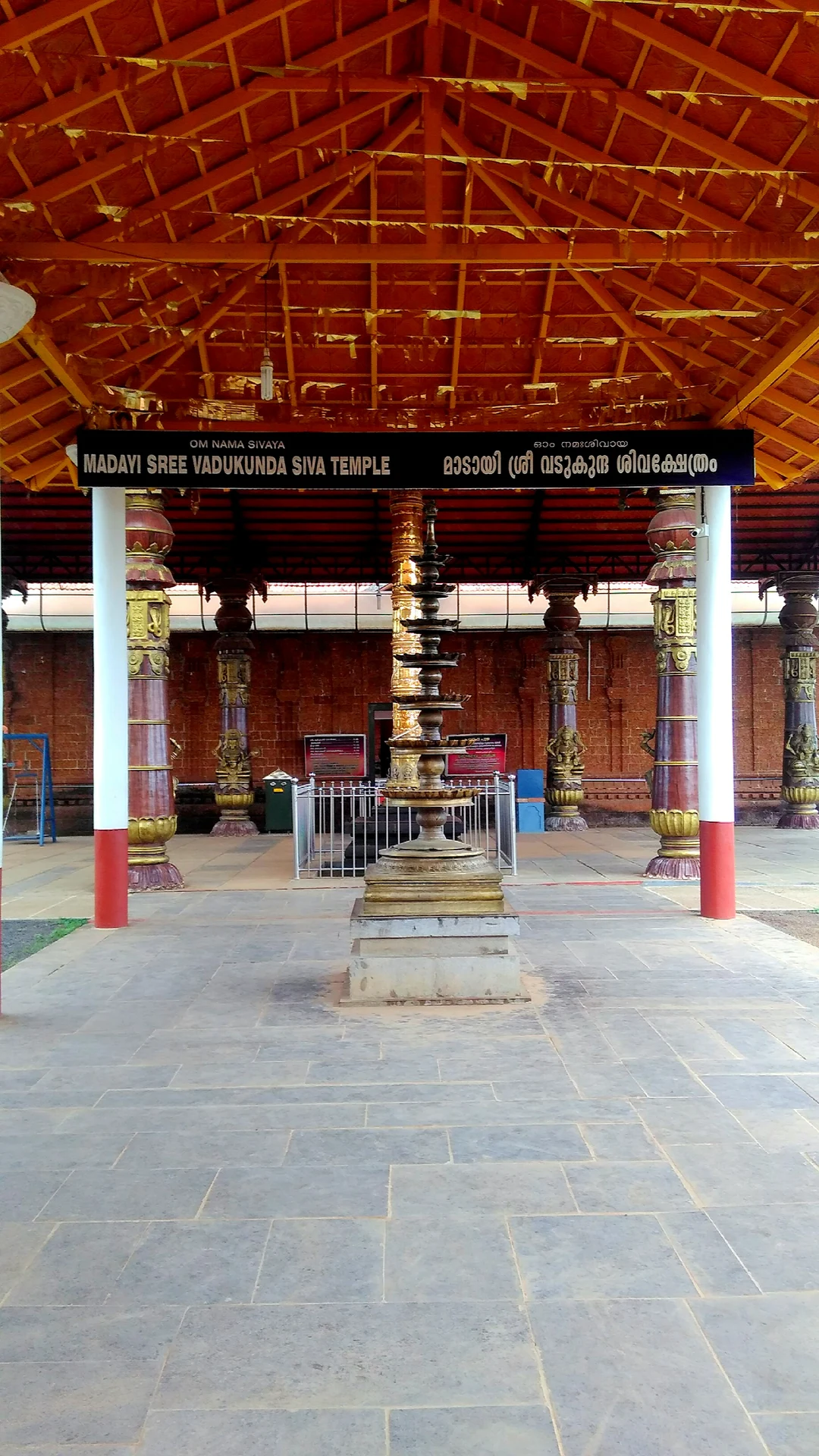
The tall flagstaff outside Vadukunda’s tiled porch and the pond beside the enclosure are not unrelated scenic details. The temple community’s festival account connects the annual celebration with a flag-hoisting and a concluding ritual bath. Reading the site through that sequence makes the pond part of the temple’s ritual geography, while leaving its water firmly outside the category of a visitor swimming attraction.
The calendar follows Dhanu Thiruvathira
The archived temple account describes the main festival beginning on Thiruvathira in the Malayalam month of Dhanu, around December or January. It gives a duration of eight days, with the deity’s ritual bath on the eighth morning. A date expressed through a Malayalam month and star does not correspond to one fixed Gregorian date every year.
Anyone travelling specifically for the festival therefore needs the temple’s current annual programme. The historical description explains the pattern, but it is not a timetable for the next celebration. Nor does an image of a previous procession establish which performances or arrangements will recur in a particular year.
Movement beyond the sanctuary
The account names processions, special rituals, Thidambu Nrutham and Pallivetta among the festival observances. These descriptions point to a temple life that extends beyond a quiet view of the sanctum. At festival time, the spaces around the porch and along procession routes serve movement, gathering and ritual. A position that is unobtrusive on an ordinary afternoon may obstruct the programme when a procession begins.
The flagstaff is an especially useful visible anchor for this understanding. It rises above the lower rooflines and stands on the approach axis. The ceremonial beginning described in the account gives that vertical element a role beyond decoration. A visitor does not need to approach restricted ritual areas to notice its relationship to the porch and courtyard.
The pond has its own significance
The community’s account identifies Vadukunda pond as the place of the deity’s holy dip. Kerala Tourism separately maps and photographs it beside the temple. Its broad surface and rocky margins belong to a plateau where rainwater also appears in shallow seasonal hollows. The temple pond should not be confused with every other water-filled depression on Madayipara.
The description of a sacred bath concerns a ritual performed under temple arrangements. It does not authorise recreational bathing, establish safe depth or provide a maintained route into the water. For an ordinary visitor, the appropriate experience is to look from firm ground without entering the pond or crowding its edge.
Other observances remain distinct
The archived calendar also describes Shivaratri and commemorates the consecration following renovation on 8 May 1992. These are different occasions from the eight-day Dhanu festival. A visitor searching for “Vadukunda festival” may encounter material about any of them; the event name matters as much as the temple name.
The account explicitly distinguishes Madayikavu’s Pooram from Vadukunda’s annual celebration. Both contribute to the wider sacred landscape of Madayi, but their programmes cannot be exchanged. Keeping the shrine and occasion together avoids arriving for a ceremony that belongs elsewhere on the plateau.
Visiting within the rhythm of worship
An ordinary visit can focus on the entrance gate, porch, flagstaff and pond as separate but related spaces. During a celebration, follow the temple’s directions about where to stand and when to move. Photography should yield to worship, and a request at the gate is more useful than assuming permission from the existence of festival photographs online.
Sources and further reading
Temple community’s archived festival account