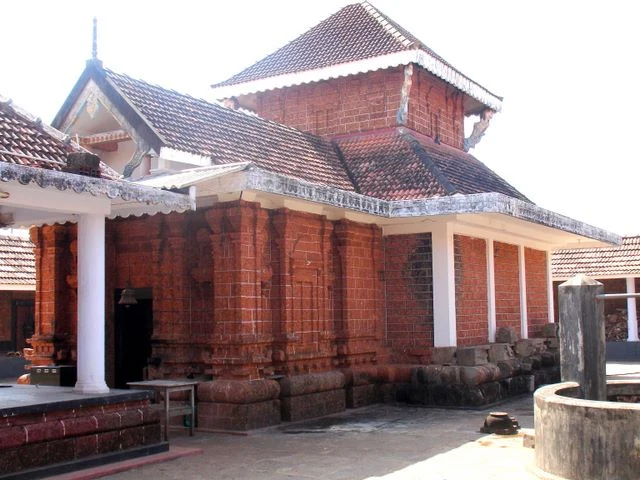
“Vadukunnu Siva Temple” is the name used in this place-page route. In the temple’s own historical material and Kerala Tourism’s Madayipara guide, the destination is Madai Sree Vadukunda Shiva Temple. The location is the laterite plateau at Madayi near Pazhayangadi in Kannur district. That combination of name and place is essential: this is not Thrissur’s Vadakkunnathan Temple.
Use the landscape as a second identifier
Kerala Tourism identifies the temple, its entrance gate and its pond as separate mapped points on Madayipara. The gate has carved doors under a tiled roof, while the shrine lies within a laterite-walled enclosure. The pond is a further feature beside the temple rather than the whole destination. Asking for Vadukunda at Madayipara gives a driver more useful information than the word Shiva alone.
The temple’s landscape also distinguishes it from nearby Madayikavu. Both belong to the wider cultural geography of Madayi, but they are different shrines. A festival reference to Madayikavu should not silently become a programme for Vadukunda, and a photograph of one temple should not stand in for the other.
A reconstruction with named dates
The temple community’s archived renovation account describes a local committee formed in 1979 to rebuild the shrine. Its festival account records the consecration on 8 May 1992 after an eleven-day kalasam, in the presence of Kattumadom Thantri. These dates offer a firmer chronology for the modern building than an undated claim that the whole visible complex is ancient.
The same account attributes an earlier destruction to attacks associated with Tipu Sultan’s forces during the late eighteenth century. It presents that explanation as belief. It should remain a reported community tradition rather than being converted into a precisely dated, independently documented military event. The modern reconstruction can be described concretely without pretending that every earlier episode has the same kind of evidence.
Sacred tradition and material history
The temple’s legend connects the site with the Kolathiri rulers and describes Shiva here as swayambhu, or self-manifested. Such traditions explain how devotees understand the sanctity of the place. They are not archaeological measurements of the age of a linga or a foundation wall. Ganapathy and Ayyappa also appear in the temple community’s account of the shrine.
Looking around, keep the material questions separate. Laterite blocks, tiled roofs, a pillared porch and a flagstaff can be described from the visible building. Their arrangement provides a way to appreciate the reconstructed complex. It does not prove that every component occupies an unchanged position from the period recalled in the legend.
Administration is more specific than a board label
A Kerala High Court judgment of 21 May 2025 identifies Vadukunda as one of the Chirakkal Kovilakam Devaswoms within the Malabar Devaswom framework. The proceedings discuss the hereditary trustee, the renovation committee, an executive officer’s financial responsibilities and appointments of non-hereditary trustees. That is a layered institutional relationship.
For visitors, the useful consequence is straightforward: current ritual and entry questions belong with this temple’s administration. An old community website remains valuable for the reconstruction chronology, but its archived telephone numbers or timetables should not be treated as a current booking service. Carry the precise temple name and locality, and read the arrangements at the entrance as those of a living shrine.
Sources and further reading
Kerala Tourism: Madayipara and named temple locations