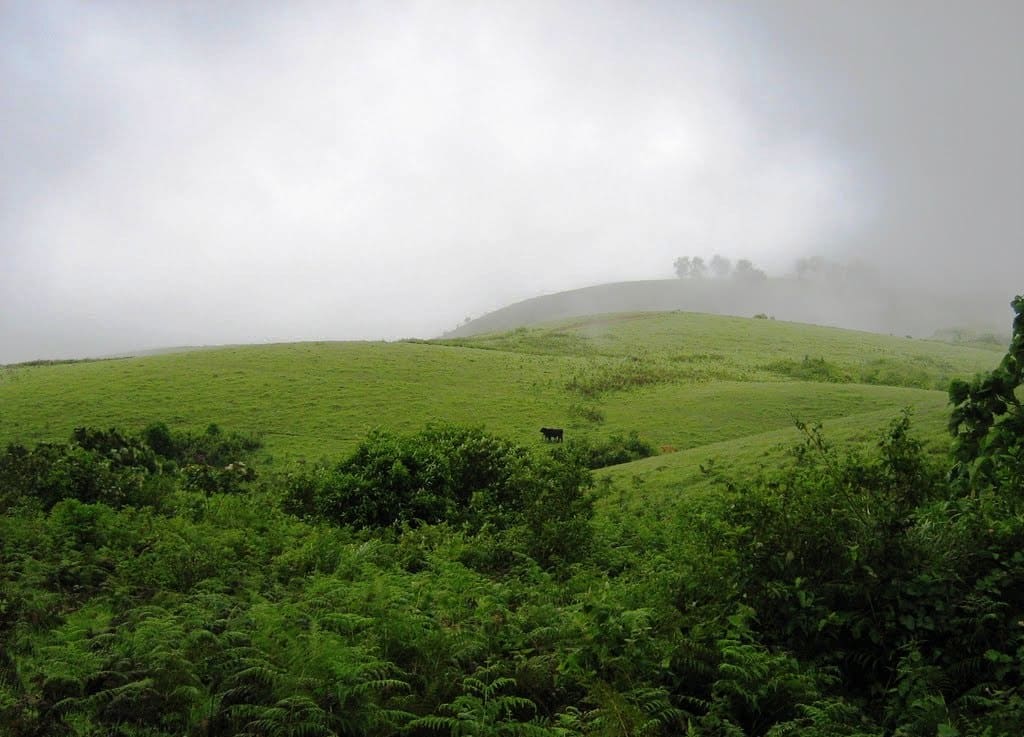
Mist moves over Vagamon the way tide moves over sand — filling the grassy hollows, then draining away to reveal tea rows and pine. This small hill town on the Idukki–Kottayam border sits high in the Western Ghats, around 1,100 to 1,200 metres up, where the air stays cool the year round. What sets Vagamon apart from Kerala's other green retreats is not just the meadows. It is a trio of neighbouring hills that, over roughly a century, came to hold a Christian ashram, a Muslim saint's rock and a Hindu temple — three faiths sharing one ridge of sky.
Three hills, three faiths
Locals speak of Vagamon's hills as a set: Kurisumala for the Christians, Thangal Para for the Muslims, and Murugan Mala for the Hindus. They stand within sight of one another, so that from the saint's rock you can pick out the cross on the far peak and the temple hill beyond. None of this was planned as an interfaith gesture; each site grew on its own timeline, drawn to the same high, quiet ground. Yet the result is a landscape where pilgrims of three traditions climb the same misty slopes, and where the meadows below carry no single creed at all.
Kurisumala: the mountain of the holy cross
Kurisumala means the mountain of the holy cross. Its ashram was founded near Vagamon on 21 March 1958 by Francis Acharya — born Jean Richard Mahieu in Ypres, Belgium — a Cistercian (Trappist) monk who had received permission from his abbot in 1955 to begin a monastic foundation in India. He was joined in the early days by the English Benedictine Bede Griffiths, and the community was consciously dedicated to the encounter between Christian monasticism and Indian spiritual tradition, blending Syriac liturgy with an Indian ashram style of life. The monastery later became an independent Cistercian abbey in 1998. In 1963 the architect Laurie Baker and Dr Elizabeth Baker set up a hospital at Kurisumala to serve tea-plantation workers, tying the ashram to the working life of the hills around it.
Thangal Para: the saint's rock
A short way off, at Kolahalamedu, a bare granite dome rises out of the grass at about 1,070 to 1,144 metres — roughly 3,600 feet, measured on three independent elevation models rather than repeated. This is Thangal Para — the saint's rock — a dargah revered by Kerala's Muslim community. It is held to be the resting place of the Sufi saint Sheikh Fariduddin, remembered as having come from Afghanistan and lived on the hill some eight centuries ago. One local legend, told as legend rather than record, says the great rock began as a small stone the saint used to grind betel, and that it swelled to its present size after his death. On a clear day the peak looks straight across to Kurisumala and Murugan Hill — the whole trio laid out at once.
Murugan Mala: the temple on a single rock
On the eastern side of the Kurisumala ridge, about 8 km from the town, rises Murugan Mala. Its temple to Lord Murugan — in Hindu tradition a son of Lord Shiva — is described as being raised from a single rock, a small shrine set amid grass and open sky. For many who make the climb the draw is as much the cool breeze and the sweep of surrounding valleys as the deity; the hill has long pulled in nature lovers and photographers alongside devotees. Together with the cross and the saint's rock, it completes Vagamon's unusual three-cornered sacred geography.
Meadows, pine and the making of a retreat
The Vagamon we visit today was shaped as much by tea as by faith. Commercial planting took hold from 1926, when Walter Duncan and Company opened estates across these slopes, and the plantation economy drew workers, roads and a scatter of settlements up into the hills. Alongside the tea came the region's signature sights: the treeless rolling meadows, the plantation-era pine forest ranked in rows down steep hillsides, and more recently a cantilever glass bridge billed as the longest of its kind in India. National Geographic Traveller once listed Vagamon among 50 of the most attractive places to visit in the country. Yet it is the older layering — grass, tea, cross, rock and temple — that gives the retreat its particular calm.
- Kurisumala — Christian ashram and pilgrim hill; the mountain of the holy cross, ashram founded 1958.
- Thangal Para — Muslim dargah of Sufi saint Sheikh Fariduddin, a giant spherical rock at Kolahalamedu.
- Murugan Mala — Hindu temple to Lord Murugan, said to be raised from a single rock, about 8 km from town.
- All three stand within sight of one another above Vagamon's meadows and pine.
Frequently asked questions
Why is Vagamon called a tri-faith hill station?
Because three of its hills are each associated with a different religion — Kurisumala with Christianity, Thangal Para with Islam and Murugan Mala with Hinduism — standing close together above the same meadows.
Who founded Kurisumala Ashram?
It was founded near Vagamon on 21 March 1958 by Francis Acharya, a Belgian-born Cistercian monk, in the early company of the Benedictine Bede Griffiths. It became an independent Cistercian abbey in 1998.
What is Thangal Para?
Thangal Para, meaning the saint's rock, is a large spherical boulder at Kolahalamedu revered as the dargah of the Sufi saint Sheikh Fariduddin, remembered as living on the hill about eight centuries ago. The story of the rock growing from a grinding stone is told as local legend.
Can visitors see all three hills together?
Yes — on a clear day the viewpoints link up, and from Thangal Para you can pick out Kurisumala and Murugan Hill across the valleys. Check access and any pilgrimage-day restrictions locally before you set out.