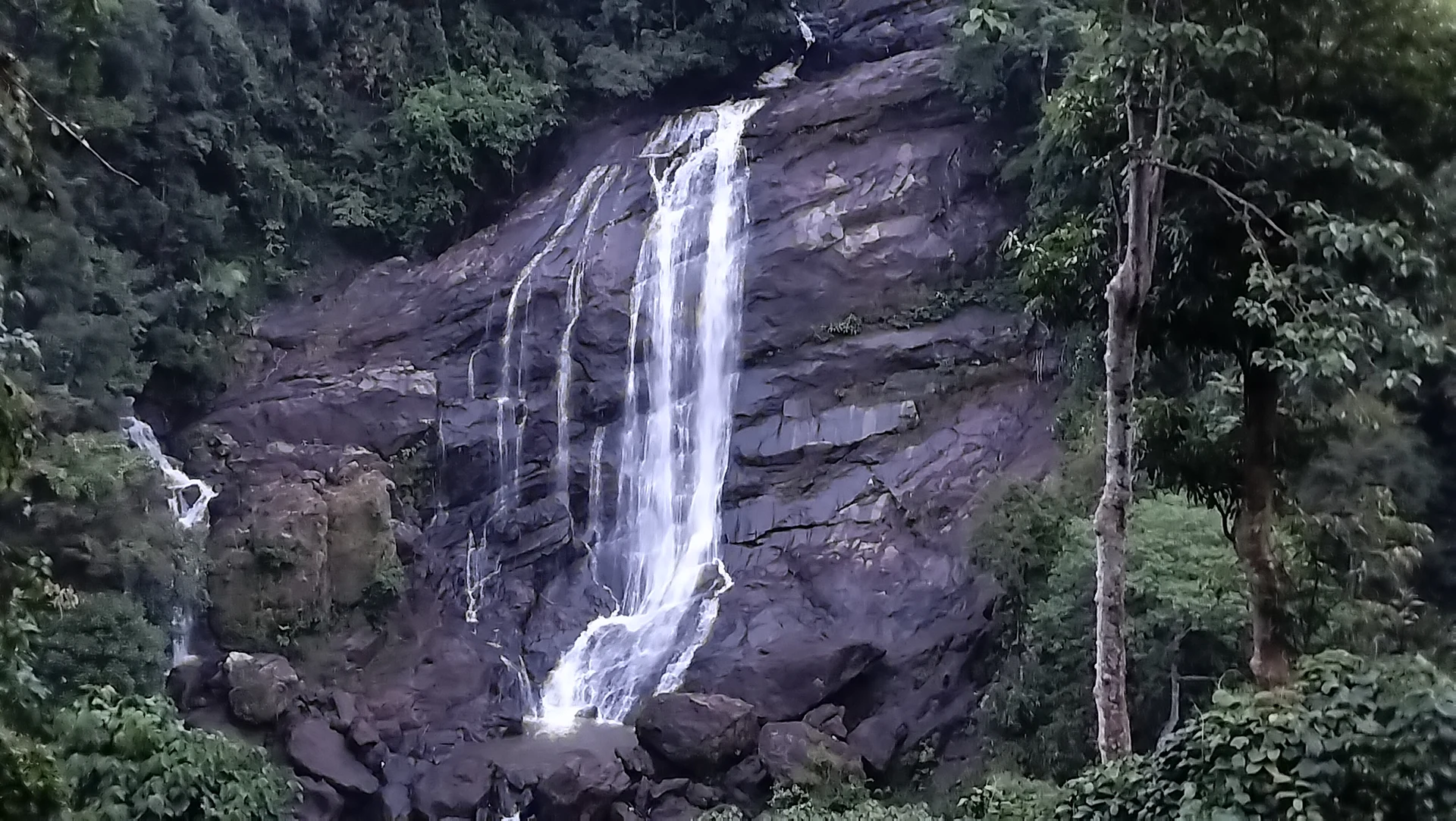
Valara and Cheeyappara are frequently presented together because they lie on the same western approach towards Adimali and Munnar. They are still separate waterfalls. A combined tourism page or a driver’s familiar two-stop suggestion should not turn their photographs, descriptions or access arrangements into one interchangeable attraction.
Do not transfer the seven-tier description
Kerala Tourism describes Cheeyappara through its sequence of seven tiers. That well-known description belongs to Cheeyappara. Valara has its own visible main drop and lower cascade within a wooded setting. Copying the seven-tier phrase into a Valara guide creates a specific identification error, even if both places are part of the same road journey.
The better way to recognise Valara is to compare its rock face and forest frame with a correctly identified photograph. Water volume can change the appearance, but the broad arrangement of rock and vegetation remains more useful than a generic phrase such as “a cascade on the Munnar road”.
Keep each photograph attached to its name
A travel album may contain both waterfalls in quick succession. The fact that two photographs were taken minutes apart does not make their captions interchangeable. Look for the form of the drop, the surrounding vegetation and any visible roadside context before assigning a name.
At Valara, some photographs emphasise the main face while others frame the lower cascade through a tree. These can be different views of one waterfall. Conversely, a photograph showing Cheeyappara’s stepped form should remain with Cheeyappara even when it appears on a page discussing the pair together.
Make two stopping decisions
A safe stop at one waterfall does not establish a safe stop at the next. Traffic, available space and the direction of travel can differ. The driver needs to assess each location independently, with the vehicle fully clear of through traffic and a safe place for passengers to stand.
If one location is congested or affected by weather, seeing only the other is a reasonable outcome. The route should not become an obligation to stop twice simply because an itinerary lists a pair. Waterfall viewing is the purpose; blocking the road or descending an uncertain slope adds no value to it.
Separate viewing from activities at the base
Combined descriptions sometimes discuss the general appeal of waterfalls in broad terms. That does not establish swimming, trekking or access to the base at Valara. Those activities require their own site-specific permission and safe route. A roadside cascade can be appreciated as a view without becoming an adventure programme.
The same caution applies when information about one of the pair seems more detailed. A facility or path described at Cheeyappara cannot be assumed at Valara. The visitor needs the exact location attached to the claim, especially for parking, barriers, walking routes and any restriction in force.
Seasonal change can make comparison more interesting
In strong flow, water can conceal much of the rock and make two cascades seem superficially similar. In lower flow, their different structures become easier to read. Kerala Tourism describes reduced dry-season water and stronger monsoon or post-monsoon conditions for the destination. Neither season guarantees that every planned stop will be suitable on the day.
Rather than ranking one against the other, notice what each reveals about the road’s river landscape. Cheeyappara’s tiered description and Valara’s forest-framed drop give two distinct observations along the journey. A short, accurate visit to each is more memorable than repeating the same generic waterfall story twice.
Put the names into the day plan
Use separate map entries and say the intended waterfall’s name when arranging a stop. Agree on the pickup position before passengers spread out, and leave the return decision with the driver if conditions change. The practical result is simple: two clear destinations, each visited on its own terms, within one onward journey.