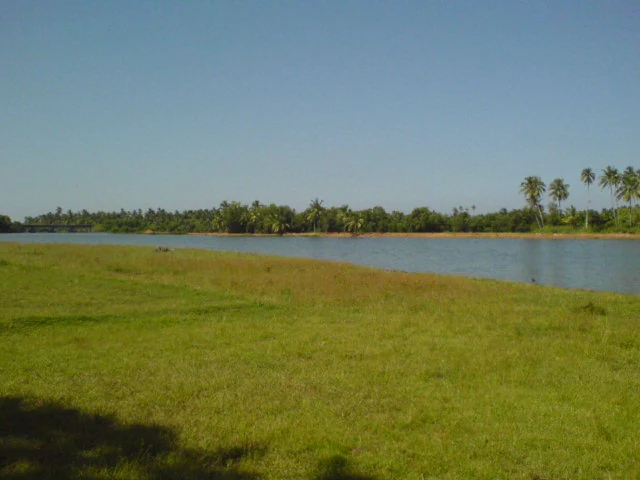
A backwater view can look still even when it belongs to a busy working landscape. Boats have been pulled onto the bank, a landing is temporarily empty, and coconut trees hide houses from a distant view. At Valiyaparamba, looking for these small signs of use gives a fuller picture than imagining an uninhabited stretch of water.
Boats belong to livelihoods as well as holidays
Kasaragod district identifies fishing and mussel cultivation among the activities associated with Valiyaparamba. Narrow timber craft beside the shore are therefore part of the local economy, while a passing houseboat represents another use of the same water. Their shapes, ways of landing and time spent on the bank differ because their purposes differ.
A visitor can observe that contrast from public ground without boarding a working boat. Nets and gear may occupy space that looks like an empty foreground in a photograph. Leave them where they are, keep the landing clear and ask before making a close portrait of someone at work. A host’s explanation is more informative than guessing what a particular boat or piece of equipment is used for.
The coconut shore is inhabited ground
Coconut cultivation is another part of the district’s description of local life. Groves frame the water, but they can also screen homes, access paths and places where people keep their boats. An attractive opening between palms is not necessarily a public path. Follow an established road or an agreed hosted route when exploring on foot.
The panchayat records mangrove vegetation within the coastal environment. Along a permitted shore, notice how rooted vegetation meets the water and how that differs from a sandy landing or a cleared bank. There is no need to enter a soft margin to appreciate it. Keeping feet and boat traffic out of sensitive edges is a practical way to leave the setting as you found it.
An arranged village visit adds a voice to the view
Valiyaparamba is one of the places included in Kerala Tourism’s STREET initiative under Responsible Tourism. Its water and village setting makes a hosted activity a useful complement to a cruise. The value is the person who can explain a livelihood, a route or a household practice in its own setting, rather than a checklist of activities assumed to be available everywhere.
Arrange the actual host, meeting point, language and duration before travelling for that purpose. A destination’s inclusion in a programme does not mean every home receives visitors, every day includes a performance or every fishing boat takes passengers. Ask what the visit contains and whether photography or a meal is part of the arrangement.
This approach also changes how a visitor uses time. A short conversation at an agreed stop can explain more than a long cruise past unidentified shores. The boat journey supplies the broad geography; the host supplies detail about how a particular place is lived in. Together they make the landscape memorable without turning its residents into scenery.
Leave room in the day for both scales. Watch the width of the water and the line of palms, then pay attention to one landing or one hosted activity. Valiyaparamba’s interest comes from that relationship between the broad backwater and the ordinary work along its edge.
Context: Kasaragod district, Valiyaparamba panchayat and Kerala Responsible Tourism’s STREET programme.
Plan the visit: Valiyaparamba Backwaters.