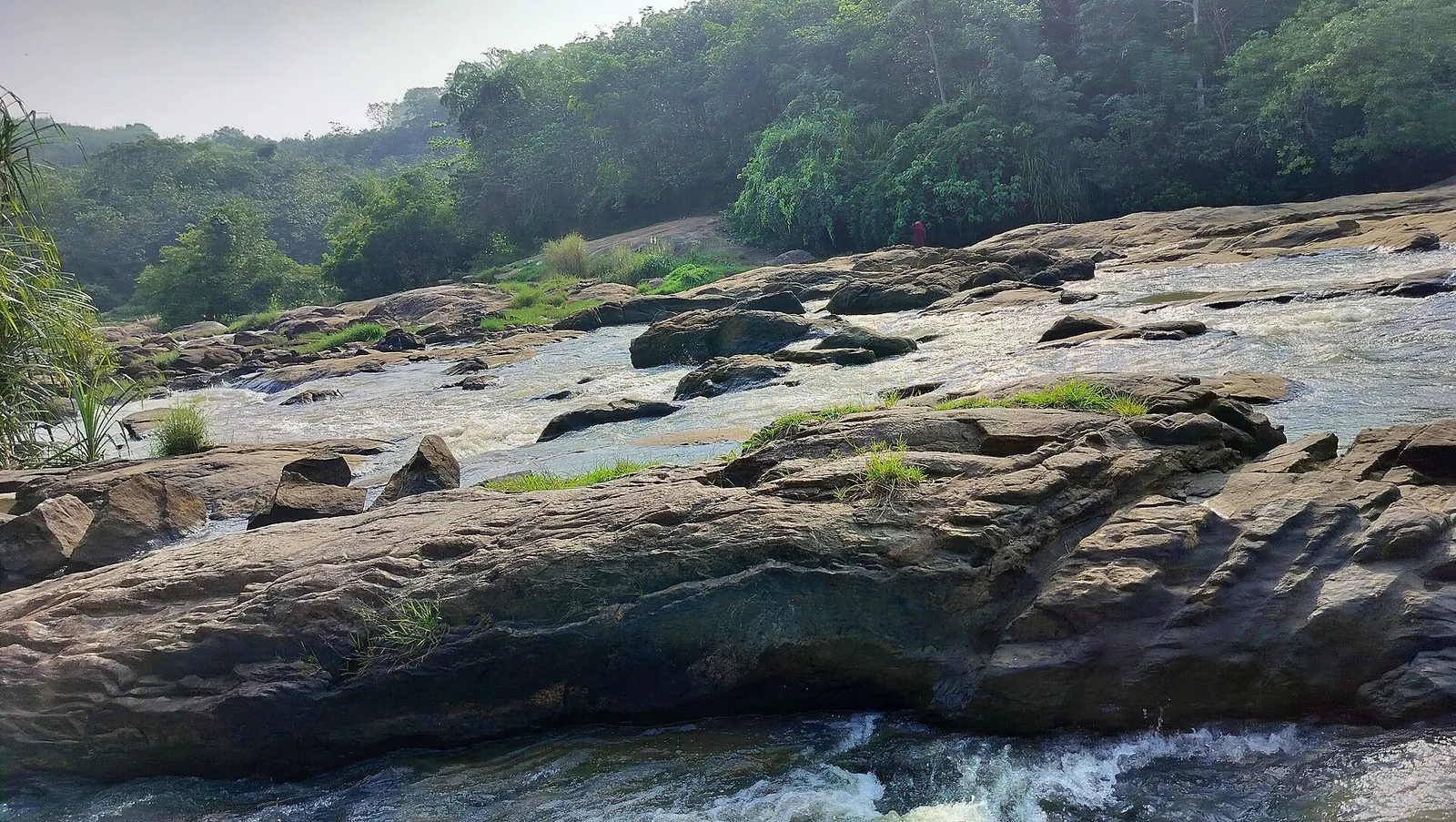
Most places we write about have one name and several stories. This one has four names and no story at all, and we should say that at the top rather than quietly fix it.
The legend that is not here
Four kilometres up the road from this river is one of the most heavily told legends in Kerala. Jatayu Earth’s Center sits on the rock at Chadayamangalam where the vulture Jatayu is said to have fallen after Ravana cut off his wing, and there is a 200-foot sculpture of the bird lying on the hilltop to make sure nobody misses it.
It would take almost nothing to attach that to the falls. The wounded bird was washed in the river below. The round pools in the rock are where he struck it. Write either sentence with enough confidence and it will be repeated back to you within a year.
We could find no source that says anything of the kind, so we are not writing it. This is not a hypothetical risk: an earlier version of our own Chadayamangalam pages asserted eight separate times that the shrines of this district are tied to the Jatayu story, and when we went looking, no named temple in the belt supported it. The tradition attaches to the rock and to the place-name, and it stops there. Vattathil has no origin legend that we could source. What it has is names.
Vattakayam — the one that means something
A Malayalam travel account records what young people from the area call it: Vattakayam. Vatta is round. Kayam is a deep pool — and in Malayalam it is a loaded word, the pool you drown in rather than the pool you paddle in.
Stand on the shelf and the derivation looks obvious. This is precisely the rock that makes round pools. Water finds a hollow, traps a stone in it, and spins that stone in the same circle for decades until it has ground out a smooth cylindrical pot; one pot joins the next and the shelf ends up pocked with them. The photographs show the fluting and the grooving that comes with the process.
The same account carries the sentence that goes with the name. The young people of the area, it says, call Vattakayam the pride of their place, and say they will not let anyone lay a hand on it. That is not a tourism slogan. It is written in the context of reported attempts to quarry rock from an adjoining property of some eleven acres, and of a local action council formed to oppose it.
Vattathil — the one on the map
OpenStreetMap and Wikimedia Commons both use Vattathil Waterfall, sometimes as Kalladathanni Vattathil Waterfall. Vattathil is literally “in the round” or “at the round place”, which points at the same pools.
That does not settle the name. Malayalam place-names ending in -athil are often house-names — the family at the round place, rather than the round place itself — and no cited source derives this one. The pools are real and the word fits; the linguistic origin remains uncertain.
Kalladathanni — the one the first visitor used
The earliest account of a visit we could trace, from 10 January 2016, does not use Vattathil at all. It calls the water the Kalladathanni river, and navigates by the Kalladathanni bridge because, as the writer notes with some feeling, the falls were not on Google Maps.
That is a reminder worth keeping: Kalladathanni is the name of the locality and the bridge, and for at least one visitor it was the name of the river too. The river, on the other three accounts, is the Ithikkara — the same Ithikkara whose mouth at Paravur, forty kilometres west, was closed with granite boulders in 1986 and now silts up behind a spillway that SANDRP calls purely unscientific. We have a whole page on that ruin. This is the same water, a long way above it, still running across bare rock with nothing built into it.
One mapping qualification matters: the drawn stretch of Ithikkara aaru stops about 1.85 km west of the falls, so the map does not itself connect the watercourse to the site. Three independent sources identify the water here as the Ithikkara; the small river’s linework is simply incomplete.
Vattathil Thangal — the one we could not check
DTPC Kollam’s official name for the site is Vattathil Thangal Waterfalls, and that fourth word is the most interesting in this article.
Thangal, in Kerala, is the honorific for a Sayyid — a Muslim religious figure claiming descent from the Prophet. Across the state the tombs of such figures, the jarams and maqbaras, are among the genuinely shared sacred places in India: it is entirely ordinary for Hindus and Christians to visit them, make vows at them and attend their annual feasts. One Malayalam account of this site describes exactly that here — a kabr near the falls venerated by local people of all faiths.
If that is right, then the official name is not decoration. It records that this stretch of river is named for a saint, and that a small shared shrine stands beside a waterfall in a Hindu-majority village in inland Kollam. That would be a quietly remarkable thing and very much the story this valley deserves.
But it rests on a single source. The detailed 2016 account — which describes the mud road, the rubber trees, the log bridge, villagers bathing and the danger of the current — never mentions a tomb, a shrine or a Thangal. None of the forty-one photographs taken in 2025 shows one. We could find no record of who the Thangal was, when he lived, or where the kabr stands.
So this is where the page stops. The name is official and documented. The tomb is reported once and uncorroborated. We are printing both of those facts and promoting neither into a legend — and if you go and find it, you will know something we do not.
Frequently asked questions
What does Vattakayam mean?
Round deep pool — vatta, round, and kayam, a deep pool, which in Malayalam carries the sense of dangerous depth rather than a shallow bathing spot. It is the name recorded in Malayalam as local usage, and it doubles as the safety warning: the pool below the shelf is opaque and of unknown depth.
Is there a legend attached to the falls?
None that we could source. Jatayu Earth’s Center and its Ramayana story are only 4.4 km away and it would be easy to borrow, but no source connects the two, so we have not. The place’s real interest is in its names.
Who was the Thangal in “Vattathil Thangal Waterfalls”?
Unknown to us. Thangal is the Kerala honorific for a Sayyid, a Muslim religious figure, and one Malayalam account reports a kabr near the falls venerated across faiths — but the detailed 2016 account does not mention it and no photograph shows it. DTPC Kollam’s official name is the strongest evidence that something of the kind is there.