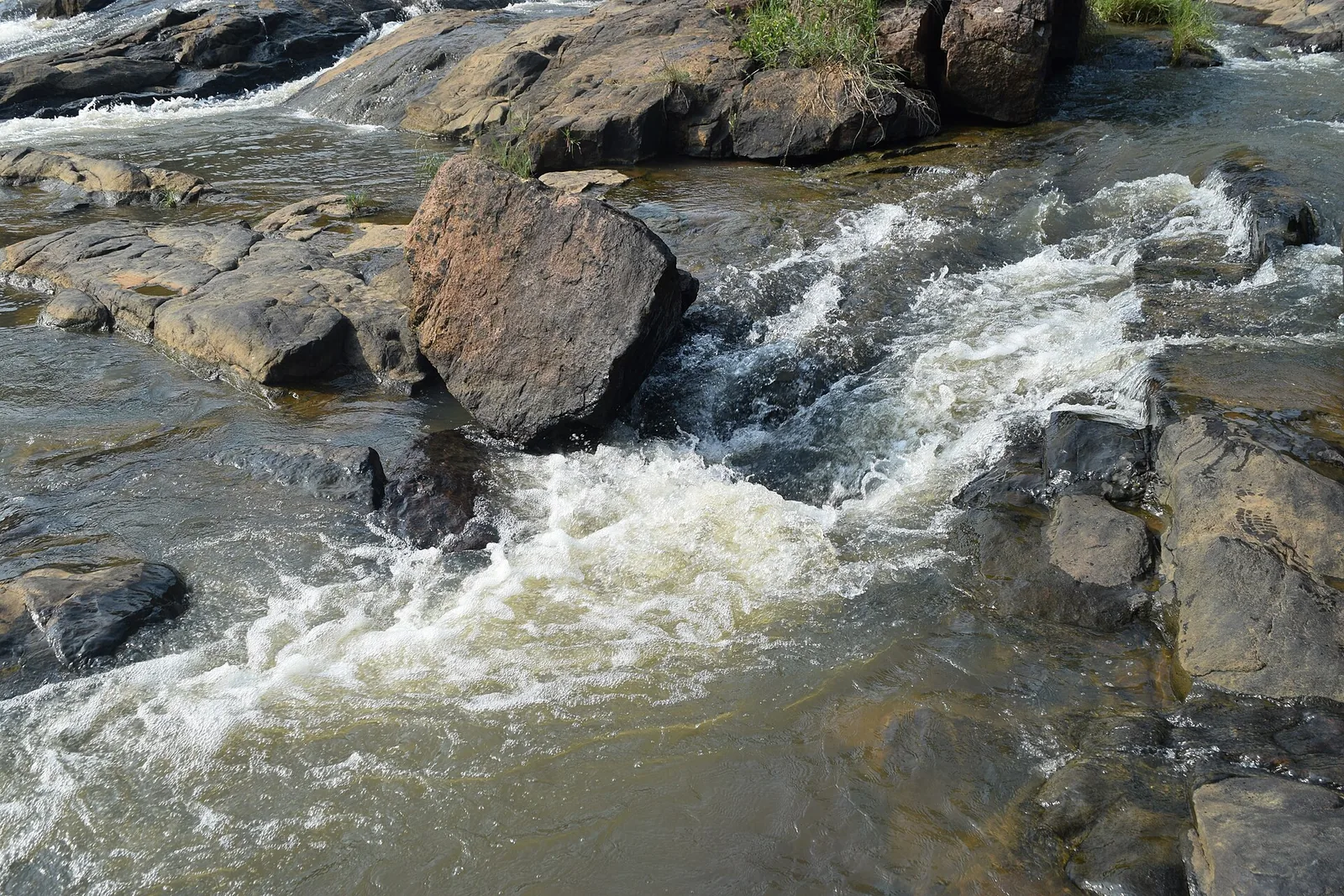
The District Tourism Promotion Council of Kollam maintains a page for this site, and on it is a sentence that no marketing department should have allowed out of the building. Vattathil, it says, is a small waterfall that does not particularly fall, but flows through the terrain.
It is the truest thing anyone has written about the place.
What is actually there
The Ithikkara arrives at Kalladathanni and hits a shelf of hard rock perhaps a hundred metres across. Instead of concentrating into a channel and dropping off an edge, it loses its channel entirely. The water spreads, finds every low line in the rock at once, and comes down in half a dozen separate white chutes, each falling thirty to sixty centimetres at a time in a staircase of small steps rather than a single plunge. Below the shelf it gathers again into a broad, slow, tea-coloured pool with a low wooded bank on the far side and screwpine leaning out over the water.
The rock itself is the reason to come. It has been scoured smooth and pale, fluted along the grain, studded with rounded boulders that the river has parked and left, and grooved into long ledges you can walk out along. There is a great deal of it, it is all open, and on the afternoon it was photographed there were perhaps four people on the whole expanse.
Why the season is the surprise
The obvious assumption about a small Kerala waterfall is that it is a monsoon act — thunderous in July, a damp stain on a rock by February. Vattathil appears not to work that way, and there is a specific reason we can say so.
Every photograph that exists of this place was taken on one afternoon: 13 April 2025, between roughly 15:51 and 16:42. That is the tail end of the dry season, the hottest, lowest-water fortnight of the Kerala year, immediately before the pre-monsoon showers. And the frames show white water running across the full width of the apron, standing waves against the boulders, and a pool below deep enough to be completely opaque.
So the flow in the driest week is already substantial. June to September will be stronger and louder. But unlike a good many falls on this coast, an off-season visit here is not a wasted drive — which, given that this is a free site with no booking and no gate, makes it an unusually low-risk detour.
The walk in
From the road it is an unmade laterite track, red and rutted, holding puddles even in April, running on electricity poles into a rubber estate. A narrow concrete footbridge with steel-pipe railings crosses a gully under the rubber trees. Then about two hundred metres on foot and the trees stop and the rock opens out.
Two hundred metres is DTPC’s figure and it is roughly what the photographs suggest. It is, in effort terms, about the same as walking across a large car park — which is a slightly absurd amount of effort for the amount of river you get at the end of it.
And the part that is not charming
There is nothing here. No ticket counter, because there is no ticket — DTPC states outright that there is no entry fee. But also no toilet, no shop, no bin, no signboard at the road, no rope, no railing at the water and nobody on duty. The nearest anything is Chadayamangalam, 6.7 km away.
That cuts both ways and the second way matters more than the first. An unmanaged river with a walkable rock shelf and an opaque pool is exactly the configuration that catches people out in Kerala every year. The name local people use, recorded in Malayalam, is Vattakayam — vatta, round; kayam, a deep pool, and specifically the drowning kind of pool rather than the paddling kind. The earliest account of a visit here, written after a trip in January 2016, puts the warning bluntly: after rain the speed of the water is beyond what a person can control even if they can swim.
Wet gneiss is slick. There is no edge protection anywhere. Keep children within arm’s reach, do not jump into water whose bottom you cannot see, and if the river is up, look at it from the bank and go home.
Go for the right thing
If you want height, Palaruvi drops off a cliff about seventy kilometres east of here and Kumbhavurutty falls in two tiers on the Achankovil. Vattathil is not competing with either and should not be sold as though it were.
What it offers instead is space and quiet and moving water, forty minutes off the Kollam–Thiruvananthapuram road, for nothing, with a two-hundred-metre walk. Set against Jatayu Earth’s Center 4.4 km away — ₹450 a head plus tax, timed slots, a cable car and a mandatory photo ID — it is a useful reminder that the best half-hour of a Kerala day is quite often the one nobody is charging for.
Frequently asked questions
So is it worth the detour?
If you want a wide, quiet expanse of open river rock with nobody on it, yes — and it is only about 200 m on foot from where you park. If you specifically want a tall waterfall to photograph, no: go to Palaruvi or Kumbhavurutty instead. DTPC Kollam’s own description is the honest one — it does not particularly fall.
Will there be water outside the monsoon?
On the evidence, yes. The only photographic record of the place was made on 13 April 2025, at the end of the dry season, and shows white water across the full width of the rock and a deep pool below. The monsoon months of June to September will be stronger.
Can I swim?
There is no lifeguard, no rope, no railing and nobody on duty, and the pool below the shelf is opaque and of unknown depth — the local name Vattakayam means exactly that, the round deep pool. Treat it as an unmanaged river. Stay out entirely after rain: the 2016 account of a visit here warns the current is then beyond what a swimmer can control.