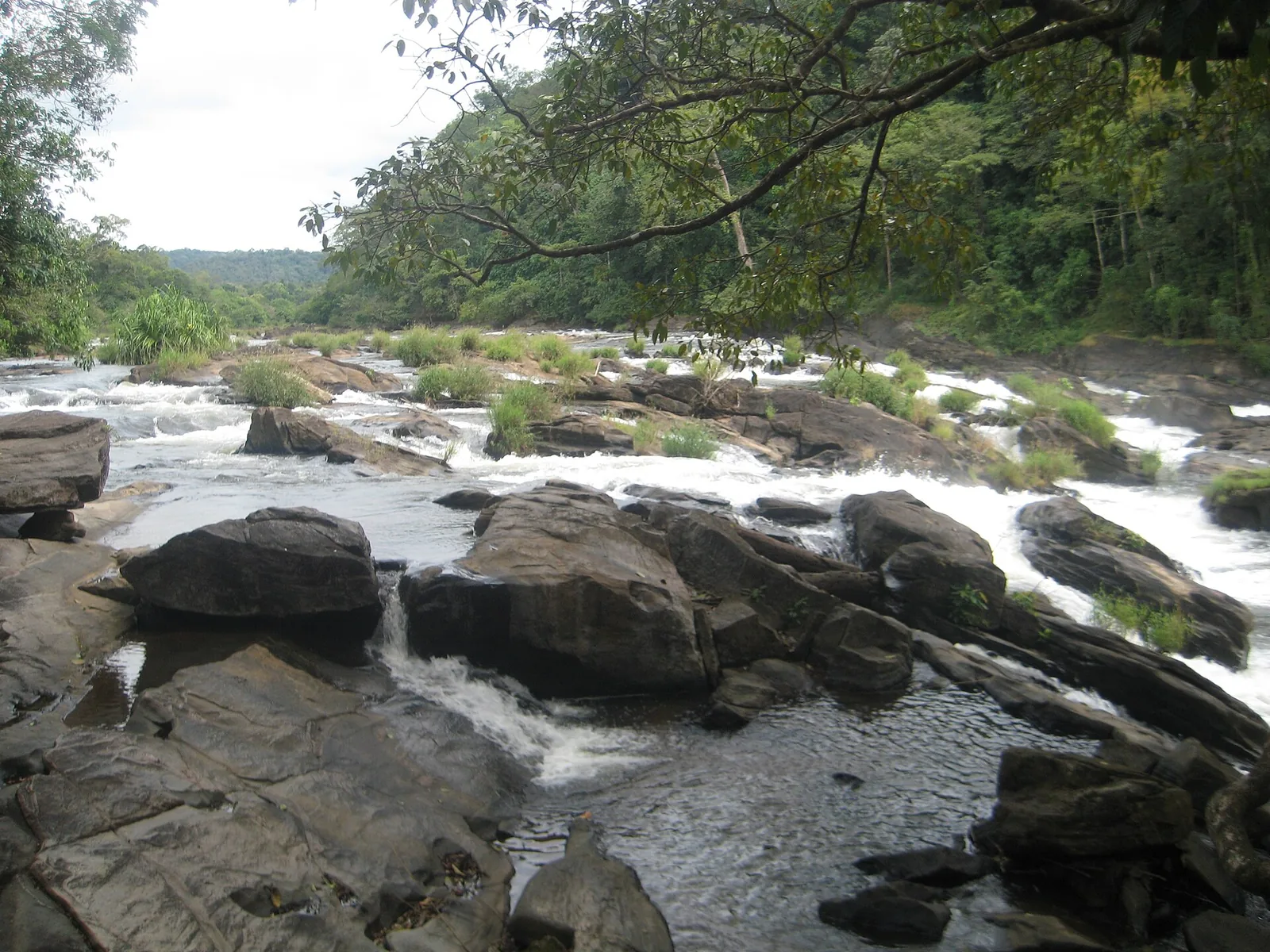
Everything you will be told at Vazhachal points upwards. All four peninsular hornbills in one forest. The last substantial low-elevation riverine rainforest in Kerala. Lion-tailed macaques, Malabar giant squirrels, an elephant corridor. It is an extraordinary list and every word of it is true.
The rarest thing here is beneath your feet, in the water sliding between the black rocks, and it appears on no signboard at the site.
Ninety-eight species
Published surveys of the Chalakudy river record 98 species of freshwater fish. Thirty-five of them are endemic to the Western Ghats — found in this mountain range and nowhere else on earth. Thirty-one of the 98 are assessed as vulnerable, endangered or critically endangered. And three critically endangered species are strictly endemic to the Chalakudy river system itself: not to Kerala, not to the Ghats, but to this catchment.
That makes the Chalakudy the richest river in Kerala for freshwater fish. It is the fourth longest in the state, about 145 kilometres from the Anamalai hills to the sea, and it carries more fish diversity than any of the longer ones.
A field survey published in the same body of work collected 71 species from sampling sites along the river, across 27 families and 50 genera. These are not obscure numbers buried in a journal nobody reads; the Chalakudy fish fauna is one of the better-studied freshwater assemblages in southern India, precisely because it has been under argument for thirty years.
Why nobody tells you
Partly because you cannot see it. A hornbill crossing the river is a spectacle; a Critically Endangered barb holding station in a pool below a rapid is not. Tourism describes what a visitor can photograph, and freshwater fish lose that contest to almost everything.
Partly, too, because the standard framing of this landscape was set by the fight over the dam, and that fight was popularly narrated through the birds. The hornbill is Kerala’s state bird, the great hornbill is the malamuzhakki vezhambal of Malayalam song, and it made an unanswerable emblem. The fish arguments were made — by ichthyologists, in the technical objections — but they never reached the signboards.
What is actually threatening them
The published threat list for the Chalakudy fish fauna is ordinary and cumulative, which is exactly why it is hard to campaign about. Damming and the flow regulation that comes with it. Loss of riparian cover — the trees along the bank that shade the water and drop the insects and fruit into it. Pollution. Introduced exotic species. Over-exploitation of endangered food fishes.
And one that surprises people: the indiscriminate collection of endemic and threatened ornamental species for the aquarium export trade. Some of the small, brilliantly coloured hill-stream fish of the Western Ghats are commercially valuable abroad, and they are collected from streams like these. A fish endemic to one river system does not have anywhere to retreat to.
How to look at the river instead
Vazhachal is unusually good for this, which is the practical point of knowing any of it. Athirappilly five kilometres downstream is a fall you look at. Vazhachal is a shelf of rock the river runs across, and in the drier months it separates into braided channels sliding between smooth boulders with pools in between — water you can actually see into.
Sit above a pool in the early morning, out of the wind, with the sun behind you, and give it ten minutes. Hill-stream fish hold in the slack water at the edge of a current and are largely invisible until your eye adjusts to the shadow patterns, at which point a pool that appeared empty turns out to be busy. You will not identify anything to species from the bank and that is not the point. The point is that you are looking at the part of this place that is genuinely irreplaceable.
And do not fish, do not move rocks around in the shallows, and do not put anything into the water. This is a Forest Department stretch inside the Vazhachal division and the rules exist. The rocks here are also lethally slippery and the current is stronger than it looks — the river-watching is done from the bank.
Frequently asked questions
How many fish species are in the Chalakudy river?
98 freshwater species on published surveys, of which 35 are endemic to the Western Ghats. Thirty-one are assessed as vulnerable, endangered or critically endangered, and three critically endangered species are strictly endemic to the Chalakudy river system — found in this catchment and nowhere else.
Is that a lot?
It is the highest freshwater fish diversity of any river in Kerala. The Chalakudy is only the fourth longest river in the state, at about 145 km, so the diversity is not a function of size — it is a function of the range of habitats between the Anamalai hills and the coast, and of the forest still standing along the banks.
What threatens the fish?
The published list: damming and flow regulation, loss of riparian tree cover, pollution, introduced exotic species, over-exploitation of endangered food fishes, and the indiscriminate collection of endemic and threatened ornamental species for the aquarium export trade.
Can I see any of them?
From the bank, in the dry months, yes — not to identify, but to watch. Vazhachal breaks into braided channels with pools between the boulders, and ten quiet minutes above a pool with the sun behind you will usually resolve fish holding at the edge of the current. Do not enter the water: the rock is extremely slippery and the current is faster than it appears.
Why is this never mentioned at the site?
Because it is invisible and because the public argument about this landscape was carried by the hornbills, which are Kerala’s state bird and make a far better emblem. The fish objections were made in the technical record rather than on the placards, and they never made it onto the boards at the viewpoint.
Does the dam proposal affect the fish?
It was one of the technical grounds of objection. Damming and the flow regulation that follows it appear at the top of the published threat list for this fauna, alongside loss of riparian cover — and a species endemic to a single river system has nowhere to move to if its stretch of river changes.