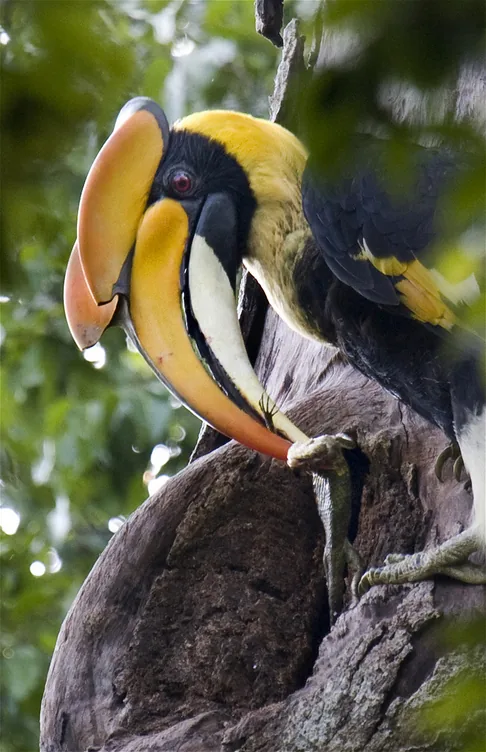
Stand at Vazhachal Falls in April, when the Chalakudy has dropped to braided channels between hot black rocks, and there is a fair chance of hearing a sound like a heavy door being pushed open somewhere above the canopy. That is the wingbeat of a great hornbill. In Malayalam it is the malamuzhakki vezhambal — roughly, the one whose call makes the mountains resound.
And in Kerala, everyone knows what that bird is doing up there. It is waiting for rain.
The legend
The belief, held widely across Kerala and carried in songs, poems and everyday speech, is that the vezhambal cannot drink water like other birds. It cannot dip its bill in a river or a puddle. The only water it can take is water falling from the sky, caught in the open bill as it comes down.
So the picture that goes with it is a bird high in a bare tree in the worst heat of summer, head tilted back, bill open to the empty sky, calling and waiting for the first drop of the monsoon. It is one of the great images in Malayalam popular culture — patience stretched to the edge of endurance, a thirst that only the season can end. To wait like a vezhambal is to wait for something that will not come one moment earlier for your wanting it.
You are standing, as you hear this, beside a river. That is the whole cruelty of the picture: the bird is supposed to be dying of thirst directly above one of the most water-rich landscapes in India.
What is actually going on
The belief is not true, and the truth is more interesting than the correction usually sounds. Great hornbills are overwhelmingly fruit eaters — figs above all — and they get essentially all the water they need from what they eat. They do not need to drink. A bird that never goes down to the river is not a bird that cannot; it is a bird that has no reason to.
Where the legend probably comes from is the timing. Hornbills become conspicuous — calling, moving, displaying — in the weeks before the rains break, which is exactly when a Kerala village is most anxiously watching the sky. A large, loud, unmistakable bird that appears to be announcing something in the last hot days before the monsoon is a bird that will end up carrying the meaning.
- Malayalam: malamuzhakki vezhambal. It is the state bird of Kerala, chosen for its size, its colour and its place in tribal culture and ritual.
- It is a fruit specialist, and figs are the core of the diet — which is where its water comes from.
- Nesting is extraordinary: the female seals herself into a tree cavity, plastering the entrance nearly shut, and the male feeds her through a narrow slit.
- Incubation runs roughly 38 to 40 days, and she stays sealed in until the chicks are half grown; the chicks then re-seal the hole behind her.
- That behaviour needs very large old trees with very large cavities — the single reason low-elevation riverine forest like Vazhachal’s matters so much.
A word of caution about hornbill folklore
Hornbills carry beliefs across half the world, and a good deal of what gets attributed to Kerala online actually belongs elsewhere — including a much-repeated account of rain-doctors ritually killing a hornbill in drought, which comes from southern African traditions about a completely different bird, the ground hornbill. We have left it out for that reason. The Kerala belief is the rain-drinking one, and it is well enough attested in the state’s own songs and idiom that it needs no borrowing.
Why it belongs at Vazhachal specifically
Because this is one of the very few places in the Western Ghats where all four peninsular Indian hornbill species live in the same forest — the Great, the Malabar Pied, the Malabar Grey and the Indian Grey. The nesting behaviour explains why: sealing a female into a cavity for weeks requires enormous old riverside trees, and the strip of low-elevation riverine forest along the Chalakudy is one of the last places in Kerala that still has them.
So the legend and the ecology point at the same thing. The bird everyone in Kerala pictures with its head tipped back at an empty sky can only exist where there are old trees by a river — and that is the forest that a proposed dam on this stretch would have taken, and that the Kadar community here fought for decades to keep.
Go early, stay quiet, and listen for the door being pushed open above the canopy. The bird will not be thirsty. It will just be enormous.
Frequently asked questions
What is the vezhambal?
The Malayalam name for the hornbill; the great hornbill specifically is the malamuzhakki vezhambal, roughly “the one whose call makes the mountains resound”. It is the state bird of Kerala, designated for its size, colour and importance in tribal cultures and rituals.
What is the legend about hornbills and rain?
A widely held Kerala belief that the hornbill cannot drink water from the ground and can only take water that falls from the sky — so it spends the hot months with its bill open to the air, calling and waiting for the first rain. It appears constantly in Malayalam song, poetry and idiom as an image of extreme patience.
Is it true that hornbills only drink rainwater?
No. Great hornbills are fruit specialists — figs above all — and get essentially all the water they need from their food, so they have no need to drink. The belief probably grew from the fact that hornbills become loud and conspicuous in the weeks just before the monsoon breaks.
How do great hornbills nest?
The female seals herself inside a tree cavity, plastering the entrance almost shut, and is fed by the male through a narrow slit. Incubation runs about 38 to 40 days and she remains sealed in until the chicks are half grown, at which point she emerges and the chicks seal the hole again behind her.
Can I see hornbills at Vazhachal?
It is one of the very few places in the Western Ghats where all four peninsular Indian hornbill species occur — Great, Malabar Pied, Malabar Grey and Indian Grey. Sightings are never guaranteed; early morning, patience, binoculars and quiet along the riverside forest give the best chance.
Why does the forest at Vazhachal matter to hornbills?
Because hornbill nesting needs very large old trees with cavities big enough to seal a female inside for weeks. Low-elevation riverine forest with trees that old has been almost entirely cleared across the Western Ghats, and the strip along the Chalakudy here is one of the last substantial pieces left in Kerala.