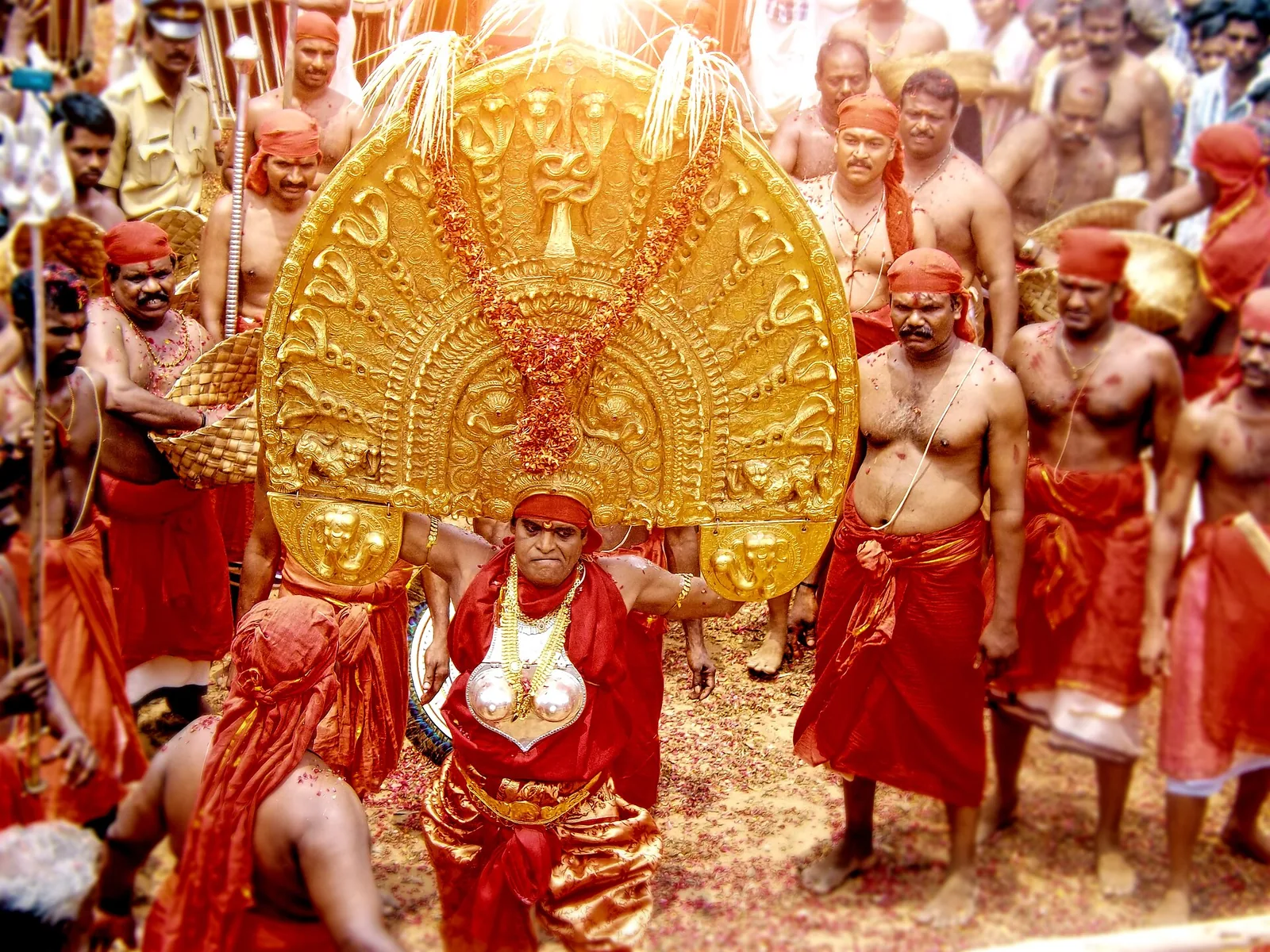
A visitor can reach Vellayani Lake on an ordinary day and find the temple beside it. The festival that gives the temple its most elaborate public drama is harder to catch. Kerala Tourism’s festival record describes Kaliyoottu as a roughly 64-day event held once every three years. A story staged over two months asks its audience to wait years for the first beat of its drum.
The drum opens a long drama
Karadikottu, the beating of a special drum, begins the sequence recorded by Kerala Tourism. The festival follows Bhadrakali and Darika through confrontation and Darika’s defeat. Its length is part of the form: different parts are performed on different days by people from the region. You cannot see the whole narrative in a single evening.
The same record describes Kalamkaval, in which the chief priest carries the deity’s image on his head while dancing, and Uchabali, with a performer enacting nearly 64 gestures. These are named stages in the festival account, not promises that every visitor will see them on any chosen date.
A battle above the crowd
The drama climbs before it resolves. Paranettu depicts the battle on a raised stage that Kerala Tourism describes as almost 100 feet high, usually at night. Nilathilporu follows as another significant stage, with Aaraattu and Pongala also listed in the festival sequence. The public source supports the height and sequence; it does not supply a current performance schedule or justify treating the staging as an everyday attraction.
Why the empty years matter
Kerala Tourism places Kaliyoottu broadly between February and April in its festival year and describes a three-year cycle. Those are useful planning boundaries, not dates for the next edition. The temple and Travancore Devaswom Board contact directory are the appropriate places to confirm the next calendar and public access arrangements. A traveller who arrives in an intervening year can still visit the lakeside area, but should not expect a shortened version of the 64-day drama.
The festival’s unusual scale is compelling enough without adding an unverified origin tale or assigning a caste to the current priesthood. What the official record lets us follow is the movement from one drumbeat, through weeks of enactment, to a battle lifted above the crowd. Then the stage waits for the cycle to return.
The gaps belong to the calendar
Because Kaliyoottu follows a three-year cycle, a traveller can arrive at Vellayani Temple in an ordinary year and find no long festival underway. The absence is part of the schedule, not evidence that the tradition has disappeared. When the cycle returns, individual events have their own dates within a sequence that lasts weeks.
The Vellayani Lake visit and the temple festival are different reasons to come to the area. A lake view is available outside the ritual calendar; a specific Karadikottu or Paranettu performance requires the current programme from organisers. Old promotional dates should not be carried forward.
The festival’s scale is not just the height of a stage or length of a run. It is the repeated gathering of people around a story whose dramatic stages return only after a long wait.
Frequently asked questions
How often is Vellayani Kaliyoottu held?
Kerala Tourism records it as once every three years, lasting about 64 days. Confirm the next edition’s exact dates with the temple or Travancore Devaswom Board.
What does the festival enact?
It presents the story of Bhadrakali and Darika over a sequence of performances, including Karadikottu, Kalamkaval, Uchabali, Paranettu and Nilathilporu.
Is the Paranettu stage really high above the ground?
Kerala Tourism’s festival record describes a stage almost 100 feet high, usually used at night. It does not give a current event timetable.
Can I see Kaliyoottu on any visit to Vellayani?
No. The festival follows a three-year cycle. Check its current schedule before planning a visit around a particular performance.