Stand on the old quay at Vizhinjam among the ice boxes and the auction, look south, and you can see the breakwater of a container terminal that is described almost everywhere as India's first transhipment port. It is a good story and it is not quite right — and the port that actually holds that title is also in Kerala.
What Vallarpadam did first
The International Container Transshipment Terminal at Vallarpadam, in Kochi, opened on 11 February 2011. It was built for exactly the reason Vizhinjam was later built: to stop Indian export containers being trucked or fed to Colombo, Singapore and Dubai to be transferred onto larger ships, and to capture that handling — and its revenue — inside India.
So Vallarpadam is India's first transhipment terminal. That is not a technicality. It was a fifteen-year head start.
What Vizhinjam is first at
Vizhinjam's claim is narrower and, in shipping terms, more consequential: it is India's first deepwater transhipment port. The difference is draft.
Vizhinjam has roughly 24 metres of natural depth close inshore. That is enough to bring the largest container ships afloat alongside without dredging an approach channel and without dredging it again, continually, forever. Vallarpadam does not have that; its depth is maintained, and maintenance dredging in a silting estuary is both a recurring cost and a ceiling on the size of ship that can call.
The second advantage is position. Vizhinjam sits about 10 nautical miles off the main east–west shipping lane. A ship calling here has barely deviated from the route it was already sailing. A ship calling at Kochi has gone materially out of its way. For a transhipment hub, where the entire proposition is that stopping is cheap, that distinction decides everything.
This is the same deep water that made the anchorage worth fighting over for the Ay kings, the Cholas and the Pandyas. The bathymetry has not changed. What changed is that ships got big enough for it to matter again.
The dates, since they are usually vague
Adani Ports took a 40-year concession to design, build, finance and operate the terminal, and construction began on 5 December 2015 — a decade before the ribbon was cut, which is worth remembering when the port is described as though it appeared suddenly.
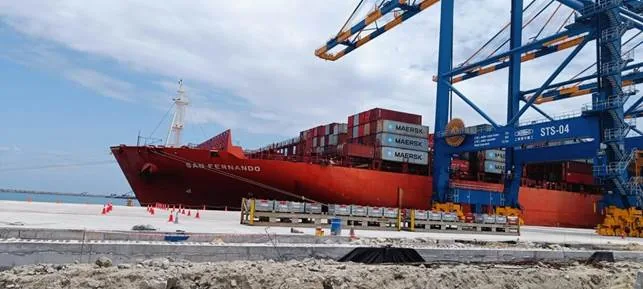
The first cargo vessel, the Zhen-Hua 15, arrived on 12 October 2023. The first container ship, the San Fernando, docked on 11 July 2024. The Prime Minister inaugurated the port on 2 May 2025. Phase one is built for about a million TEU a year, with roughly 6.2 million more planned across later phases, and the breakwater runs about 3,180 metres today against a designed final length of 4.5 kilometres.
The part that complicates the story
The case made for Vizhinjam over two decades was national: Indian cargo should stop being handled abroad. The first clearly visible effect has been domestic. Vizhinjam's transhipment volumes have come substantially at Vallarpadam's expense, with Kochi's transhipment throughput roughly halving in 2025–26.
That is not an argument that the port should not have been built — deep water on the shipping lane is a genuine national asset, and Vizhinjam can serve ships Vallarpadam physically cannot. But it does mean the simplest version of the story, in which a new port repatriates business from Colombo, is not what the first year's numbers show. What they show is one Kerala terminal taking traffic from another while the Sri Lankan hubs continue.
Kochi's response has been to push Vallarpadam towards gateway cargo — containers originating and terminating in India — rather than competing for transhipment it is no longer positioned to win. Two terminals in one state, being sorted into two different jobs, by physics.
One more thing that confuses the data
There are two Vizhinjam ports. The old fishing harbour is a minor port under the Kerala Maritime Board, port code IN VZJ, whose wharves have drafts of four and five metres. The deepwater terminal is a separate entity with the code IN TRV. If you find a Vizhinjam figure that seems impossibly small for a container port, you are reading the fishing harbour's — and they are about a kilometre apart.
Frequently asked questions
Is Vizhinjam India's first transhipment port?
No. India's first transhipment terminal was the International Container Transshipment Terminal at Vallarpadam, Kochi, opened 11 February 2011. Vizhinjam is India's first deepwater transhipment port — the first with enough natural draft to take the largest container ships without a continually dredged channel.
What makes Vizhinjam's location so good?
Two things together, which almost no other point on India's west coast has: about 24 m of natural depth very close inshore, and a position roughly 10 nautical miles from the main east–west shipping lane, so a ship calling there is barely deviating from its route.
When did the port actually open?
Construction began 5 December 2015. The first cargo vessel, Zhen-Hua 15, arrived 12 October 2023; the first container ship, San Fernando, docked 11 July 2024; and the Prime Minister inaugurated the port on 2 May 2025.
How big is it?
Phase one is designed for about one million TEU a year, with roughly 6.2 million TEU more planned in later phases. The breakwater is currently about 3,180 m and is designed to reach 4.5 km. Adani Ports holds a 40-year concession to build and operate it.
Has Vizhinjam taken business from Kochi?
Yes, substantially. Vallarpadam's transhipment volumes roughly halved in 2025–26 as Vizhinjam ramped up. Kochi has been repositioning Vallarpadam towards gateway cargo — containers with an Indian origin or destination — rather than competing for transhipment traffic it cannot match on draft or location.
Can visitors go into the new port?
No. It is a secure operating container terminal with no public access. You can see the breakwater clearly from the old fishing harbour and from the rise by the rock-cut cave temple, which is the view worth walking to.