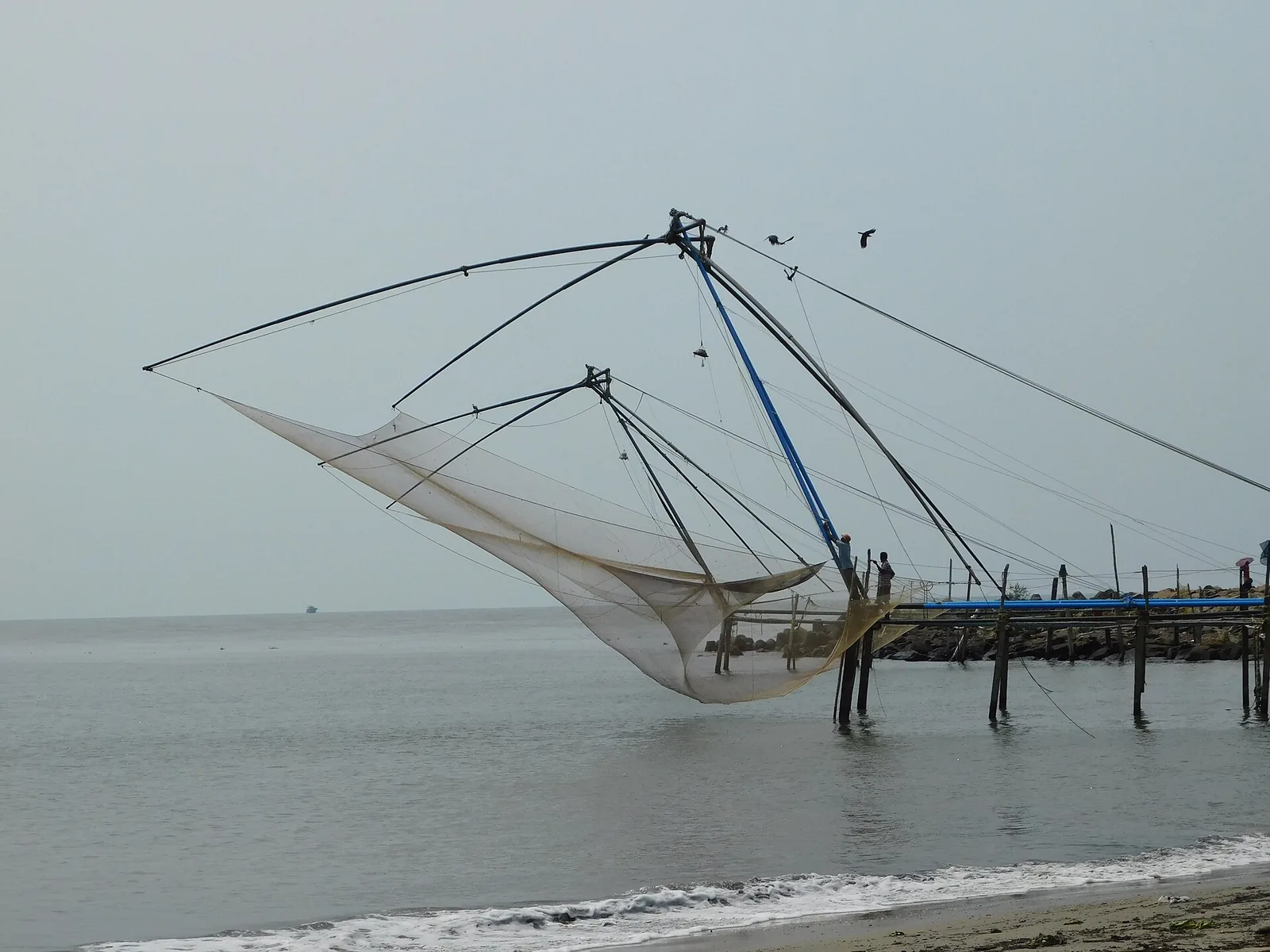
Stand on Fort Kochi Beach at six in the evening and you are looking at the single most reproduced image in Kerala tourism: a row of teak-and-bamboo cantilevers dipping into the harbour mouth, silhouetted against the sun. They are on the state’s posters, on book covers, on the tail of more than one airline advertisement. And almost every account of where they came from is stated with a confidence the evidence does not support.
This is not a case of a mystery nobody has looked into. It is a case of several competing explanations, each with something going for it, being flattened into one tidy sentence and repeated until it sounds settled. It is worth pulling apart, because the honest answer is more interesting than the tidy one.
The official version, and the problem with it
Kerala Tourism’s own page on the nets says they are “believed to have been introduced in Kochi by Chinese explorer Zheng He, from the court of the Kubla Khan”, and dates their establishment on these shores to between 1350 and 1450 AD.
That single sentence contains two different people from two different dynasties, and they could not have met. Kublai Khan, founder of the Yuan dynasty, died in 1294. Zheng He, the Ming admiral, was born around 1371 — roughly seventy-seven years later — and made his seven Indian Ocean voyages between 1405 and 1433, under the Yongle Emperor. Zheng He never served at Kublai Khan’s court, because Kublai Khan’s court no longer existed.
This is not pedantry about dates. It is a sign that two separate traditions — one attributing the nets to Yuan-era Chinese traders in the thirteenth century, the other to Zheng He’s fifteenth-century fleet — have been welded together somewhere along the way, and the join is still visible on the official page.
The silence of Ma Huan
The Zheng He attribution has a second, harder problem. Zheng He’s voyages were documented in unusual detail by Ma Huan, the Chinese interpreter and scribe who sailed with the fleet and wrote up what he saw. Ma Huan described Cochin. He wrote about the place, its people and its trade.
He did not mention the nets. A chronicler recording a fleet that had supposedly just introduced an enormous and highly distinctive piece of fishing apparatus to a foreign shore might reasonably be expected to say so. The absence is not proof — arguments from silence never are — but it sits awkwardly with the story built on top of it.
What the fishermen still call the parts
The strongest positive evidence points somewhere else entirely, and it is hiding in plain sight in the vocabulary. The men working the nets use a set of names for the components that are not Malayalam and not Chinese. They are Portuguese.
The net itself is the rede. Its edge is the borda. The great wooden arms are brasão, the flexible ring is the argola, the balancing rope and the counterweight stones are corda and pedra, and the walkway and support posts carry Portuguese names too. This vocabulary was documented in research by Deepa Leslie, and it is difficult to explain if the technology arrived a century before the Portuguese did.
The alternative account follows the language: that the cantilever nets reached the Malabar coast after 1500 with Portuguese Casado settlers — married colonists — coming from Macau, where Portugal held a foothold on the Chinese coast. On that reading the nets are genuinely Chinese in design and genuinely Portuguese in delivery, which is why they are called Chinese nets and named in Portuguese.
The argument that is usually overstated
You will often read that the nets prove their own mystery because they are not found in China at all. It is a good line and it is not quite true. They are certainly not a common sight in southern China today, but the historian who writes as Maddy turned up a photograph published in The Wide World Magazine in 1898 showing an immense cantilevered fishing net at Wen Chow — Wenzhou, on the Chinese coast. They existed there. They have mostly gone since.
This matters because the “not found in China” claim is often used to argue the nets are uniquely Keralan. What it actually shows is that a shared technology survived in one place and died out in the other, which is a different and less mystical story.
What can honestly be said
No primary document settles it. What survives is a set of pointers running in different directions: a Portuguese technical vocabulary that is hard to argue with, a Chinese design lineage nobody disputes, a fifteenth-century chronicler who did not mention them, and a nineteenth-century photograph showing the same apparatus a very long way north.
The reasonable position is that the nets are Chinese in origin as a technology and probably Portuguese in transmission to this coast, arriving during or after the sixteenth century rather than being handed over by a passing Ming fleet. But “probably” is the operative word, and any source that tells you otherwise without showing its evidence is selling you a cleaner story than exists.
- Only about eleven nets remain on the Fort Kochi shore, and just a few are fully restored and worked.
- Following a platform collapse on 21 November 2025 that injured a group of visitors, Fort Kochi police barred operators from allowing tourists onto the net platforms. Do not climb on. Confirm the current position locally.
- Best light is the last hour before sunset, from the promenade rather than the structures.
- Operators may ask for a tip for photographs. Agree a figure first, or simply shoot from the sea wall.
The nets sit on the Fort Kochi Beach seafront beside Vasco da Gama Square, a few minutes’ walk from St Francis Church. If you are building a day around them, our Fort Kochi in a day walking itinerary strings the seafront, churches and palace together on foot.
Frequently asked questions
Who built the Chinese fishing nets in Kochi?
Nobody can prove it. The design is Chinese, but the strongest surviving evidence — the Portuguese names still used for every part of the net — points to Portuguese settlers from Macau bringing the technique to this coast after 1500, rather than to Zheng He’s fleet or to Kublai Khan’s court.
Did Zheng He bring the Chinese fishing nets to Kochi?
It is widely repeated but poorly supported. Ma Huan, who sailed with Zheng He and wrote a detailed account of the voyages including Cochin, never mentions the nets. Kerala Tourism’s own page also places Zheng He “from the court of the Kubla Khan”, though Kublai Khan died in 1294 and Zheng He was born around 1371.
Why are they called Chinese fishing nets if the Portuguese brought them?
Because both things can be true. The cantilever design is Chinese in origin; the route by which it reached Kerala appears to be Portuguese, via their colony at Macau on the Chinese coast. Locally they are called cheena vala, literally Chinese net.
Are Chinese fishing nets found anywhere else?
They are now largely confined to Kochi and nearby stretches of the Kerala coast. They were not always unique to it — a photograph published in 1898 shows a very similar cantilevered net at Wenzhou in China — but they have mostly disappeared elsewhere.
Can you climb onto the fishing net platforms?
Not at present. After a platform collapsed on 21 November 2025, dropping a group of tourists into the water, Fort Kochi police barred operators from allowing visitors onto the platforms. Treat any invitation to climb on with caution and confirm the current rule locally.