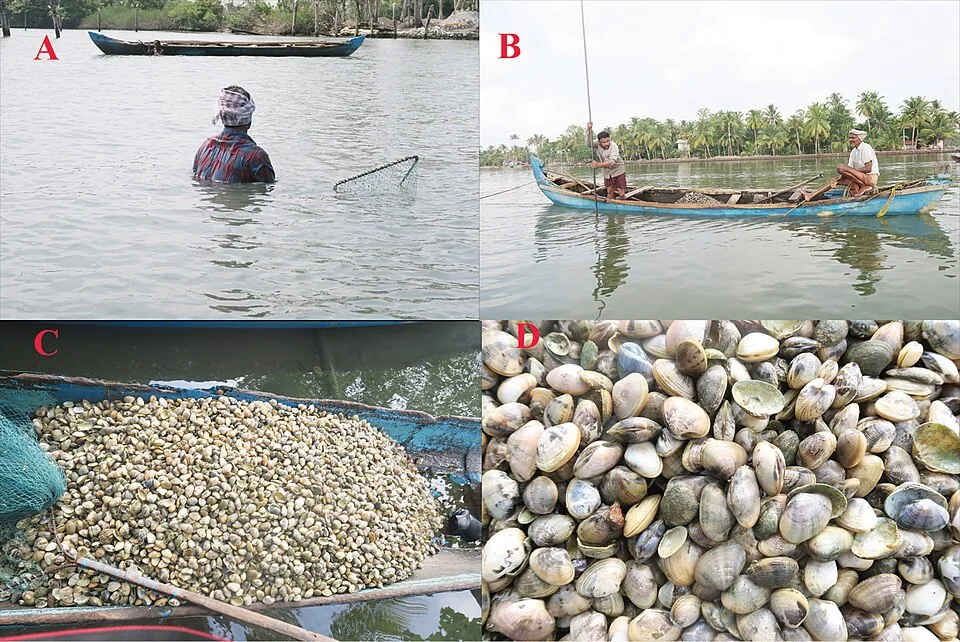
In November 2014 a clam fishery in a Kerala lake became the first fishery in India, and only the third in Asia, to be certified by the Marine Stewardship Council — the blue tick you see on fish counters in Europe. It was a genuine achievement, won by hand-gatherers standing chest-deep in Ashtamudi, and it was widely and rightly reported. What is much less widely reported is that the certificate is no longer in force.
What the fishery is
The species is Paphia malabarica, the short-neck clam. It is taken from the bed of the Ashtamudi estuary by hand and with hand dredges and traps, worked from small canoes — this is not a trawl fishery and there is no boat here you would call a vessel. Commercial working of the bed dates to around 1981, and something in the order of 3,000 people make a living from it across collection, cleaning, processing and trade. Reported landings were about 5,010 tonnes in 2018.
The certification itself was not a piece of paperwork somebody bought. WWF-India began the process in 2010; the Central Marine Fisheries Research Institute, the state fisheries department, the district administration and the fishing community itself all had to agree on and then live with management measures. Four years is a long assessment, and the fact that a small-scale, low-technology estuarine fishery in India could pass one at all was the reason the story travelled.
The dates, and the word "withdrawn"
The certificate, as the MSC’s own fishery database records it
| Certified from | 5 November 2014 |
| Certificate expiry | 5 September 2020 |
| Status now | Withdrawn |
| Certifier | LRQA (Seafood) Limited |
That is not a rumour or an interpretation; it is what the entry on the MSC’s public fisheries database says. An MSC certificate runs for five years and is then re-assessed. This one was extended into 2020 and then lapsed, and the fishery has not appeared as certified since.
We have not been able to establish publicly why it was not renewed, and we are not going to guess at it. A lapse can mean a stock problem, or it can mean that nobody was willing to pay for and coordinate a re-assessment — certification is expensive, and the cost falls awkwardly on a fishery of very small operators. Those are extremely different stories and we do not know which one this is.
Why this matters more than a pedantic correction
Search for this fishery and you will find government pages, university pages, NGO pages and news archives all saying, in the present tense, that Ashtamudi is India’s first MSC-certified fishery. Read literally that is now false, and read charitably it means "was the first to be certified", which is true and will stay true forever. The trouble is that a reader buying clams, or a journalist writing about Indian fisheries policy, cannot tell from those pages which one is meant.
- Certificates expire. A page that says "is certified" without a date is telling you about the past.
- Check the certifying body’s own database rather than the press release. MSC, Fairtrade, GI and organic schemes all publish current status.
- "First to be certified" and "currently certified" are different claims. Both can be honestly made about the same fishery.
- A lapsed certificate is not proof of a collapsed stock. It is proof of a lapsed certificate.
What you can actually see
The fishery is not an attraction and there is nothing organised to visit, which is part of why it is worth knowing about. If you take a canoe out on Ashtamudi in the early morning — which is the best reason to be in Kollam at all — you are likely to pass people working the beds: standing in the water with a net, or bent over the side of a small boat. That is the fishery. It looks like nothing, and it once carried a certificate that most European fleets do not have.
Ashtamudi is also a Ramsar-listed wetland and the second largest estuarine system in Kerala, with eight arms that give it its name. The clams are one strand of a working lake that also carries ferries, houseboats, coir retting and a great deal of ordinary domestic life along its edges.