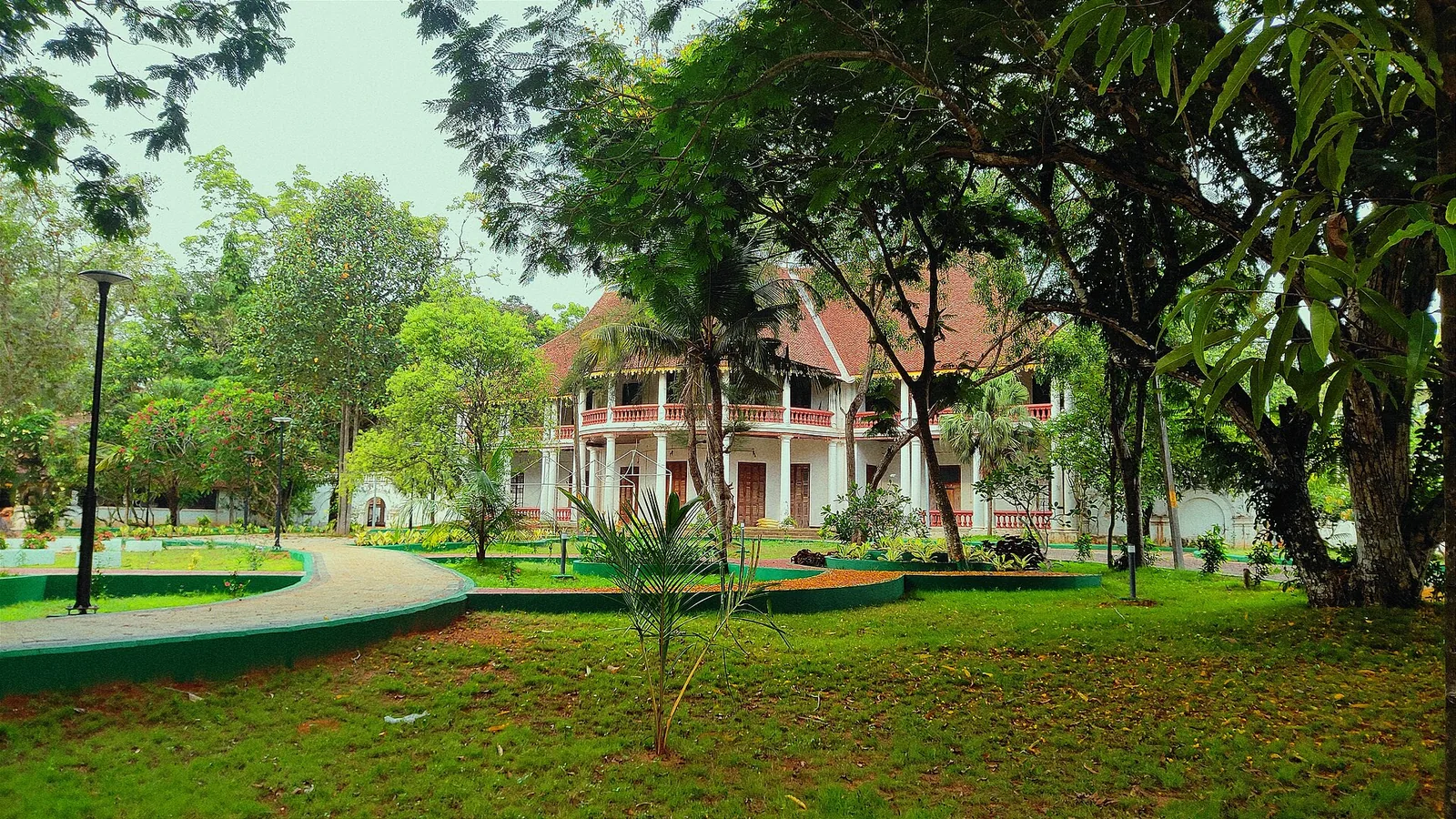
On the northern edge of Kollam, in a large green compound beside Ashtamudi, stands a long white house with a rounded central bay, a gable, and on the roof a crown with a lion on it and the motto Dieu et mon Droit — the motto of the British sovereign. It is called the British Residency. It was built between 1811 and 1819, and the interesting thing is not the architecture. It is the job description of the man who built it.
Two offices, one officer
Colonel John Munro was the British Resident to Travancore and Cochin. A Resident was, in theory, a diplomat: the representative of a foreign power at the court of an allied state, there to advise. Between 1810 and 1819 Munro was also the Diwan of both Travancore and Cochin — the head of their governments.
Set that out slowly, because it is easy to read past. The ambassador of the paramount power was simultaneously the prime minister of the state he was accredited to. There was nobody for the state to appeal to about the ambassador except the ambassador. This was not a scandal at the time and was not hidden; it was an arrangement, made during the regency of Rani Gowri Parvati Bayi in the years after the Velu Thampi revolt, and it is the clearest single illustration available of what "princely state" actually meant in practice in the early nineteenth century.
The Residency was raised in that period, to a design credited to a Captain Arthur, in a mix of European and Indian building with Tuscan columns. It is a large, calm, well-proportioned house, and it was the residence of a man who was both guest and government.
What Munro is remembered for locally
The record is genuinely mixed rather than simply dark, and it is worth saying so. Munro’s administration is associated with a series of reforms in Travancore, and his name is attached across this district in ways that have nothing to do with the fort or the flag — most visibly on Munroe Island in the Ashtamudi backwaters, a few kilometres from this house, which carries his name to this day and is now much better known to visitors than he is.
This site has a separate article on that island, so we will not retell it here. The point worth carrying from one to the other is simply that a single Scottish officer’s nine years left both a house and an island named after him inside one small district, which tells you how much of the machinery of the state passed through one desk.
The building now, and the maidan beside it
It functions as a government guest house, which is an unusually good outcome for a colonial building: it is maintained because it is used, rather than being either demolished or embalmed. The grounds are the part most visitors experience, and they are worth the walk.
Next door is Asramam Maidan, the largest open space in the middle of this city and the ground where Kollam Pooram is held. Between the maidan, the Residency compound, the adventure park and the lake frontage, the whole northern edge of Kollam is essentially one long green strip on the water, which is not what people expect from a cashew-processing town.
- It is a working government guest house. The grounds are the visit; the interior is not a museum and access depends on whether it is in use.
- Asramam Maidan is immediately adjacent, and is the venue for Kollam Pooram on the day after Vishu — mid-April.
- The whole strip is about two kilometres from Chinnakada, the town centre, and easiest by auto.
- Early morning and late afternoon are the hours worth spending here; the middle of the day on an open maidan is punishing.