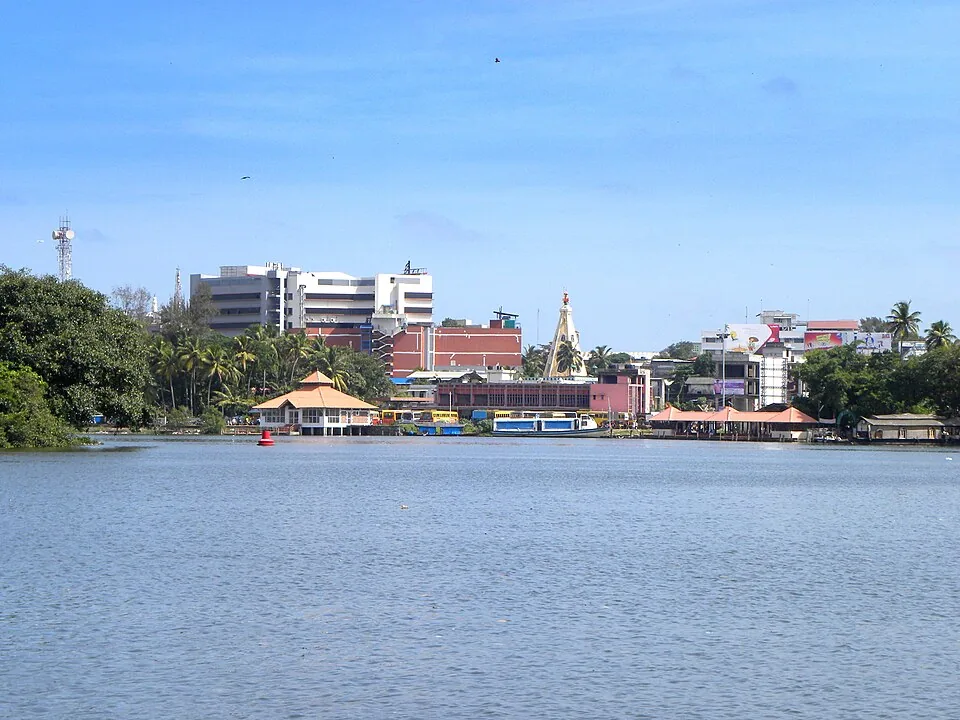
Kollam is the third of Kerala’s backwater bases and the one almost nobody uses. Alappuzha has the houseboat industry, Kumarakom has the resorts, and Kollam — which sits on a lake bigger and quieter than either — has cashew factories and a railway junction. That is exactly the argument for it: the same water, a fraction of the price, and a working town around it instead of a resort strip.
The shape of the place
Hold this and you will not get lost: the sea is west, Ashtamudi is east and north, and the town is the narrow ground in between. That is why Kollam feels long and thin, and why almost everything worth reaching sits within about four kilometres of the Chinnakada clock tower.
What is where, from the clock tower
| Direction | What | Roughly |
|---|---|---|
| West | Kollam beach and the seafront park | Under 2 km |
| North | Asramam — the maidan, the British Residency, the lake frontage, the boat jetty | About 2 km |
| North-west | Thangassery — the fort ruins, cemeteries and lighthouse | About 3 km |
| East and north | Ashtamudi Lake, canoes, Munroe Island beyond | 10 minutes to the water |
Do the lake properly, and do it small
The mistake here is booking the same product you would book in Alappuzha. Ashtamudi rewards the opposite: a small canoe with a punt pole, early in the morning, into the narrow canals rather than out onto the open water. That is where the fishing, the clam beds, the coir retting and the village edges are, and a large boat physically cannot go there.
The long public ferry to Alappuzha leaves from here too, and it is one of the genuine bargains of Indian travel — most of a day on the water for a fraction of a houseboat. It is covered on our Munroe Island page, along with the island itself, so plan it from there.
Getting here and using it as a base
Kollam Junction is a main-line station on the Thiruvananthapuram–Ernakulam route, which makes this one of the easiest towns in Kerala to reach without a car and one of the best places to sleep if you are moving by train. Thiruvananthapuram and its airport are about seventy kilometres south; Varkala is roughly half that. Alappuzha is a couple of hours north by road.
From here you can reach Thenmala, Palaruvi, Jatayu Earth’s Center, Sasthamcotta lake and the Achankovil forest road as day trips — an unusually varied set for a coastal town, because Kollam district runs all the way up into the Ghats.
What Kollam does not have
It has no beach worth swimming from in the resort sense — Kollam beach is a town beach and an evening place, not Varkala. It has no old quarter of the kind Fort Kochi has: the medieval port left documents rather than buildings, and the twelve-hundred-year-old trading city is legible in a copper-plate grant and a calendar rather than in streets. It has very little in the way of upmarket hotels. And its most famous industry, cashew processing, is behind factory walls and is not a visitor experience.
It is also, frankly, not a pretty town in the centre. Chinnakada is congested and functional. The beauty here is all on the water and at the edges, which is why the base-not-sight framing matters so much.
Two days that work
Day one: canoe on Ashtamudi at first light, Asramam and the Residency grounds mid-morning, out of the heat for the middle of the day, Thangassery in the late afternoon for the fort and the lighthouse, and the beach at sunset. Day two: either the long ferry north to Alappuzha, or inland to Thenmala and Palaruvi and back. If you are here in mid-April, the day after Vishu, everything else gives way to Kollam Pooram on the maidan.