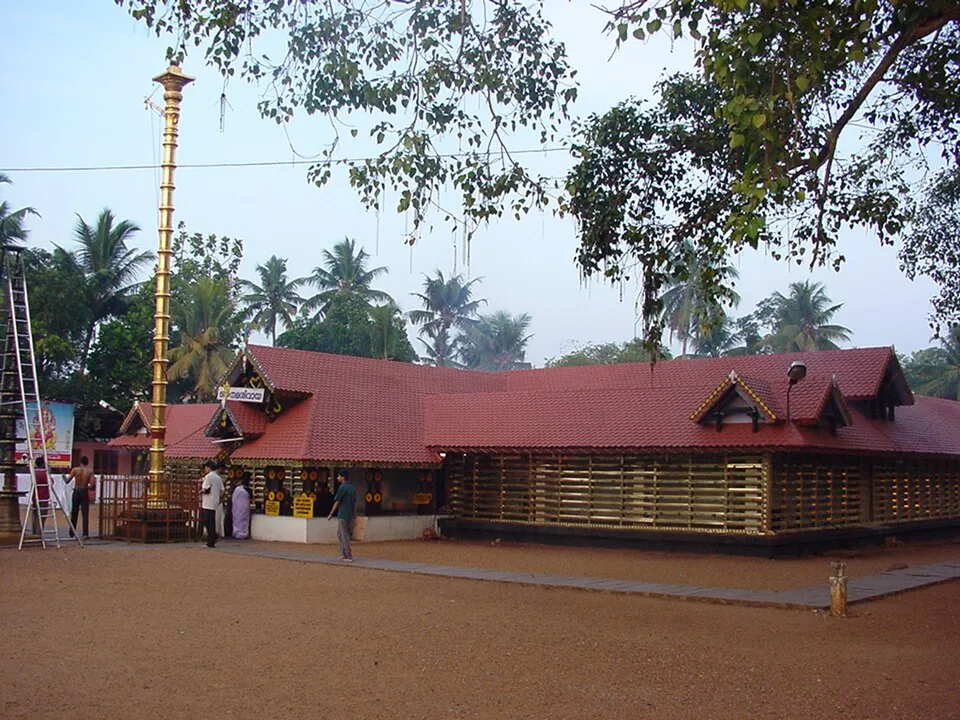
Kottarakkara today is a taluk headquarters of about thirty thousand people at a junction on the Main Central Road: a bus stand, a taluk office, a market, a great deal of through traffic. The interesting question about it is not what is there. It is how a capital becomes an absence — and in this case the answer is a specific, well-documented and rather brutal piece of eighteenth-century politics.
The house
Ilayidathu Swaroopam — also written Elayadathu — was a principality ruled by a branch of the same family as Venad, the house that became Travancore. Its seat was here. That relationship is the whole engine of what follows: this was not a foreign kingdom being conquered, it was a cousin branch being absorbed by the senior one.
The sequence, in order
In 1739 the chief of Kottarakkara died. Under the matrilineal succession customary in these houses, the claim passed to the senior female member of the family. Marthanda Varma of Travancore — then in the middle of welding the scattered chiefdoms of southern Kerala into one kingdom — refused to recognise her claim. She fled, and was given asylum by the chief of Thekkumkur.
At exactly this moment the Dutch East India Company saw an opening. Gustaaf Willem van Imhoff, governor of Dutch Ceylon, arrived at Kochi in 1739, took up the cause of the displaced Rani, and protested formally against Travancore’s annexation of the chiefdom. A local succession dispute had acquired a European sponsor — which is precisely how a great many small Indian polities ended in that century.
In 1741 the Dutch went further than protest and reinstated her by force. Marthanda Varma attacked, defeated the combined Kottarakkara and Dutch forces, and annexed the chiefdom outright. The Rani fled again, this time to Cochin. Ilayidathu Swaroopam ceased to exist as a state.
- 1739 — the chief dies, the succession is refused, van Imhoff arrives and protests.
- 1741 — the Dutch reinstate the Rani by force; Travancore defeats them and annexes the chiefdom.
- Accounts that give only one of these are compressing the sequence, not disagreeing. The two years measure different events and neither is wrong.
What this is NOT
It is not the cause of the Battle of Colachel. The annexation quarrel and the battle belong to the same year and the same war between Travancore and the Company, and it is fair to say the Kottarakkara succession was one of the occasions of that conflict. It is not fair to say the battle was fought over Kottarakkara. Colachel was fought on the coast far to the south and turned on much larger ambitions. The honest formulation: a small principality’s disputed inheritance became one of the levers by which a European company tried to intervene in Kerala, and the attempt failed comprehensively within two years.
After
By 1835 the place had been folded into the administrative machinery of Travancore as part of Kollam, and it has been a taluk town ever since — today one of Kollam district’s six taluks alongside Kollam, Pathanapuram, Karunagappally, Kunnathur and Punalur, with twenty-seven revenue villages under it. In most histories of the period Kottarakkara is a footnote to the Dutch war. Standing in the town, it is the other way round.
Frequently asked questions
What happened to the Kottarakkara principality?
Ilayidathu Swaroopam was annexed by Travancore in 1741, after Marthanda Varma refused to recognise the Rani’s succession in 1739 and then defeated the combined Kottarakkara and Dutch forces that had reinstated her.
Who was van Imhoff?
Gustaaf Willem van Imhoff, governor of Dutch Ceylon. He arrived at Kochi in 1739 and made the displaced Rani of Kottarakkara’s cause the Company’s, protesting against Travancore’s annexation.
Was the Battle of Colachel fought over Kottarakkara?
No. They belong to the same year and the same Travancore–Dutch conflict, and the Kottarakkara succession was one of its occasions, but Colachel was fought far to the south and over much larger ambitions.
Is there anything of the principality left to see?
Remnants and sites associated with the Ilayidathu Swaroopam period have been recorded around the town — something on the order of seven — but there is no standing, visitable palace. The town’s visitable heritage is the Mahaganapathi temple and the Thampuran Memorial Museum of Classical Arts.