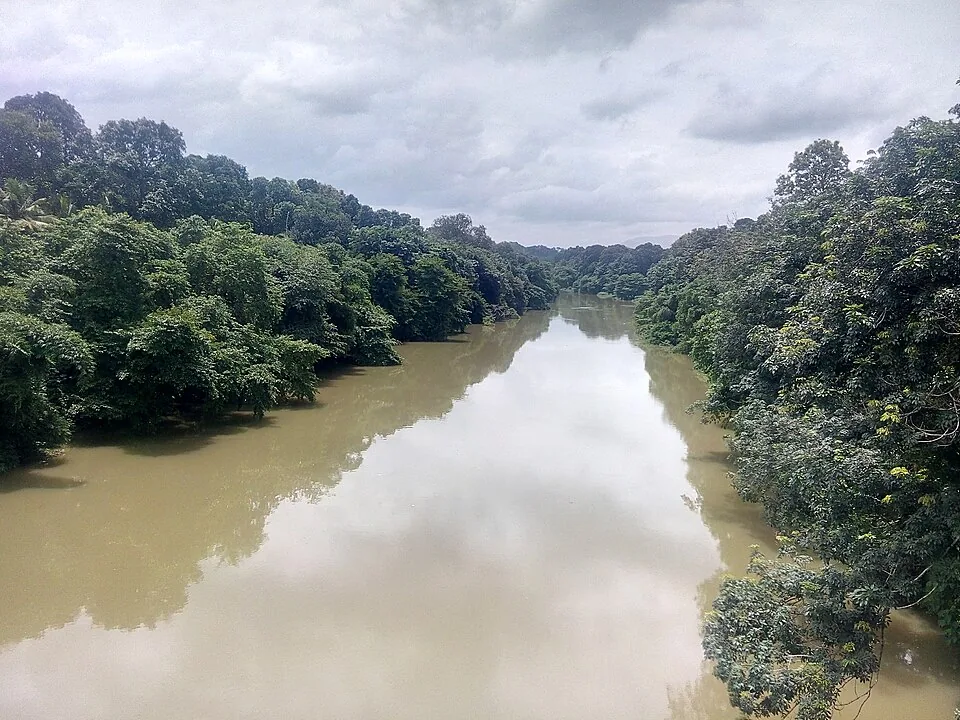
Bharananganam is small, and the thing most visitors get wrong is scale rather than direction. This is a highland parish village of a few thousand people on the Meenachil river, not a pilgrimage town with an infrastructure built around visitors. Most of the year it is quiet enough that arriving feels like intruding, and for ten days in July it is not.
Getting there
Pala is the practical anchor: the market town, the seat of the Syro-Malabar eparchy, and where the buses and the places to stay are. Sources put Bharananganam at four kilometres from Pala (Wikipedia) or about five (other accounts), and Kottayam at around thirty-three. We give both of the small figures because they differ and neither matters much — it is a short hop by bus or auto either way.
Two completely different visits
Which Bharananganam you will get
| When | What it is like |
|---|---|
| Most of the year | A quiet village. A steady but unhurried line at the tomb chapel, nuns, families, students before exams. An hour covers it comfortably. |
| Mid-July to 28 July | The nine-day novena and the feast of St Alphonsa. Tens of thousands of pilgrims, candle-lit processions through the lanes, bishops from many dioceses, roadside stalls, buses. A different place entirely. |
Neither is the better visit; they are two different experiences and you should choose deliberately rather than arrive in one expecting the other. If you want the feast, go for the feast and accept the crowds and the accommodation problem. If you want to stand quietly at a grave in a highland parish, go in any other month.
- This is a working parish. Masses, weddings and funerals happen in the same building people are queuing through.
- The tomb chapel line moves slowly and quietly. Join it, do not step around it.
- The small museum and convent chapel hold her belongings — spectacles, rosary, sandals, letters. Worth the extra fifteen minutes.
- Modest dress, as at any Kerala church. Phones down in the chapel unless you can see other people using them.
What else is here
Bharananganam is not a one-church village. It holds several historic Syro-Malabar parishes and convent chapels across its hills, plus the Franciscan Clarist convent connected with the saint. Walking between two or three of them, through rubber and spice smallholdings on red-earth slopes, is the part of the visit nobody puts in an itinerary and the part that actually tells you where you are. This is the Palai highlands, where the parish is the unit of social life and has been for a very long time.
What it does not have
No hotel strip, no restaurant row, no visitor centre. Stay at Pala or Kottayam. And no ancient visible fabric — whatever date you accept for the parish, the buildings you can see are modern, and the shrine chapel that draws the crowds dates from 1945. Come for a place people keep coming to, not for architecture.