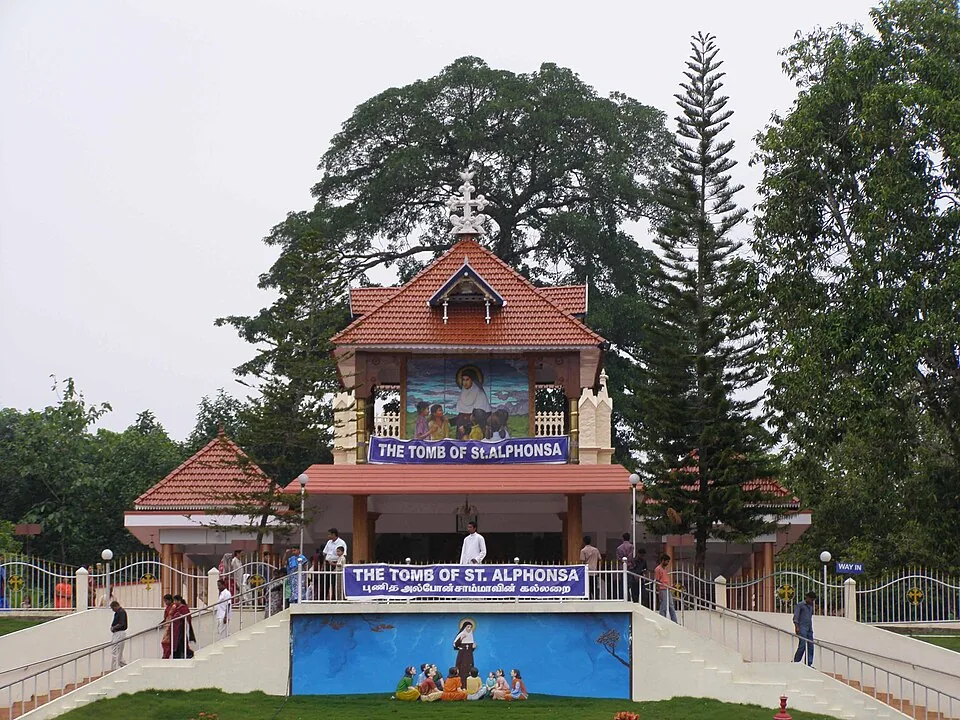
Bharananganam is one of the most visited Christian pilgrimage places in Kerala, and the reason is a grave. What almost nobody arriving here knows is that the woman in it was not from this village. She came as a teenager, spent nineteen years in it, and died at thirty-five — and the record of those nineteen years is unusually precise, because a religious congregation keeps dates.
Kudamalur, 1910
She was born Anna Muttathupadathu on 19 August 1910 at Kudamalur, then in the princely state of Travancore, and baptised on 27 August. Her parents were Joseph Muttathupadathil and Mary Puthukari. Kudamalur is about thirty kilometres from Bharananganam and is a distinct place with its own claim on her; conflating the two is the commonest error in writing about this village.
One incident from her girlhood is recorded and is impossible to leave out, though it should be reported plainly rather than dramatised. In 1923, aged thirteen, she suffered severe burns to her feet. The account given is that the injury was self-inflicted, to make herself an unattractive prospect and so avoid an arranged marriage. She lived with the consequences of it. Whatever one makes of that as an act, it belongs to the biography and it is the first thing in it that she chose.
The Bharananganam years, dated
She arrived at the Franciscan Clarist convent at Bharananganam on Pentecost Sunday 1927, at sixteen. From there the record is a sequence of fixed points.
Nineteen years at Bharananganam
| Date | What happened |
|---|---|
| Pentecost Sunday 1927 | Arrives at the Franciscan Clarist convent, Bharananganam |
| 2 August 1928 | Receives the postulant’s veil and takes her religious name |
| 19 May 1930 | Begins her novitiate |
| 11 August 1931 | First vows |
| 12 August 1936 | Permanent vows |
| 14 June 1939 | Pneumonia |
| 29 September 1941 | Receives the Anointing of the Sick |
| July 1945 | Gastroenteritis and liver complications |
| 28 July 1946 | Dies, aged 35 |
She taught — at the school attached to the parish, among other places — and she was ill for most of her adult life. The years between 1930 and 1935 are described as a period of continuous poor health. What the timeline shows, read without devotional framing, is a woman who took final vows at twenty-five, was anointed for death at thirty-one, and lived another five years after that.
- The shrine is a working parish, not a monument. Ordinary Masses, funerals and weddings happen here.
- The feast is 28 July, the anniversary of her death, with a nine-day novena building through mid-July. The village fills.
- A small museum and the convent chapel hold her belongings — spectacles, rosary, sandals, letters.
- She is not from here, and Kudamalur is a separate place with its own claim. Saying so takes nothing away from either.
Why the devotion started at all
Nothing about the death of a young nun in a highland village in 1946 made it inevitable that anyone outside the parish would remember her. What is recorded is that people began visiting her grave and praying there, and kept coming — first the pupils and the parish, then further afield. The institutional process followed the popular one rather than starting it: she was declared a Servant of God in 1953, seven years after her death, by which time the visiting had already established itself.
That order of events is the honest shape of this place. Bharananganam did not have a saint installed in it. It had a grave that people would not stop coming to, and the Church eventually caught up. The formal machinery that followed — Venerable, Blessed, canonised — is set out in our companion piece on the two very different claims made about her, which are routinely flattened into one.