
At the heart of the temple town of Chidambaram, in Tamil Nadu’s Cuddalore district, stands a shrine devoted to an idea as much as to a god. Here Shiva is worshipped as Nataraja, the “Lord of the Dance”, caught mid-movement in the pose that Hindu tradition calls the Ananda Tandava — the dance of bliss through which, the texts say, the universe is created, sustained and dissolved. The Thillai Nataraja Temple has drawn pilgrims, poets and kings for well over a thousand years, and it guards one of the most quietly radical ideas in Indian religion: that the divine, at its deepest, has no form at all.
- Where: Chidambaram, Cuddalore district, Tamil Nadu, around 220 km south of Chennai.
- Deity: Shiva as Nataraja, performing the Ananda Tandava, the cosmic “dance of delight”.
- Element: The akasha (space or ether) shrine among the five Pancha Bhoota Sthalams of Shiva.
- Signature features: the golden-roofed Chit Sabha, the hereditary Dikshitar priests, and the curtained “Chidambara Rahasya”.
The temple of space
Across southern India, five temples honour Shiva through the five great elements of classical thought — earth, water, fire, air and space. These are the Pancha Bhoota Sthalams, and Chidambaram is the shrine of akasha: space, sky, ether, the subtlest and most all-pervading of the five. It is a fitting assignment. Where the other four temples give the worshipper something to see — a linga of earth or sand, a spring, a lamp — Chidambaram’s inner sanctum offers, in one corner, an emptiness. This is deliberate. Space cannot be sculpted, and so the temple asks the visitor to contemplate exactly that.
The dance, read line by line
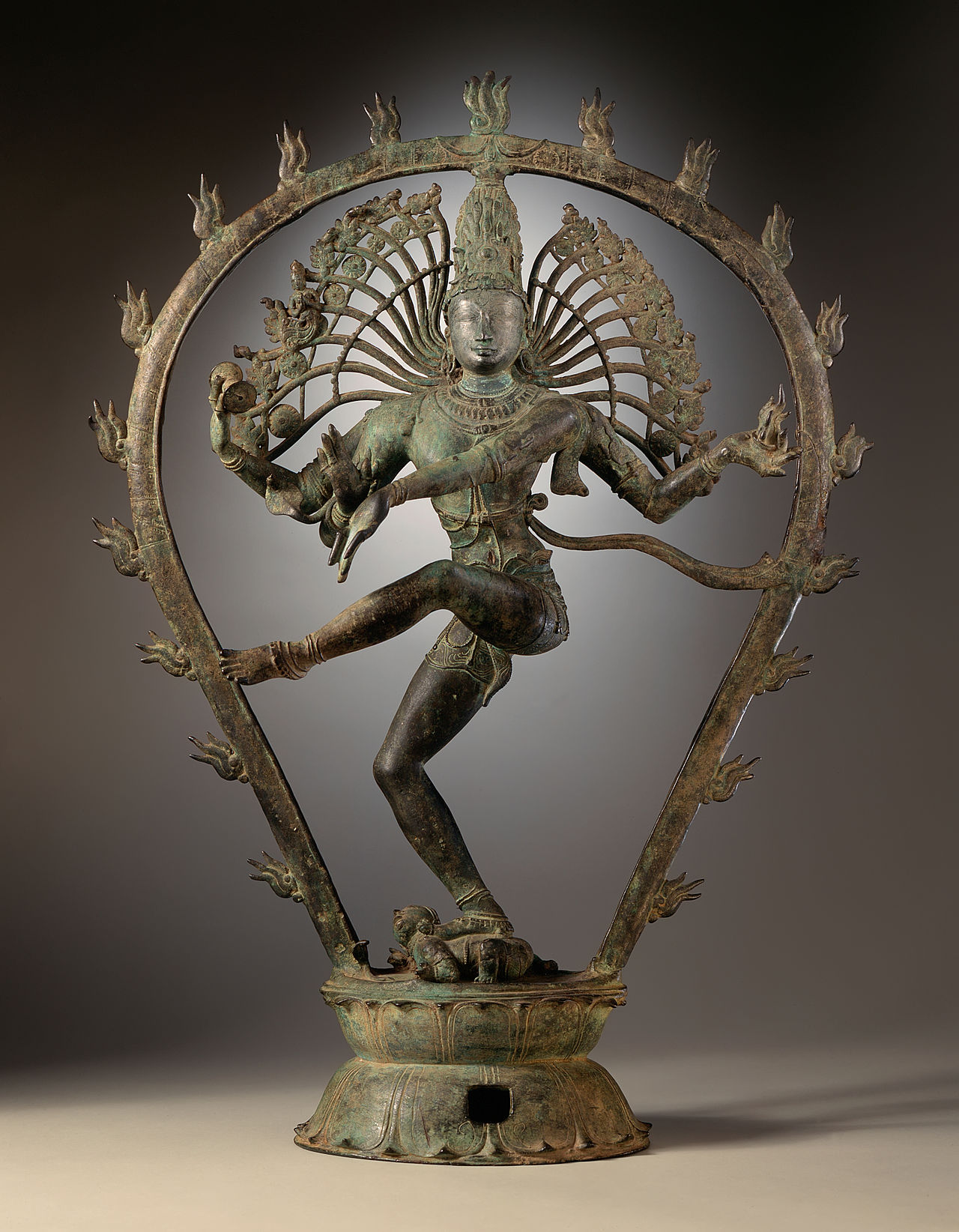
The Nataraja image that spread from this region under the Cholas is among the most studied in world art. Shiva dances within a ring of flame that stands for the cosmos. His raised foot promises release; the foot pressed down crushes a small figure — the demon Apasmara, ignorance itself. One right hand holds a drum whose beat marks creation; one left hand cradles the fire of dissolution. A further right hand is raised in the gesture of reassurance, telling the devotee not to fear, while a lower hand points to the lifted foot and the refuge it offers. Creation and destruction, motion and stillness, are held in a single balanced figure. Fittingly, the eastern gateway tower of Chidambaram carries relief panels illustrating all 108 karanas — the basic units of movement set out in the Natya Shastra — a stone grammar of dance that underlies the classical Bharatanatyam tradition.
The golden hall and the curtained secret
The bronze Nataraja stands in the Chit Sabha, the “hall of consciousness”, a modest wooden pavilion whose roof — together with the adjoining Kanaka Sabha — is famous for its covering of gilded and copper plating that gives Chidambaram its epithet, the golden hall or Pon Ambalam. Yet the shrine’s most celebrated feature is not the idol but the space beside it. To the right of the Nataraja, behind a curtain roughly 3.5 metres long, is the Chidambara Rahasya — the “secret of Chidambaram”. When the curtain is drawn during worship, there is no image behind it, only garlands of golden bilva leaves hung over empty air. This void is understood as the akasha linga, the formless representation of Shiva as the boundless absolute, Brahman. Tradition frames it gently: the point one spends a lifetime seeking cannot be carved, and so it is shown as nothing, and everything.
Priests, patrons and a temple rebuilt in gold
Chidambaram is served not by an outside priesthood but by the Dikshitars, sometimes called the Podu Dikshitars, a hereditary Brahmin community said by tradition to have accompanied Shiva to Thillai. By custom every married Dikshitar man becomes a trustee and officiating priest of the temple, and the community has administered it collectively for centuries — an unusually independent arrangement among the great South Indian temples. Their care preserved a site that the medieval Chola dynasty raised to imperial prominence. The Cholas took Nataraja as their tutelary deity; the ninth-century king Parantaka Chola I is credited with gilding the roof of the central hall, and successive rulers enlarged the complex into the walled temple-city seen today, with its towering gopurams — the four principal gateway towers rising to around 42.7 metres — and its pillared pilgrim halls, including the great thousand-pillared mandapa. To dance at Chidambaram, in the Chola imagination, was to reign over the cosmos itself.
Frequently asked questions
What does the Chidambaram temple represent among the Pancha Bhoota Sthalams?
It is the akasha shrine — the temple of space, sky or ether — among the five elemental temples of Shiva in South India. The other four honour earth, water, fire and air.
What is the Chidambara Rahasya?
It is the “secret of Chidambaram”: a curtained space beside the Nataraja idol that, when opened, reveals no image at all — only strings of golden bilva leaves over empty air. This void, the akasha linga, symbolises formless divinity, Shiva as the boundless absolute.
Who are the Dikshitar priests?
The Dikshitars (Podu Dikshitars) are the hereditary Brahmin community that has managed and performed worship at Chidambaram for generations. By tradition, every married Dikshitar man becomes both a trustee and an officiating priest of the temple.
What is the Ananda Tandava?
It is the “dance of bliss” that Nataraja performs — a cosmic dance encoding the creation, preservation and dissolution of the universe. The famous Chola bronze captures it: drum of creation, fire of destruction, a foot crushing ignorance, and a hand raised in reassurance.
Why was Chidambaram important to the Chola dynasty?
The Cholas revered Nataraja as their family deity. Parantaka Chola I is credited with gilding the central hall’s roof in the ninth century, and later Chola rulers expanded the complex into a grand walled temple-city, making Chidambaram a spiritual centre of their empire.