
In the foothills of the Western Ghats in Tenkasi district, at roughly 160 metres above sea level, the little town of Courtallam — Kutralam in Tamil — sits beneath a wall of forested hills. From that wall the Chittar river spills over a series of ledges to form a scatter of some nine waterfalls, large and small, threaded through the town and the woods above it. The cascades, and the health resorts and bathing ghats that have grown up around them, long ago earned Courtallam its enduring nickname: the ‘Spa of South India’.
- Where: Tenkasi district, Tamil Nadu, in the Western Ghats foothills.
- The draw: a cluster of waterfalls fed by the Chittar river.
- The season: the south-west monsoon, roughly June to September.
- Also here: the Kutralanathar Shiva temple and its Chitra Sabha.
The waters and the herb-slope belief
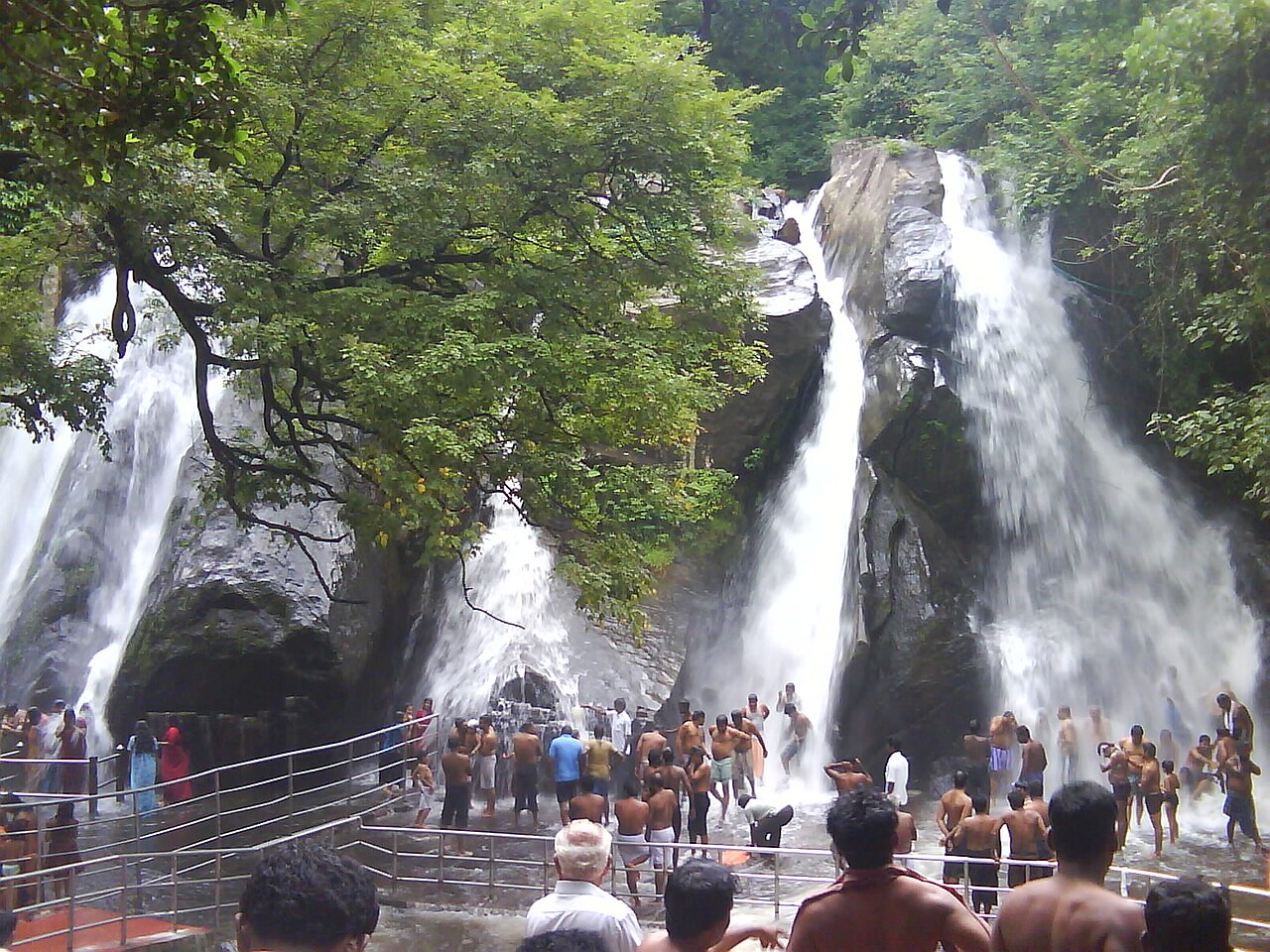
What sets Courtallam apart, in local tradition, is not just the falls but the water itself. The streams that feed them run down forested slopes said to be thick with medicinal herbs, and a long-standing belief holds that the water picks up therapeutic and curative properties on the way — that a soak beneath the falls eases aches and ailments. This is best understood as folk tradition rather than proven fact, but it is central to Courtallam’s identity: bathers come as much for the reputed cure as for the spectacle, and the epithet ‘Spa of South India’ grew directly from it. The place carries the traditional Tamil-Saivite epithet Dakshina Kailasam, the ‘Kailash of the South’.
A cluster of falls
Courtallam is not one waterfall but many, each with its own name and character. The Main Falls (Peraruvi), tumbling around 60 metres beside the town, is the largest and busiest, its pool railed off into bathing enclosures. A short way off, the Old Courtallam Falls (Pazhaya Aruvi) mark the original bathing spot, while the Five Falls (Aintharuvi), which splits into a fan of separate streams, is often the most popular of all.
Deeper into the hills lie the quieter cascades: Shenbaga Devi Falls, reached by a forest path and named for a nearby shrine; Honey Falls (Thenaruvi), so called for the wild bees’ nests on the cliffs above; Tiger Falls (Puli Aruvi); and the smaller Chitraruvi. Together they turn a visit into a circuit rather than a single stop.
The temple and the Chitra Sabha
Courtallam is a place of pilgrimage as well as bathing. In the heart of the town stands the Kutralanathar Temple, dedicated to Shiva, and beside the sacred landscape sits the Chitra Sabha — the ‘hall of pictures’. It is counted among the Pancha Sabhai, the five halls in which Shiva as Nataraja is said in tradition to have performed his cosmic dance; Courtallam’s is the one associated with the picture hall, its walls carrying old paintings of deities and legends. For devotees the falls and the temple are of a piece: the descent to Dakshina Kailasam is a cleansing of body and spirit alike.
The season, and staying safe
Courtallam runs on an unusual calendar. Most of Tamil Nadu takes its rain from the north-east monsoon late in the year, but Courtallam’s falls swell with the south-west monsoon, and the ‘season’ — the busy months when the water runs full and the town fills with bathers — falls roughly between June and September. Come in the dry months and several of the cascades slow to a trickle or fail altogether.
Full water is also the dangerous water. The catchment is small and steep, and heavy rain in the hills can send a sudden surge — a flash flood — down the streams within minutes. Authorities close the bathing areas whenever the falls are in spate, and the more remote cascades such as Honey Falls are periodically shut for strong undercurrents. The sensible rule is simple: bathe only where and when the falls are officially open, watch for warning whistles, and leave the water the moment the flow changes.
For where Courtallam sits among the state’s other cascades, see our guide to the waterfalls of Tamil Nadu at /india/tamil-nadu/guides/tamil-nadu-waterfalls, and for planning around its unusual south-west monsoon calendar, our guide on the best time to visit Tamil Nadu at /india/tamil-nadu/guides/best-time-to-visit-tamil-nadu.
Frequently asked questions
Why is Courtallam called the ‘Spa of South India’?
The name grew from a long-standing belief that the falls’ water, having run down forested slopes rich in medicinal herbs, carries therapeutic and curative properties. Bathing beneath the cascades is a tradition here, and health resorts cluster around the falls. The curative claim is folk belief rather than proven fact, but it is central to Courtallam’s identity.
Which are the main waterfalls at Courtallam?
The Chittar river forms a cluster of some nine falls. The best known are the Main Falls (Peraruvi), the Old Courtallam Falls (Pazhaya Aruvi) and the popular Five Falls (Aintharuvi). Quieter ones in the hills include Shenbaga Devi Falls, Honey Falls (Thenaruvi), Tiger Falls (Puli Aruvi) and the smaller Chitraruvi.
When is the best time to visit?
Courtallam’s season runs roughly June to September, when the south-west monsoon keeps the falls full. This is unusual for Tamil Nadu, most of which relies on the later north-east monsoon. Outside these months several of the cascades run low or dry.
Which district is Courtallam in?
Courtallam (Kutralam) lies in Tenkasi district in the south of Tamil Nadu, in the foothills of the Western Ghats. The town of Tenkasi is about 5 km away. It was formerly part of Tirunelveli district before Tenkasi was carved out.
What is the Chitra Sabha?
The Chitra Sabha, or ‘hall of pictures’, is associated with the Kutralanathar Shiva temple at Courtallam. It is counted among the Pancha Sabhai, the five halls where Shiva as Nataraja is said in tradition to have danced, and its walls carry old paintings of deities and legends.
Is it safe to bathe in the falls?
Only in the designated, officially open bathing areas. The steep catchment can produce sudden flash floods after rain in the hills, so the authorities close the falls when they are in spate and shut remote cascades for strong undercurrents. Heed warnings and leave the water if the flow changes.