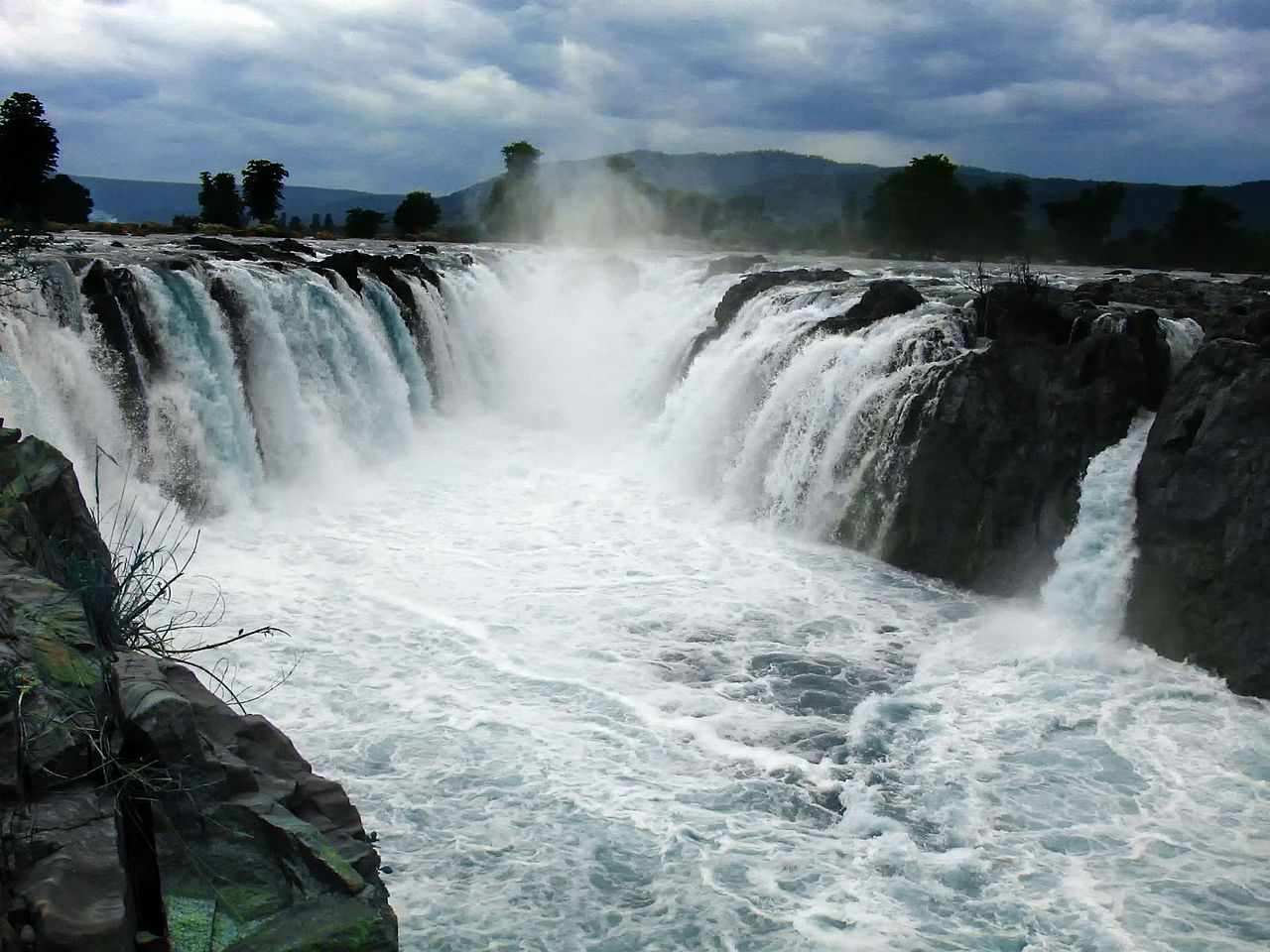
There is a moment, on the road down from Dharmapuri, when you hear Hogenakkal before you see it — a low, continuous roar carried on the wind. Then the gorge opens up and the Kaveri (Cauvery) is there below you, no longer the broad, placid river of the plains but a torrent forcing itself through a narrow throat of black rock. Where the water strikes the ledges it explodes into a fine white spray that hangs in the air like smoke. That spray is the whole story of the place, and it is written into its name.
- On the Kaveri (Cauvery) at the Tamil Nadu–Karnataka border, Dharmapuri district.
- Name from Kannada hoge (“smoke”) + kal (“rock”) — “smoking rock”.
- Signature experience: a spin through the gorge in a parisal (round coracle).
- Best after the monsoon, roughly October to February, when the river is in full spate.
The smoking rock
The name is Kannada in origin, a compound of hoge, meaning “smoke”, and kal, meaning “rock”. When the river falls on the rocks below, the sheer force of the water throws up a mist so dense that it seems to rise from the stone itself, as if the rocks were smouldering. Travellers and tourism writers have long borrowed a grander comparison, dubbing Hogenakkal the “Niagara of India” — a flattering nickname worth taking with a pinch of salt, since the falls are a series of modest drops rather than one great sheet, the longest measuring around twenty metres.
What gives Hogenakkal its drama is not height but geometry. Here the Kaveri leaves the Deccan uplands and squeezes into a gorge before spilling out onto the plains, splitting into a dozen channels that plunge, braid and rejoin among carved stone islands. In the wet season the whole gorge becomes a single churning cauldron; in the dry months it settles into a maze of green pools and quiet cascades.

Among the oldest rocks on Earth
The dark stone the water carves through is far older than the river itself. Geologists have taken a particular interest in the carbonatite here — an unusual igneous rock rich in carbonate minerals. The site is described in the scientific literature as among the oldest carbonatite occurrences of its kind in South Asia, and one of the oldest in the world; a 1994 study of the pyroxenite–carbonatite complex dated it to roughly two billion years. Figures like these are best treated as attributed findings rather than settled fact, but they place Hogenakkal firmly in the story of the Earth’s deep past, when the crust of the southern peninsula was first taking shape.
A spin in the parisal
The signature way to meet the falls is from the water, in a parisal — the round basket boat known in English as a coracle. Built on a bamboo frame roughly two metres across and made watertight with hide or plastic and a coat of tar, each carries a handful of passengers plus a boatman who propels and pirouettes it with a single paddle. There is no keel and no bow; the coracle simply drifts, spins and slips between the rocks, carrying you close enough to the cascades to feel the spray. Boatmen will steer you under a curtain of falling water if the flow allows, and the little craft turns lazy circles in the calmer pools.
Back on the rocks and along the bathing ghats, a second tradition waits: the oil massage. Masseurs work in the open air, kneading herbal oils into the shoulders and limbs of pilgrims and day-trippers before they bathe. The river water itself carries a long-standing local reputation for being medicinal — said to gather the virtues of the many herbs growing along its course upstream. This is a matter of belief rather than proven fact, and it is part of why bathing at Hogenakkal has drawn people for generations.

When to go, and a note on safety
The falls are at their most spectacular soon after the monsoon, when the Kaveri is in full spate — broadly October to February, with the strong post-monsoon flow of November to January the popular window. This is exactly when the river demands respect. Coracle rides and bathing are suspended when the water rises dangerously, and it pays to heed local warnings; the gorge that makes Hogenakkal beautiful also makes it unforgiving. The wooded Melagiri hills that frame the approach add to the sense of remoteness, and the nearest large towns are some distance away, so most people come on a day trip.
Hogenakkal is more than a scenic stop. As a major point where the Kaveri enters Tamil Nadu, it lends its name to the Hogenakkal Integrated Drinking Water Project, a large scheme — backed from 2008 by Japanese funding — to supply drinking water to the Dharmapuri and Krishnagiri districts. It is a reminder that this river, so theatrical here, is above all a lifeline for the plains it is about to enter. To place Hogenakkal among the state’s other cascades, see our guide to /india/tamil-nadu/guides/tamil-nadu-waterfalls, and to time your trip with the seasons, read /india/tamil-nadu/guides/best-time-to-visit-tamil-nadu.
Frequently asked questions
What does the name Hogenakkal mean?
It comes from the Kannada words hoge (“smoke”) and kal (“rock”) — “smoking rock”. The force of the Kaveri hitting the rocks throws up a mist that looks like smoke rising from the stone.
Why is Hogenakkal called the “Niagara of India”?
It is a nickname popularised by tourism and travel writers for its rushing multi-channel cascades. It is a loose comparison rather than a literal one — Hogenakkal is a series of drops through a gorge, the longest about twenty metres, not a single giant sheet of water.
Are the rocks at Hogenakkal really among the oldest on Earth?
The carbonatite rock here is described in scientific studies as among the oldest of its kind in South Asia and one of the oldest in the world, with a 1994 study dating the complex to around two billion years. These are attributed research findings and worth treating as such.
What is a coracle ride at Hogenakkal?
A parisal is a round basket boat on a bamboo frame, waterproofed with hide or plastic and tar, steered by a boatman with a single paddle. It carries you through the gorge and close to the cascades — the classic Hogenakkal experience.
Is the water at Hogenakkal really medicinal?
The river has a long-standing local reputation for medicinal properties, attributed to herbs growing along its upstream course, and oil massages before bathing are a local tradition. This is a matter of belief rather than proven fact.
When is the best time to visit Hogenakkal Falls?
Soon after the monsoon, broadly October to February, when the river is in full spate; November to January is the popular window. Note that boating and bathing are suspended when the water runs dangerously high.