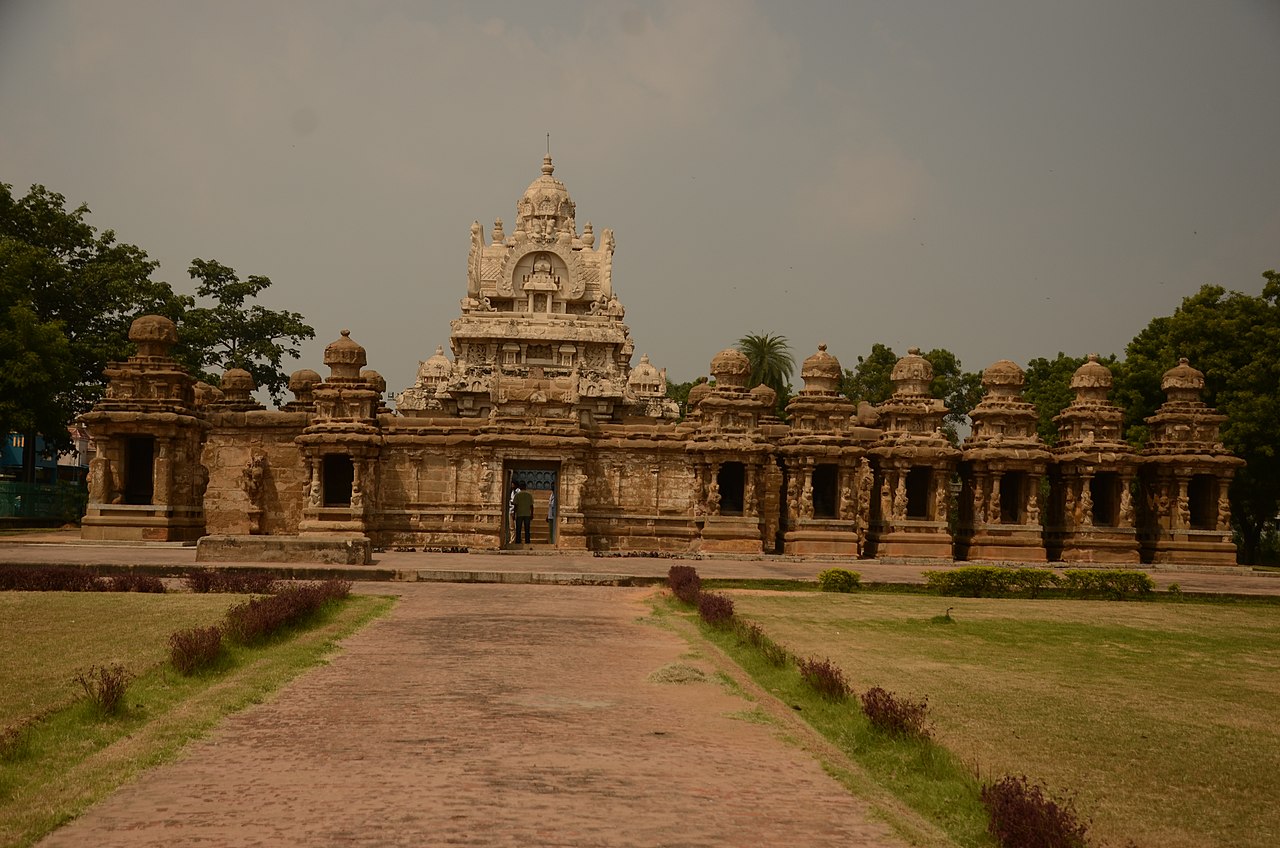
Most temple towns keep their busiest shrines at the centre and their oldest wonder somewhere quiet. Kanchipuram — the “city of a thousand temples” — is no different. On the western edge of town, largely empty of the crowds that fill the great living temples nearby, sits the oldest survivor of them all: the Kailasanathar Temple, a low sandstone complex raised around 700 CE by the Pallava king Rajasimha. It is the oldest structure in Kanchipuram, and it is, in a very real sense, the blueprint from which much of South Indian temple architecture would later grow.
- Built by the Pallava king Rajasimha (Narasimhavarman II), around 685–705 CE.
- The oldest surviving structural temple in Kanchipuram — built of sandstone.
- An ASI-protected monument: quiet and largely open, not a busy active temple.
- Look for the 58 sub-shrines, the recurring Somaskanda panels and faded early murals.
- On the western edge of town — an easy, uncrowded add-on to the silk-and-temple circuit.
A king called “the lion”
The temple was the work of Rajasimha — a throne-name that means “the lion” — better known to historians as Narasimhavarman II, who ruled the Pallava dynasty in the early 8th century. Construction is usually dated to roughly 685–705 CE, with a small front shrine added a little later by his son, Mahendravarman III. The same king is credited with the celebrated Shore Temple at Mahabalipuram. Where earlier Pallava monuments there had been carved out of living rock, the Kailasanathar Temple was built up, block by block, from soft sandstone — a temple assembled rather than excavated, and one of the dynasty’s first steps from cave into freestanding architecture.

A ring of fifty-eight shrines
Step inside the rectangular courtyard and the design reveals itself. The main sanctum is crowned by a tiered, pyramidal vimana — the tower that later Dravidian builders would raise ever higher — while the enclosing wall is lined with 58 small sub-shrines, each once housing a different form of Shiva. Carved into the sanctum walls are repeated Somaskanda panels: Shiva seated with his consort Parvati and the infant Skanda between them, a composition the Pallavas made their own. The soft sandstone let the sculptors work freely, and lion-based pilasters and half-animal figures — hallmarks of the early Dravidian style — run through the complex. Traces of paint still cling to some of the inner cells: faded fragments that count among the earliest surviving mural art in Tamil Nadu.
The passage of birth and death
The temple’s most quietly moving feature is easy to miss. Around the innermost sanctum runs a narrow circumambulatory passage — a sandhara — so tight that a visitor must almost crawl through it. It has two small openings, and tradition reads them as the gate of birth and the gate of death: you enter the passage as if born, pass around the god in darkness, and emerge as if reborn. The idea that this cramped circuit stands for the whole cycle of life, death and release is an interpretation handed down in local devotional tradition rather than a documented statement of the builders’ intent — best enjoyed as a legend that gives the architecture its meaning, not as recorded history. Whatever the Pallavas meant by it, the passage is real, and squeezing through it is the closest a visitor comes to touching the temple’s original mystery.
Why it matters — and visiting
The Kailasanathar Temple is more than Kanchipuram’s oldest building. Its tiered vimana, its ring of sub-shrines and its enclosed courtyard set a template that later South Indian temples would refine for a thousand years — and Rajasimha’s Kailasanatha model directly shaped the temples built under his own patronage. Today it is an ASI-protected monument: cared for, quiet and largely open through the day, and free to enter. It is a still, sculptural place, not a busy working shrine, which is exactly its charm. It pairs naturally with the great active temples on the other side of town — the towering Ekambareswarar Temple and the Kamakshi Amman Temple — and makes a natural first or last stop on a temple day. For the wider circuit, see /india/tamil-nadu/guides/kanchipuram-silk-and-temples-story and, for its rock-cut Pallava cousins, /india/tamil-nadu/guides/rock-cut-cave-temples-of-tamil-nadu.
Frequently asked questions
Who built the Kailasanathar Temple, and when?
It was built by the Pallava king Rajasimha — also known as Narasimhavarman II — in the early 8th century, usually dated to about 685–705 CE, with a small front shrine added later by his son Mahendravarman III.
Why is the Kailasanathar Temple important?
It is the oldest surviving structural temple in Kanchipuram and an early prototype of the Dravidian style. Its tiered vimana, sub-shrines and enclosed courtyard set a pattern that later South Indian temple architecture followed and refined.
What is the temple built from?
Its superstructure and carvings are sandstone — a soft stone that let the Pallava sculptors work in fine detail. This is one of the first Pallava temples assembled from cut stone rather than carved from living rock.
What is the narrow passage around the sanctum?
It is a tight circumambulatory passage with two low openings that devotional tradition reads as the gates of birth and death, symbolising the cycle of life and rebirth. That meaning is legend and interpretation rather than documented fact, but the passage itself is genuine and part of the original design.
Is it a busy active temple?
No. The Kailasanathar Temple is a quiet monument protected and maintained by the Archaeological Survey of India, not a crowded working shrine. That makes it one of the calmest and most rewarding temples to visit in Kanchipuram.
What are the Somaskanda panels?
They are recurring sculpted reliefs showing Shiva seated with his consort Parvati and the infant Skanda between them — a composition the Pallavas favoured and repeated through the sanctum of this temple.