Almost everything written about Ketti describes it from above. The valley is photographed from a lay-by on the Ooty road, admired for ten minutes and left. What almost nothing says is who lives down there, and the answer changes the place completely: the Ketti valley is a Badaga valley, and Badaga is the language you will hear in its shops before you hear Tamil.
The Badaga are an ethno-linguistic community of the Nilgiris, living across the district in something close to four hundred villages, which they call hattis. Their name means northerner — it comes from the Old Kannada badagana, north — and their language is closely related to Kannada rather than to the Tamil that surrounds it. That single fact tells you the community arrived from somewhere, and their own tradition says where.
Seven siblings and a hill
The Badaga oral tradition holds that their ancestors came up from the plains of Mysore, and that they descend from seven siblings who had been living in the Thalaimalai hills before fleeing a ruler who had tried to rape their sister. Scattering into different corners of the Nilgiris, they became the founding lines of the community. One of the brothers, Hethappa, is the figure the tradition follows: while he was away working, two Todas assaulted his wife and took his goods, and he found help from two men of the Bayaluru who agreed on condition that they marry his daughters.
It is worth saying plainly what kind of account this is. It is oral tradition, recorded by outsiders, and it carries the shape that origin stories usually carry — a flight, a wrong, a bargain, a scattering into the places people now live. The anthropologist Paul Hockings, who spent close to six decades on Badaga ethnography, put the historical question the other way round and rather sharply: the tribe, he wrote, "despite its sketchy history is as indigenous to the Nilgiris as the English are to Britain."
Why there is a shrine beside the station
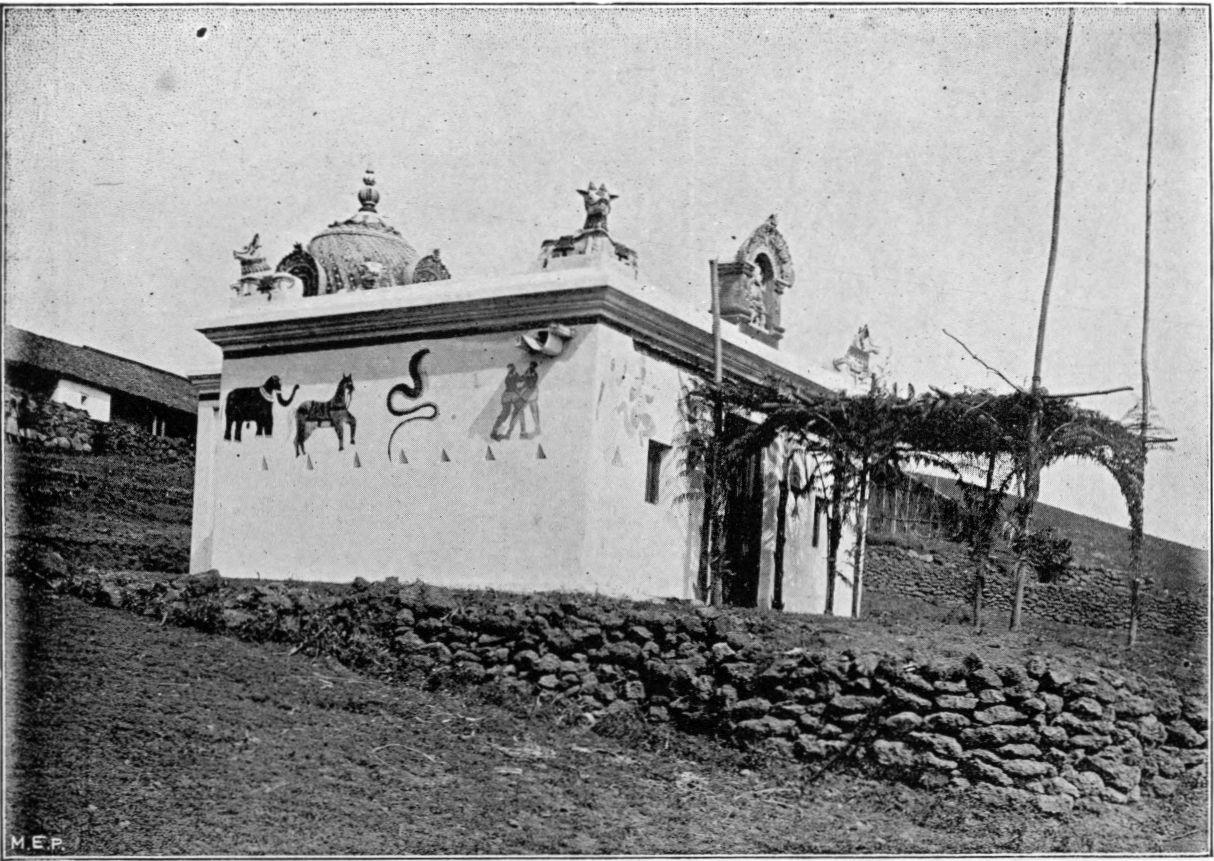
Nine hundred metres from Ketti railway station there is a Hethai Amman shrine. Visitors who notice it tend to file it as a small Hindu temple, and that is not quite what it is. The Badaga worship their seven founding ancestors under the name Hethappa, or Hetha — so a Hethai shrine is the community worshipping the people it believes it descends from. It is a working village shrine rather than a monument: opened by the community rather than kept open, and busiest in the cold months around December and January.
This is the reason the entry on our Ketti page tells you to ask before going in, and to ask before photographing anybody. It is not a heritage site with a custodian. It is somebody’s family shrine, standing beside a railway platform that tourists get off at.
The oath the British courts borrowed
One detail from the early 1900s says more about Badaga seriousness than any description could. The community swore its most solemn oaths at the Sri Mariamman temple, and the form was exact: you bathed, you brought a coconut and fruit, you killed an animal and laid its head on the step of the shrine, and then from seven feet away you walked to that step and put out the lamp burning before the idol. Extinguishing the light was the oath.
British judges knew about it and used it. Rather than rely on a courtroom oath, they would on occasion send a witness off to perform this one, with a court official going along to watch it done, and take the result as the measure of whether the witness was telling the truth. The reverence has not gone: in April the Badaga still pull a car bearing the image of Sri Mariamman through Ooty, to their own music and dancing.
A language, and a question that is still open
Badaga is spoken, taught in nothing, and written down mostly by researchers. A collection in Paris at LACITO holds a large number of Badaga stories and songs gathered over the past two decades, which is a strange place for a Nilgiri valley to keep its literature. The community has produced its share of public figures: Akkamma Devi, the first Badaga woman to graduate from college, sat for the Nilgiris in the Lok Sabha from 1962 to 1967.
And there is an unresolved argument underneath all of it. The Badaga were listed as a tribe in the census of 1931 under British rule, and were still on the Scheduled Tribe list at the census of 1951, after independence. They were removed later, and there has been a long-standing demand to put them back. Whatever the merits, it means that the largest community in the Ketti valley has spent seventy years contesting how the state classifies it.
What this changes about visiting
It changes what you are looking at. From the lay-by, the valley reads as scenery: green, terraced, photogenic. From the valley floor it reads as four hundred years of somebody living here — hattis on the slopes, carrot and cabbage in red earth, a shrine to seven ancestors, and a language that came over the hills from Mysore and stayed. Ten minutes at the rail will not show you any of that. Getting out of the car will.