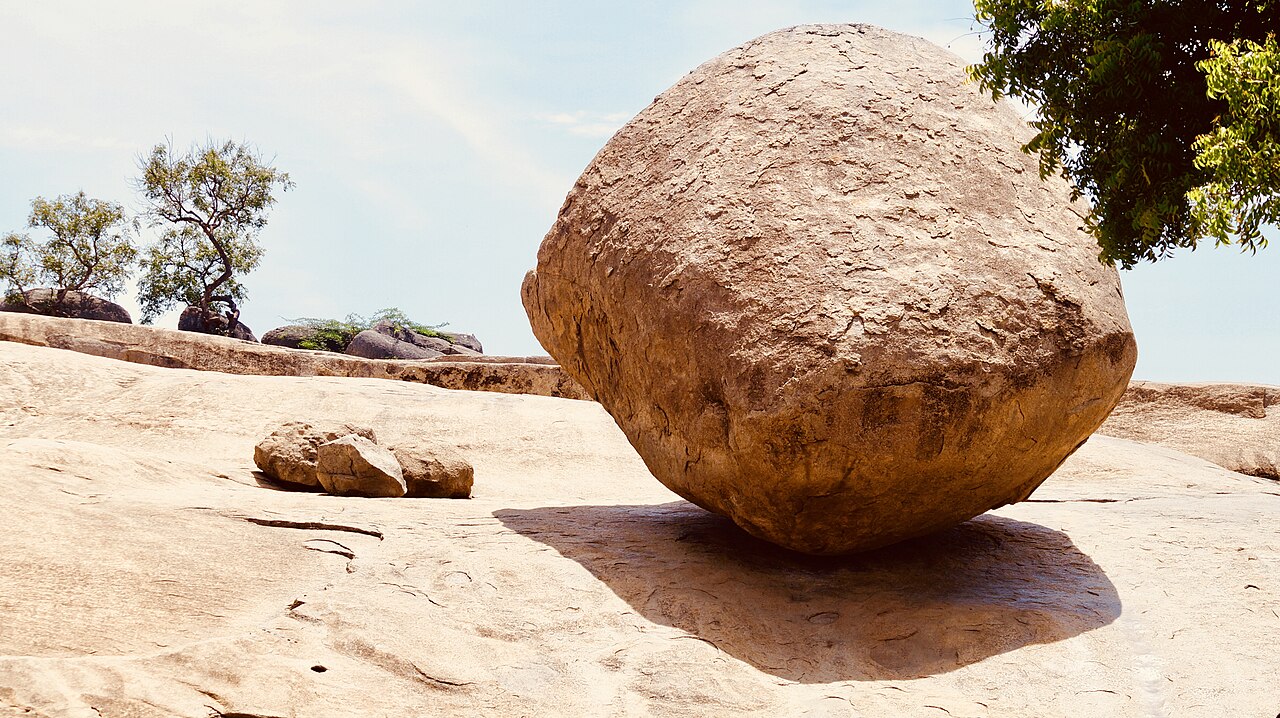
On a bare granite hillside at Mamallapuram sits a boulder that should not be there. Roughly six metres tall, five metres wide and weighing an estimated 250 tonnes, it rests on a smooth, sloping shelf of rock — perched, tilted, and to every eye about to roll. It has not moved for well over a thousand years. Visitors pose beneath it pretending to hold it up; children dare each other to stand in its shadow. Tamils call it Vaan Irai Kal, the “stone of the sky god”, but the whole world now knows it as Krishna’s Butterball, and it is only the beginning of what makes this old Pallava port town so extraordinary.
- Where: Mamallapuram (Mahabalipuram), Chengalpattu district, on the East Coast Road about 55 km south of Chennai.
- What: Krishna’s Butterball, Arjuna’s Penance and the Krishna Mandapa sit within the open Group of Monuments — a UNESCO World Heritage Site.
- When: Early morning or late afternoon; the granite radiates heat by midday.
- Tip: The Butterball and the relief are free to wander; carry water and sun cover.
The boulder that beat seven elephants
The most famous story about Krishna’s Butterball is not a myth at all — it is documented. In 1908 the town below made the Governor of Madras, Arthur Lawley, nervous. What if the great stone finally rolled? He ordered it removed. Seven elephants were brought in, ropes and muscle were thrown at the problem, and the boulder was heaved at with everything a colonial government could muster. It did not budge a fraction. Beaten, they left it exactly where it had always sat. The physics is prosaic and astonishing at once: a large flat contact area, a low centre of gravity and a shelf that is less steep than it looks lock the boulder in place through simple friction. Knowing that does nothing to lessen the thrill of standing under it.
The playful name is pure folklore. In the beloved tales of Krishna’s childhood, the butter-loving boy would sneak fistfuls of freshly churned butter from his mother’s pots. Some devotee, gazing up at this smooth golden-brown dome of stone, decided it looked exactly like a giant dollop of that stolen butter dropped from heaven — and the name stuck. It is a lovely story, and entirely a story; the rock is a natural formation of weathered granite, not a carving and not a relic.
A cliff carved into a cosmos
A short walk away, an entire face of rock has been turned into one of the largest open-air reliefs on earth. Two enormous boulders, split by a natural vertical cleft, carry a teeming carved panorama nearly 30 metres wide and 15 metres high. Scholars debate its subject — is it Arjuna performing penance to win a divine weapon, or Bhagiratha praying for the sacred Ganga to descend to earth? Most simply call it both. Down the central cleft the sculptors channelled real water in the monsoon, so the goddess-river appeared to pour down the stone itself, flanked by carved serpent-deities riding the flow.
Look closely and the Arjuna’s Penance relief reveals a Pallava sense of humour that survived thirteen centuries. Life-size elephants stride across the rock, sheltering their calves. And there, in one corner, stands an ascetic cat on its hind legs, balanced in mock meditation with paws raised to the sun — while a cluster of little mice gathers trustingly at its feet, entirely taken in by the cat’s false piety. It is a visual joke, and possibly a sly comment on fake holy men, carved by a sculptor confident enough to tease.

Krishna lifts a hill
Beside the great relief, a pillared hall cut back into the living rock houses another masterpiece. The Krishna Mandapa shows the young Krishna raising the hill of Govardhana on a single upraised hand, sheltering the cowherds and their cattle from a storm of rain sent by an angry Indra. Around the god the sculptors carved everyday village life with tender realism — a milkmaid with a pot on her head, a cowherd playing a flute, a farmer milking, cattle nuzzling their calves. It is one of the earliest surviving depictions of this scene in Indian art, and it turns a divine miracle into something warmly, recognisably human.
The Pallava sculptor-kings and the Seven Pagodas
All of this is the work of the Pallava dynasty, who from the 7th to the 8th century made Mamallapuram their great artistic workshop. Kings such as Narasimhavarman I — nicknamed Mamalla, “the great wrestler”, from whom the town takes its name — sponsored an outpouring of rock-cut caves, monolithic shrines and reliefs whose ambition still stuns. To early European sailors, this coastline of temples gave rise to a haunting name: the Seven Pagodas. Legend held that six other magnificent temples once stood along the shore beside the surviving Shore Temple, and that the sea, jealous of their beauty, swallowed them whole.
For centuries that was pure legend — until the sea offered a strange hint. When the Indian Ocean tsunami struck on 26 December 2004, the water first drew far back from the shore, briefly baring the seabed. In that eerie retreat, witnesses and later surveys reported carved stone forms emerging from the sand — an elephant’s head, a horse in flight, a reclining lion, and blocks that looked like temple walls. These exposures are documented. But the romantic vision of six drowned temples waiting intact beneath the waves remains firmly in the realm of legend; what lies offshore appears to be scattered carved stonework, not a sunken city. The mystery, pleasingly, is not fully solved.
Visiting
Mamallapuram rewards slow wandering. Start early at the Butterball while the light is soft, cross to Arjuna’s Penance and the Krishna Mandapa, then follow the rock-cut caves and the Five Rathas before finishing at the Shore Temple as the sea breeze picks up. Everything of interest sits within an easy walk. To place these marvels in their wider tradition, see the sibling guides /india/tamil-nadu/guides/rock-cut-cave-temples-of-tamil-nadu and /india/tamil-nadu/guides/tamil-nadu-unesco-world-heritage-sites .
Frequently asked questions
Is Krishna’s Butterball man-made or natural?
It is entirely natural — a huge granite boulder shaped by weathering. Its name and the Krishna butter story are folklore, not history.
Did seven elephants really try to move it?
Yes. In 1908 the Governor of Madras, Arthur Lawley, ordered the boulder removed for safety and had seven elephants attempt it. The rock did not move, and the effort was abandoned.
Why does the boulder not roll down the slope?
A broad flat contact area, a low centre of gravity and a gentler-than-it-looks incline lock it in place through friction. It has stayed put for well over a thousand years.
What is Arjuna’s Penance?
It is a giant open-air rock relief, among the largest on earth, carved by the Pallavas. It depicts either Arjuna’s penance or the descent of the Ganga — and is famous for its life-size elephants and a carved ascetic cat surrounded by mice.
Are there really drowned temples off Mamallapuram?
The 2004 tsunami briefly exposed some carved stonework offshore, which is documented. But the legend of six intact sunken temples — the Seven Pagodas — remains just that: a legend.
Who built the monuments at Mamallapuram?
The Pallava dynasty, chiefly in the 7th and 8th centuries. The town is named after King Narasimhavarman I, known as Mamalla.