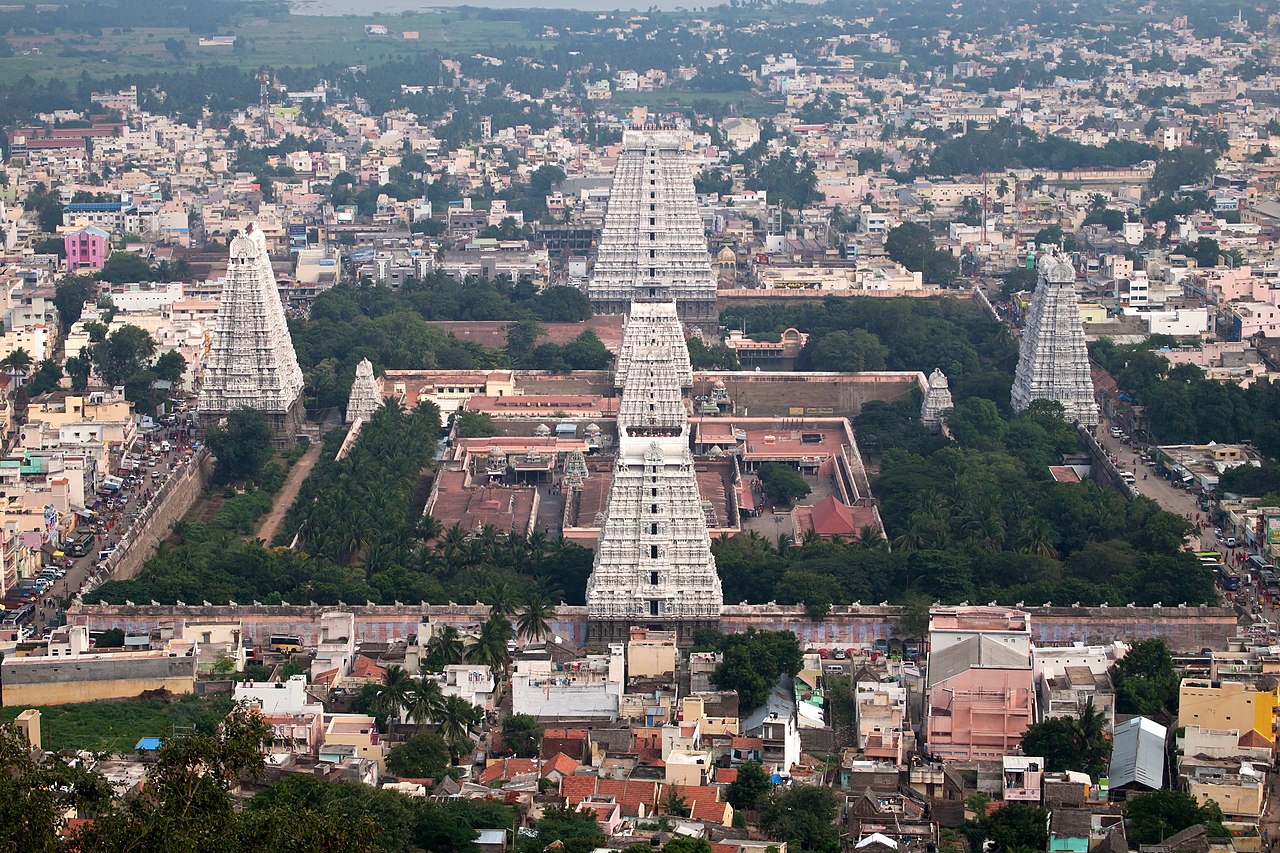
In the Shaiva tradition of South India, the whole of creation is built from five great elements — earth, water, fire, air and space. There are five ancient temples in which Shiva is worshipped as a lingam standing for one of those five elements, and together they are called the Pancha Bhoota Sthalams, the shrines of the five elements. Four of them lie in Tamil Nadu; the fifth, the wind temple, sits across the border in Andhra Pradesh. Visited together they turn a pilgrimage into a walk through the components of the universe itself.
The five element temples at a glance
| Element | Temple | Place |
|---|---|---|
| Earth (Prithvi) | Ekambareswarar | Kanchipuram, Tamil Nadu |
| Water (Appu / Jala) | Jambukeswarar | Thiruvanaikaval, near Srirangam, Tamil Nadu |
| Fire (Agni) | Arunachaleswarar / Annamalaiyar | Tiruvannamalai, Tamil Nadu |
| Air / Wind (Vayu) | Srikalahasti | Srikalahasti, Andhra Pradesh |
| Space / Ether (Akasha) | Thillai Nataraja | Chidambaram, Tamil Nadu |
The idea behind the group is straightforward in theology and ingenious in practice. Shaiva thought counts five mahabhutas — the pancha bhoota, or five gross elements — as the substance of the material world: prithvi (earth), appu or jala (water), agni (fire), vayu (air) and akasha (space or ether). At each of these five temples the presiding Shiva lingam is understood not as ordinary stone but as an embodiment of one element, and the daily worship at each site is shaped around that element. This is devotional tradition rather than geology, but it is remarkably consistent, and each temple carries a physical feature that makes its element visible.
Earth — Ekambareswarar, Kanchipuram
At the Ekambareswarar Temple in Kanchipuram, Shiva is the Prithvi Lingam, the lingam of the earth. By tradition the goddess Parvati, worshipped here as Kamakshi, shaped a lingam out of river sand beneath a mango tree and embraced it to save it from a flood — a legend told at length in our story of the sand lingam of Ekambareswarar. Because the central lingam is regarded as being of earth, it receives no direct water abhishekam, the ritual bathing given at other Shiva shrines; that single restraint keeps the element alive in daily practice. The temple spreads across roughly 25 acres behind an eleven-storeyed southern gopuram about 57 metres tall, raised under the Vijayanagara emperor Krishnadevaraya in the early sixteenth century, and its sacred mango tree is revered as astonishingly old. A short walk away stand two of Kanchipuram's other landmarks, the Kamakshi Amman Temple and the eighth-century sandstone Kailasanathar Temple.
Water — Jambukeswarar, Thiruvanaikaval
The Jambukeswarar Temple at Thiruvanaikaval, on the island of Srirangam near Tiruchirappalli, holds the Appu Lingam, the lingam of water. Here the element is not symbolic but literally present: a natural underground spring seeps up in the inner sanctum so that the base of the lingam is perpetually surrounded by water, and the shrine is often damp to the touch. Tradition explains the name through a legend in which a spider and an elephant — jambu meaning the rose-apple tree, aanai the elephant — worshipped Shiva at the spot, and the goddess here is Akhilandeswari. The temple sits a few minutes from the vast island shrine of Ranganathaswamy at Srirangam, the largest functioning Hindu temple complex in the world, so the water element and the great Vaishnava sanctuary can be seen on the same morning.
Fire — Arunachaleswarar, Tiruvannamalai
At Tiruvannamalai, the Arunachaleswarar Temple — also called Annamalaiyar — enshrines the Agni Lingam, the lingam of fire, and here the element belongs as much to the landscape as to the sanctum. The temple stands at the foot of Mount Arunachala, a hill that tradition holds to be Shiva manifest as a column of fire. It is one of the largest temple complexes in India, covering about 25 acres, and its eastern Rajagopuram rises roughly 66 metres across eleven tiers. Each year, in the Tamil month of Karthigai (November–December), the Karthigai Deepam festival crowns the whole thing: a huge cauldron of ghee and camphor is lit on the summit of Annamalai, and the flame — the Maha Deepam — is visible for many kilometres across the plain as a literal fire-beacon of the fire element. Pilgrims also walk the Girivalam path, the roughly 14-kilometre circuit around the base of the hill, especially on full-moon nights.

Air — Srikalahasti (Andhra Pradesh)
The wind temple is the one that leaves Tamil Nadu. Srikalahasti, home of the Vayu Lingam, lies in Andhra Pradesh, in the hills near Tirupati, roughly 36 kilometres from the great Venkateswara shrine at Tirumala — it is not in Tamil Nadu, and there is no Roampedia page for it here. Its element is made visible in a small, striking way: a lamp inside the inner sanctum is said to flicker constantly as though stirred by a draught, even though the chamber has no obvious source of moving air, and the deity is worshipped without being touched by the hand. The name Srikalahasti is traditionally read from its three animal devotees — sri the spider, kala the serpent, hasti the elephant — and the temple is also famous as a Rahu–Ketu kshetra for related rituals. Include it if you are travelling on toward Tirupati; treat it as a separate leg from the Tamil Nadu four.
Space — Thillai Nataraja, Chidambaram
The most abstract of the five is the Thillai Nataraja Temple at Chidambaram, the shrine of akasha, space or ether. Here Shiva is worshipped as the Akasha Lingam, and the point of the shrine is that there is, deliberately, nothing to see. Behind a screen in the inner sanctum lies the Chidambara Rahasyam, the 'secret of Chidambaram' — an empty space, strung with garlands, representing the formless element of ether and the divine that cannot be given shape. Alongside this emptiness stands its opposite: Chidambaram is the home of Shiva as Nataraja, the cosmic dancer, and the bronze image of the dancing Shiva in his ring of flame is the temple's central icon, sheltered under the gold-plated roof of the Chit Sabha. The temple's five sabhas or halls and its high gopurams make it one of the most important sites in the Tamil Shaiva landscape. The Pichavaram mangrove forest, among the largest mangrove wetlands in India, lies a short drive east toward the coast.

- Four of the five temples — Kanchipuram, Thiruvanaikaval, Tiruvannamalai and Chidambaram — are all within Tamil Nadu and make a realistic multi-day loop by road.
- Kanchipuram and Tiruvannamalai are in the state's north; Chidambaram sits on the eastern coast; Thiruvanaikaval is near Tiruchirappalli in the centre — plan for a broad circuit, not a single day.
- Srikalahasti, the wind temple, is in Andhra Pradesh near Tirupati and is usually done as a separate trip or bolted onto a Tirupati visit.
- Dress modestly, expect to remove footwear, and check that inner sanctums are open — many close during the midday break.
Frequently asked questions
What are the Pancha Bhoota Sthalams?
They are five Shiva temples where the god is worshipped as a lingam embodying one of the five great elements: earth at Ekambareswarar (Kanchipuram), water at Jambukeswarar (Thiruvanaikaval), fire at Arunachaleswarar (Tiruvannamalai), air at Srikalahasti (Andhra Pradesh) and space or ether at Thillai Nataraja (Chidambaram).
Are all five temples in Tamil Nadu?
No. Four are in Tamil Nadu, but the wind element temple, Srikalahasti, is in Andhra Pradesh, in the hills near Tirupati. Only the other four form a practical Tamil Nadu circuit.
Which temple represents which element?
Earth — Ekambareswarar, Kanchipuram; water — Jambukeswarar, Thiruvanaikaval; fire — Arunachaleswarar, Tiruvannamalai; air — Srikalahasti, Andhra Pradesh; space or ether — Thillai Nataraja, Chidambaram.
What is the Karthigai Deepam at Tiruvannamalai?
It is the annual festival of the fire temple. In the Tamil month of Karthigai (November–December) a great cauldron of ghee and camphor is lit on the summit of Mount Arunachala, and the flame, the Maha Deepam, is visible for many kilometres across the plain.
Why is there nothing to see in the Chidambaram sanctum?
Because Chidambaram represents akasha, space or ether. Shiva is worshipped there as the formless Akasha Lingam, and behind the screen lies the Chidambara Rahasyam — an empty, garlanded space that stands for the divine that has no shape. The temple's famous bronze Nataraja provides the visible form alongside that emptiness.