
Chennai is a young city by Indian standards, grown up around a seventeenth-century English fort — yet a few streets inland from the Marina, in the old Triplicane quarter, stands a temple far older than any of it. The Sri Parthasarathy Temple is generally reckoned the oldest shrine in the city, an eighth-century Pallava foundation that predates Madras by nearly a thousand years. It is dedicated to Vishnu in a very particular guise: Krishna as Parthasarathy, the charioteer who drove Arjuna into battle at Kurukshetra. And it sits beside the great sacred tank whose name — the lily pond — the whole neighbourhood still carries.
- Where: Triplicane (Thiruvallikeni), a short walk inland from the Marina beach, in central Chennai, Tamil Nadu
- What: One of the city’s oldest temples and a Vaishnava Divya Desam — a shrine sung by the Alvar saints
- Deities: Vishnu as Parthasarathy (Krishna the charioteer), with the temple unusually enshrining five forms of Vishnu
- Setting: The historic Triplicane neighbourhood, beside the great temple tank that gives the area its name
- Best paired with: The Wallajah Big Mosque nearby and a walk along the Marina
The oldest temple in the city
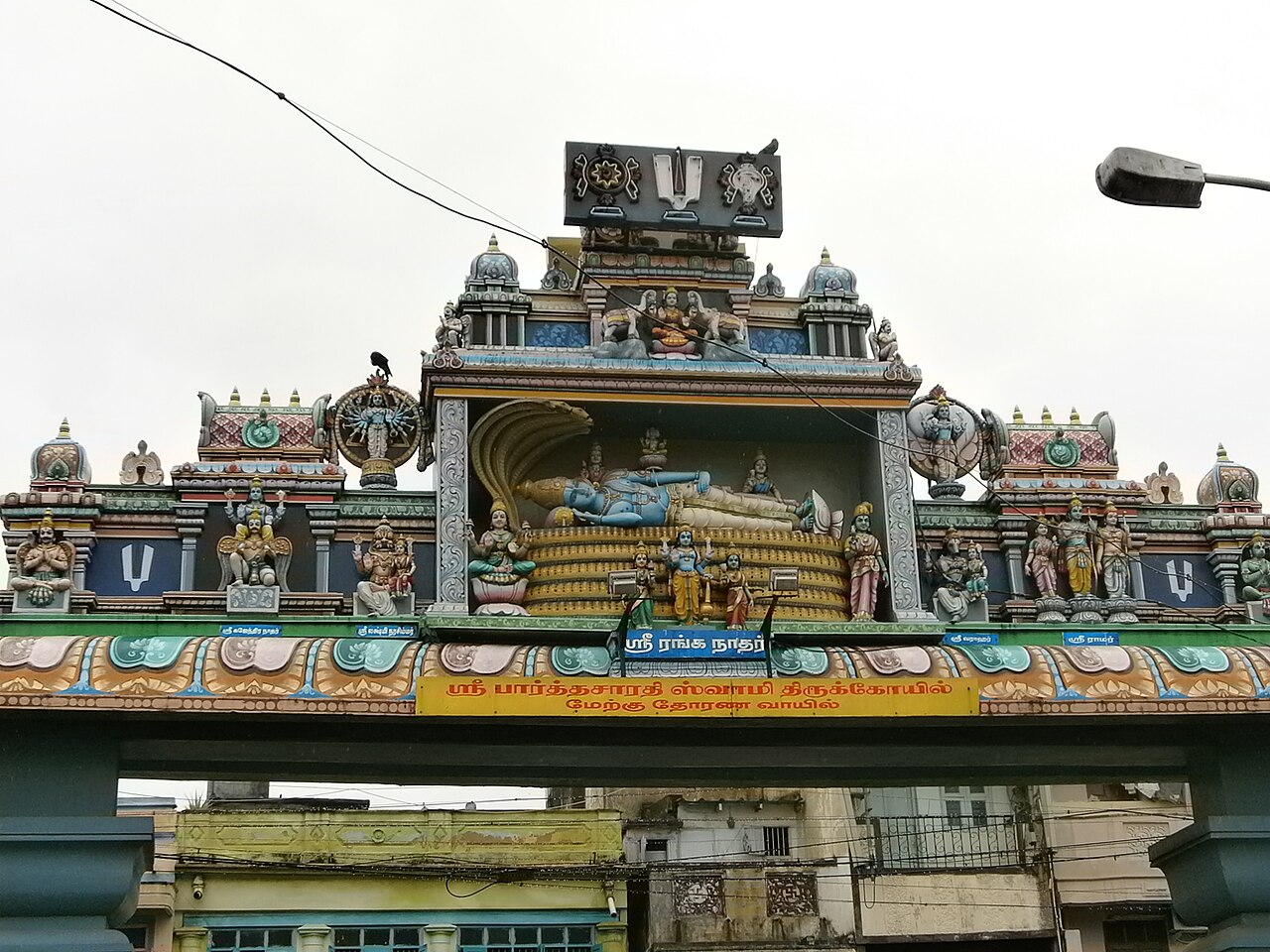
The Parthasarathy Temple is widely dated to the eighth century and credited to the Pallava king Narasimhavarman II, the ruler better known for the Shore Temple at Mahabalipuram. What began as a Pallava shrine was enlarged and endowed by later dynasties: the Cholas, who dominated the Tamil country from the tenth century, and the Vijayanagara rulers and their Nayaka governors, who added mandapams, gopurams and inscriptions over the following centuries. The result is a layered temple rather than a single-period monument, with a tall eastern gopuram over the main entrance and a separate western tower, its walls carrying the painted stucco figures that crowd Tamil temple towers. You can find the practical detail — timings, festivals and access — on the Sri Parthasarathy Temple page.
Parthasarathy, the charioteer god
The temple takes its name from its presiding deity: Parthasarathy, literally the charioteer (sarathy) of Partha, one of the names of Arjuna. This is Krishna in his role from the Mahabharata, holding the reins of Arjuna’s chariot on the field of Kurukshetra and speaking the Bhagavad Gita. In keeping with that story, the deity here is shown without the discus he usually carries — as a charioteer rather than a warrior — and tradition holds that his face bears the marks of arrows taken in the great battle. What makes the temple unusual among Vishnu shrines is that it enshrines five forms of the god in its complex: alongside Krishna as Parthasarathy (worshipped here as Venkatakrishna), there are shrines to Rama, to the man-lion Narasimha, to the boar Varaha, and to the reclining Ranganatha. It is rare for a single temple to gather so many of Vishnu’s forms under one set of towers.
The lily pond that named a neighbourhood
The Tamil name of the place is Thiruvallikeni, and it is the temple, not the city, that named the district. The word breaks down as thiru (sacred), alli (lily) and keni (pond or tank) — the sacred lily pond — a reference to the great temple tank beside the shrine, on whose still water lilies once bloomed. The English "Triplicane" is simply an anglicised echo of that older name. The tank is more than a landscape feature: it is bound into the temple’s ritual life, and the shrine is counted among the 108 Divya Desams, the Vishnu temples celebrated in the hymns of the Alvar poet-saints. Thirumangai Alvar and Peyalvar both sang of the Lord of Thiruvallikeni, which places the temple on the sacred map of Tamil Vaishnavism long before Chennai existed as a city.
Triplicane around the temple
The temple sits at the heart of one of Chennai’s oldest and most characterful neighbourhoods, a dense quarter of narrow streets, old houses and religious life of more than one faith. A short walk away stands the Wallajah Mosque, the grand eighteenth-century "Big Mosque" built under the Nawabs of Arcot, its pale granite domes and minarets a landmark of the same quarter. Beyond the neighbourhood’s edge lies the Marina, the long city beach, so the temple, the mosque and the sea sit within a compact stretch of old Madras. For a very different Vishnu shrine elsewhere in the city, the seaside Ashtalakshmi Temple at Besant Nagar makes an interesting modern contrast to the ancient one at Triplicane.
Visiting
The Parthasarathy Temple is a busy, living shrine in the middle of the city rather than a monument set apart, so it slots naturally into a day spent exploring central Chennai. Dress modestly, expect to leave footwear outside, and check the local timings, as the sanctum closes through the middle of the day like most Tamil temples; the great festival here is Vaikunta Ekadasi in the Tamil month of Margazhi, and the annual Brahmotsavam brings processions through the streets around the tank. Pair the temple with the Wallajah Mosque and a walk along the Marina for a sense of old Triplicane. For the wider city, read /india/tamil-nadu/guides/chennai-city-guide , and to see where this shrine sits among the great sung Vishnu temples of the state, /india/tamil-nadu/guides/divya-desams-of-tamil-nadu .
Frequently asked questions
Where is the Parthasarathy Temple?
It is in Triplicane (Thiruvallikeni), a historic quarter of central Chennai, a short walk inland from the Marina beach.
Why is it important?
It is generally reckoned the oldest temple in Chennai — an eighth-century Pallava foundation — and it is a Divya Desam, one of the 108 Vishnu temples sung by the Alvar saints, which makes it a major place of Vaishnava pilgrimage.
Who is Parthasarathy?
Parthasarathy means the charioteer of Partha (Arjuna). It is Krishna in his role from the Mahabharata, driving Arjuna’s chariot at the battle of Kurukshetra and speaking the Bhagavad Gita. The deity is shown as a charioteer, without his usual discus.
What are the five forms of Vishnu here?
The temple unusually enshrines five forms of Vishnu: Krishna as Parthasarathy (Venkatakrishna), Rama, the man-lion Narasimha, the boar Varaha, and the reclining Ranganatha — rare for a single temple.
How did Triplicane get its name?
From the temple. The Tamil name Thiruvallikeni means "sacred lily pond" (thiru, alli, keni), after the great temple tank beside the shrine. "Triplicane" is an anglicised form of that name.
What else is worth seeing nearby?
The Wallajah "Big Mosque", built under the Nawabs of Arcot, is a short walk away, and the Marina beach lies just beyond the neighbourhood. The seaside Ashtalakshmi Temple at Besant Nagar is a modern Vishnu shrine elsewhere in the city.