
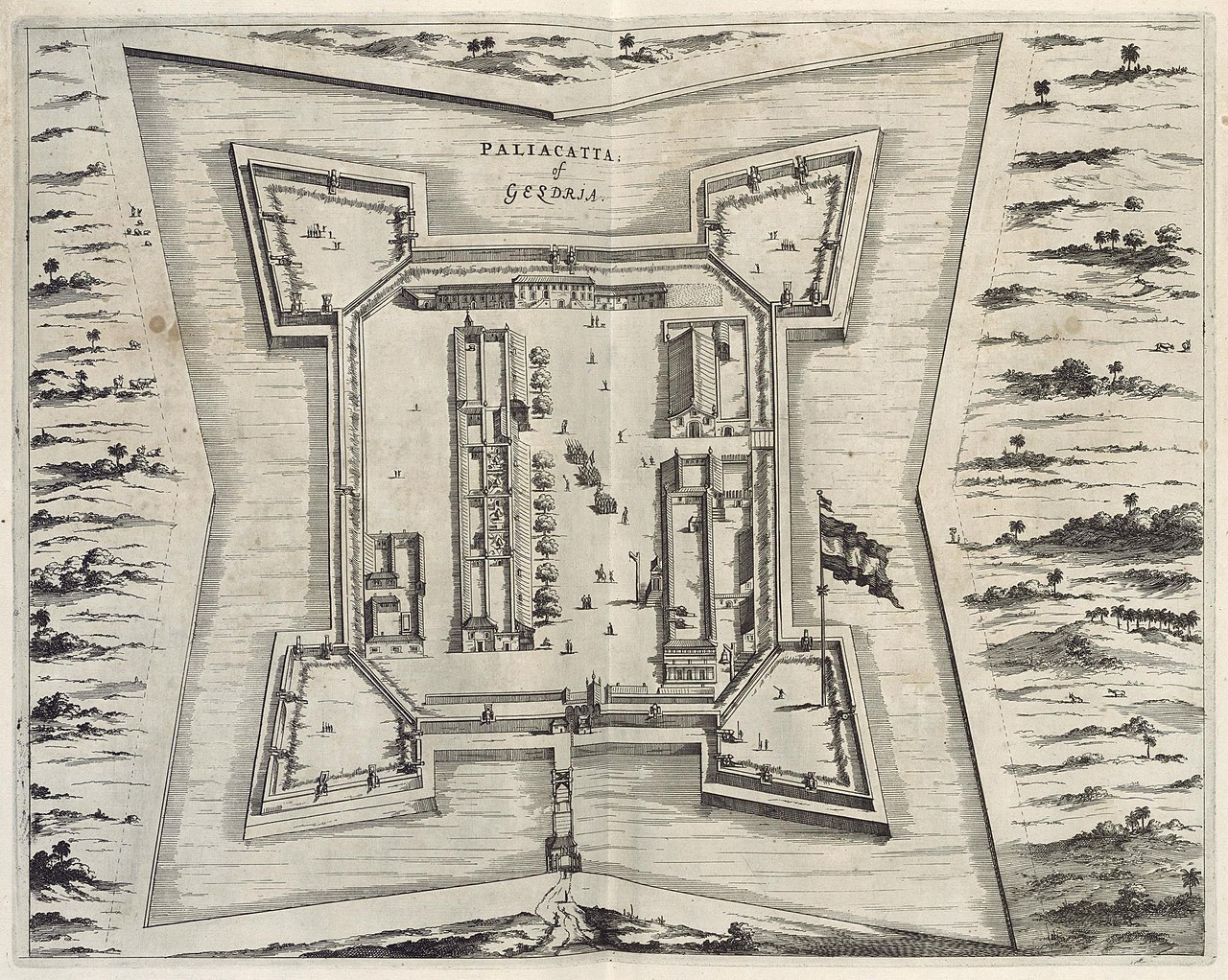
About 60 kilometres north of Chennai, past the salt pans and shrimp farms of the Thiruvallur coast, lies a quiet fishing town called Pazhaverkadu — better known by its older name, Pulicat. Today it is a place of narrow lanes, mending nets and a wide silver lagoon. Four centuries ago it was one of the most important trading posts of the Dutch East India Company on the whole Coromandel coast, guarded by a bastioned fort called Geldria.
- Where: Pazhaverkadu (Pulicat), Thiruvallur district, about 60 km north of Chennai.
- What: Ruins and traces of the Dutch Fort Geldria, an old Dutch cemetery, a heritage fishing town, and Pulicat Lake.
- History: Fort Geldria was built by the Dutch East India Company around 1613 and was for a time the seat of Dutch Coromandel.
- Setting: Pulicat Lake is commonly described as the second-largest brackish-water lagoon in India and is a noted bird sanctuary.
- Best paired with: a dawn or dusk boat ride on the lagoon in the winter flamingo season.
A Dutch foothold on the Coromandel coast
The Dutch East India Company — the VOC — reached Pulicat in the first decade of the 1600s, drawn by the fine painted and printed cottons of the Coromandel coast, which were currency in the spice trade of the East Indies. With the consent of the local ruling house, the Company fortified its factory here, and by about 1613 it had raised a stone fort named Geldria, after the Dutch province of Gelderland (Guelders). For much of the 17th century Pulicat served as the headquarters, or Governorate seat, of the Dutch on the Coromandel coast, before the administrative centre later shifted south to Nagapattinam.
From this fort the Company ran a web of trade in textiles, and — less comfortably to modern eyes — in enslaved people and in gunpowder saltpetre. The fort itself, a four-bastioned work, has largely vanished; what survives at Fort Geldria and the Dutch cemetery is more trace than monument — foundations, fragments and the memory of a once-formidable stronghold.
Skulls, crossbones and a forgotten cemetery
The most evocative survival of the Dutch centuries is the old cemetery on the edge of the town. Behind a gateway lie rows of heavy stone slabs and monuments, many carved with skulls and crossbones and winged hourglasses — the memento mori imagery of Reformation-era Europe, a blunt reminder that death spares no one. The inscriptions, worn but still legible in places, are in Dutch, and record Company servants and their families who died far from home in the tropical heat. It is one of the more atmospheric colonial burial grounds in South India, and the reason the skull-carved tombstones are the town’s most photographed sight.
Pazhaverkadu: the town the Dutch left behind
When the Dutch power on the coast faded, Pulicat passed, like the rest of the Dutch possessions in India, to the British in the early 19th century under the Anglo-Dutch settlement of 1824. The Company town slowly became an ordinary fishing town again. Walk through Pazhaverkadu heritage town today and you find a working port of fishing hamlets, an old lighthouse point, a scatter of colonial-era buildings and churches, and lanes that still follow their old lines. It is unpolished and lived-in rather than restored — which is much of its charm.
India’s second-largest lagoon
What truly dominates Pulicat is water. The lagoon that gives the town its name is commonly described as the second-largest brackish-water lagoon in India, after Odisha’s Chilika. It straddles the border of Tamil Nadu and Andhra Pradesh, sheltered from the Bay of Bengal by the long barrier island of Sriharikota — the same island that carries India’s satellite launch centre. The shallow, salty water is a nursery for prawns and fish, worked by fishermen in wooden boats with lateen sails, and in the cooler months it fills with birds.
From roughly October to March the lagoon becomes a wetland of international importance. Greater flamingos wade the shallows in pink drifts, alongside pelicans, painted storks, herons and thousands of migratory ducks and waders. The Tamil Nadu shore is protected as the Pulicat Lake bird sanctuary, and the winter flamingo gatherings are the reason serious birdwatchers make the trip north from Chennai.

Visiting
Pulicat makes an easy day trip from Chennai — around 60 km by road, best driven early to catch the birds and the light. Come between October and March for the migratory season and the flamingos; the summer months are hot and quiet. Combine the Dutch cemetery and fort traces with a boat ride on the lagoon, and allow time to simply wander the fishing lanes of Pazhaverkadu. For the wider colonial-fort context, see the guide to the /india/tamil-nadu/guides/forts-of-tamil-nadu , and for timing your trip around the seasons, the /india/tamil-nadu/guides/best-time-to-visit-tamil-nadu . Boats are run by local fishermen; agree a price before setting off, and carry water, a hat and binoculars.
Frequently asked questions
What is Fort Geldria?
Fort Geldria was a fort built at Pulicat by the Dutch East India Company around 1613, named after the Dutch province of Gelderland. It served for a time as the seat of the Dutch on the Coromandel coast. Little of the fort survives today.
Why does the Pulicat cemetery have skulls on the tombstones?
The old Dutch cemetery has 17th- and 18th-century tombstones carved with skulls, crossbones and hourglasses. These are memento mori motifs common in Reformation-era Europe, marking the graves of Dutch Company servants and their families.
Is Pulicat the same place as Pazhaverkadu?
Yes. Pazhaverkadu is the Tamil name of the town the Dutch and British called Pulicat. Both names refer to the same fishing town in Thiruvallur district, and the lagoon beside it is Pulicat Lake.
Is Pulicat Lake really the second-largest lagoon in India?
It is commonly described as the second-largest brackish-water lagoon in India, after Chilika Lake in Odisha. It spans the Tamil Nadu–Andhra Pradesh border and is separated from the sea by Sriharikota island.
When can I see flamingos at Pulicat?
The migratory season runs roughly from October to March, when greater flamingos, pelicans, painted storks and many waders gather. Early morning is the best time for both the birds and a boat ride.
How do I get to Pulicat from Chennai?
Pulicat is about 60 km north of Chennai by road, usually a 1.5 to 2 hour drive. It is easiest to visit as a day trip; there is no major rail station in the town itself.