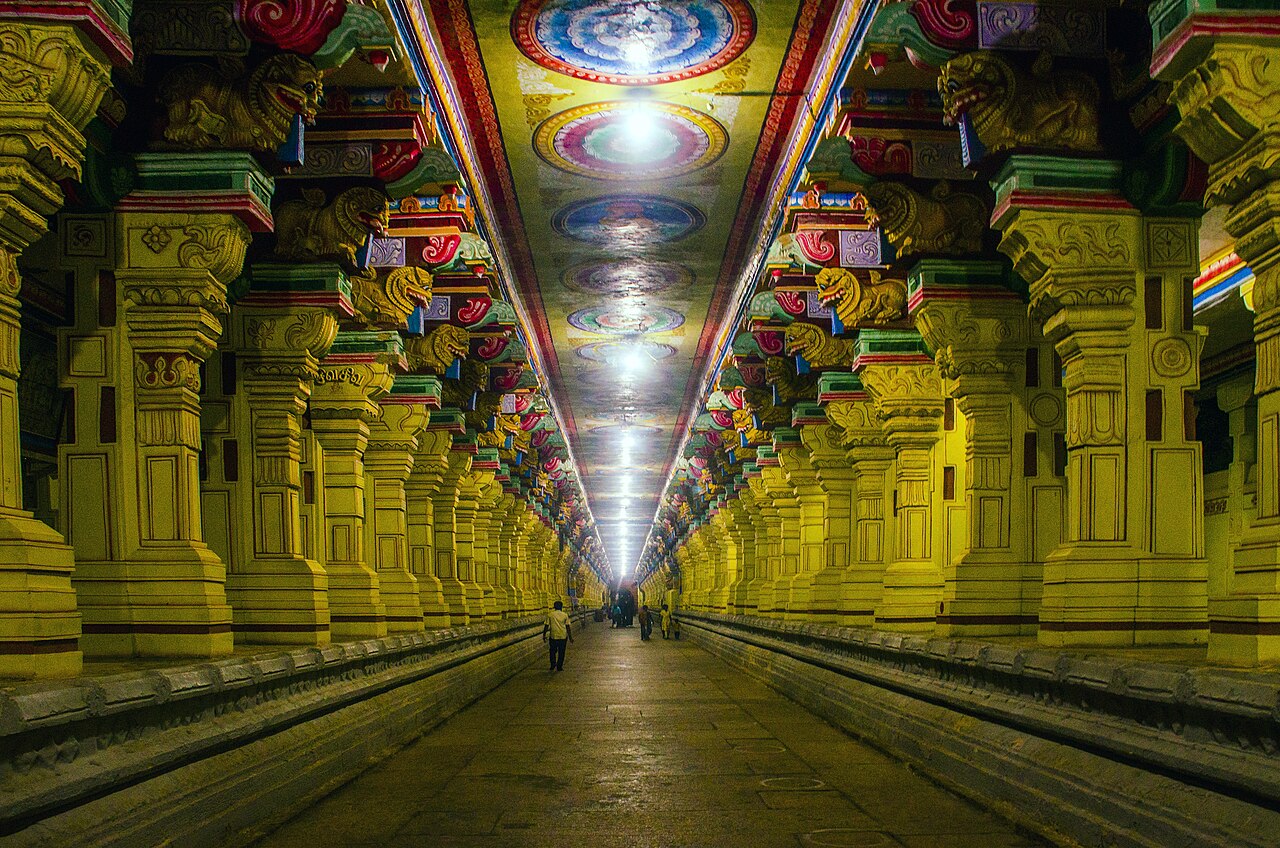
Rameswaram lies at the tip of a slender, conch-shaped island in the Gulf of Mannar, in the Ramanathapuram district of Tamil Nadu, pointing like a finger towards Sri Lanka. For Hindus it is one of the most sacred places in the country, and a rare one: the Ramanathaswamy Temple here is counted both among the twelve Jyotirlingas of Shiva and among the four Char Dham shrines that mark the cardinal points of India, alongside Badrinath in the north, Dwarka in the west and Puri in the east. Pilgrims traditionally speak of a journey that joins Rameswaram in the south with Kashi (Varanasi) far to the north.
- An island town in Ramanathapuram district, Tamil Nadu, on Pamban Island in the Gulf of Mannar.
- The Ramanathaswamy Temple is one of Shiva’s twelve Jyotirlingas and one of the four Char Dham shrines.
- Famous for its long pillared corridors and 22 sacred theerthams (water bodies) where pilgrims bathe.
- Linked to the mainland by the 1914 Pamban rail bridge, with the deserted town of Dhanushkodi at its far tip.
A temple born from the Ramayana
The town takes its name and much of its meaning from the Ramayana. By tradition, Rama came to this shore on his way home after defeating the demon king Ravana, and wished to worship Shiva to expiate the grave sin of having killed Ravana, who was a brahmin by birth. He sent Hanuman to the Himalayas to fetch a lingam. When Hanuman was delayed, Sita is said to have fashioned a small lingam from the sea sand so that the worship could begin at the auspicious hour. That sand lingam, the Ramalingam, became the temple’s principal deity, presiding beside his consort Parvathavardhini. When Hanuman returned with his own lingam from the mountains, it was installed alongside as the Vishwalingam, and, by a boon Rama granted him, it is worshipped first to this day. These accounts belong to sacred tradition rather than documented history, but they shape every ritual performed on the island.

Corridors without end
The temple that stands today was raised over several centuries, much of it under the Setupati rulers of Ramanathapuram between the sixteenth and eighteenth centuries. Its glory is architectural: a set of vast pillared corridors, or prakarams, wrapped in tiers around the sanctum. The third and outermost corridor is often described as the longest of any Hindu temple, its aisles running close to 200 metres along each of the long sides and lined by roughly 1,200 carved granite columns, each rising some nine metres (about 30 feet). The pillars are set with such precision that they appear to align into a single receding line however you look down them, an optical effect that still draws admiration from visiting architects. Towering gopurams mark the entrances, the eastern tower rising over the main gateway.
The twenty-two theerthams
A pilgrimage to Rameswaram is as much about water as about stone. Within and around the temple lie 22 theerthams — sacred wells and tanks — which tradition links to the 22 arrows in Rama’s quiver. Devotees move from one to the next, having temple attendants draw and pour a bucket of water over them at each, before entering to see the deities. The sequence usually begins in the sea itself: Agni Theertham, the stretch of shore in front of the temple, is regarded as the first and holiest of the bathing places. Each well is said to have its own quality and taste despite lying only metres from the salt sea, part of the mystery pilgrims come to experience.
Pamban, Dhanushkodi and the bridge to Lanka
For a hundred years the only rail link to the island was the Pamban Bridge, opened on 24 February 1914 as India’s first sea bridge. Its central section was a Scherzer rolling-lift double-leaf bascule that could be raised to let ships pass through the channel — an engineering landmark that remained the country’s longest sea bridge until 2010. Beside it now stands a new vertical-lift bridge, India’s first of that kind, opened to rail traffic in 2025. Beyond the temple town, the island tapers to Dhanushkodi at its south-eastern tip. Once a thriving port and railway terminus, it was destroyed in a single night by the Rameswaram cyclone of 22–23 December 1964, which killed an estimated 1,800 people, among them around 115 passengers on the Pamban–Dhanushkodi train swept into the sea. The government declared it a ghost town, and its roofless ruins still stand on the sand. From here the chain of shoals and sandbanks known as Adam’s Bridge, or Ram Setu, reaches towards Talaimannar in Sri Lanka, about 24 kilometres away. Hindu tradition holds this to be the causeway Rama’s army built to reach Lanka, and gives Dhanushkodi its name — the “end of the bow” — as the point where Rama broke the bridge with his weapon.
Frequently asked questions
Why is the Ramanathaswamy Temple so important?
It is one of the twelve Jyotirlinga shrines of Shiva and, at the same time, one of the four Char Dham pilgrimage sites, making it doubly sacred. It is the southernmost of the Jyotirlingas.
What are the two lingams in the temple?
The Ramalingam, which tradition says Sita moulded from sea sand and which serves as the main deity, and the Vishwalingam, brought by Hanuman from the Himalayas. By Rama’s boon, the Vishwalingam is worshipped first.
What are the 22 theerthams?
They are 22 sacred wells and water bodies within and around the temple, associated with the 22 arrows of Rama. Pilgrims bathe at each in turn, beginning at Agni Theertham, the sea in front of the temple.
What happened to Dhanushkodi?
The town at the island’s tip was wrecked by the Rameswaram cyclone of December 1964, which killed roughly 1,800 people, including passengers on a train that was swept away. It was declared a ghost town and remains abandoned.
Is Ram Setu a real bridge?
Adam’s Bridge, or Ram Setu, is a genuine chain of shoals and sandbanks running from Dhanushkodi towards Sri Lanka. The belief that it was built as a bridge by Rama’s army belongs to the Ramayana tradition rather than to established history.